

42 families in Madhya Pradesh showed up, dressed in sherwanis, adorning bright marigold garlands, and carrying sweets in their steel tiffin dabbas on 24 May 2026. While they were dressed for one of the most important days of their lives, the brides never came. According to the preliminary investigation, the accused allegedly convinced unmarried men and their families that girls living in an orphanage in Indore called ‘Matru Chaaya Ashram’ were willing to marry through a social marriage arrangement. Families were reportedly asked to pay different amounts as registration, wedding and processing charges. Several victims also spent additional money on clothes, jewellery, food arrangements and transportation for the ceremony.
Not only that, but the accused also allegedly identified unmarried men from rural and semi-urban areas and built trust through repeated phone conversations, WhatsApp chats, and video calls. In several cases, victims were shown detailed profiles, photographs, and even tentative wedding schedules to make the arrangement appear legitimate. This was later found to be true, as well as debunked when the photographs of the potential brides were actually taken from social media pages. The financial damages are estimated to be over 10 lakh, with each family paying prices ranging from 12,000 INR to 20,000 INR.
Madhya Pradesh Police arrested a couple named Mukesh and Sunita Das Bairagi after the police filed a case against four people. Two other accused are currently on the run.
Similar Recent Incidents
Several structurally identical, volume-based or syndicate-driven wedding scams have been busted across India recently:
The Ghaziabad “Mass Wedding Syndicate Scheme”
The case we are looking at is similar to what happened in Dewas. A big crime group was busted in Uttar Pradesh. Here, a fake charity group promoted a government-backed "Mass Community Marriage" program. They cheated families by asking for ₹20,000 from each groom for paperwork and a jewellery kit. Then 50 young men signed up. On the wedding day, the organisers shut their office and ran away with over ₹10 lakh.
The Gujarat Inter-State “Bought Bride” Extortion Ring
You see, it's similar to networks in Madhya Pradesh. A big ring was caught operating across the Gujarat-Maharashtra border, where a group of brokers targeted farmers who were struggling to find wives. They brought in women who pretended to be from very religious families. These women said they needed ₹3 Lakhs as a "donation” for the marriage. A week after the wedding, the brides ran away using cars arranged by their brokers. They then filed complaints saying they were harassed, so the families wouldn't go to the police.
The Hyderabad Matrimonial “Tech-App” Multi-Fraud Case
This situation is similar to what happened in Dewas. In Dewas, people took pictures from the media to trick desperate families, as the way these people work is by creating fake profiles on websites where rich people go to find someone to marry. They take pictures from Instagram profiles of people who work in Bengaluru and Hyderabad. These fake profiles are all. Work together. They talk to families of men who are looking to get married at the same time. They tell these families that they cannot pay for the wedding venue now because the bank's computer system is not working. They also ask the families for a lot of money. Then disappear. This happened with over 30 families at the time. The cyber syndicate, or the group of people who do this, takes the money. Then they are gone. The cyber syndicate does this to families, including the families of the prospective grooms, and they do it all at the same time.
The Bigger Picture: Marriage Scams in India
Marriage Scam refers to the deceptive techniques that are implemented when one or both parties exploit the marital relationship for immigration benefits, financial gain, and/or other personal advantages, ranging from sham marriages and marriage fraud to immigration marriage fraud. However, it has a sister trend that is called ‘wedding scam’ that can be defined as:
“ fraudulent schemes aimed at deceiving individuals into providing personal information, financial details, or money.”
Fraudsters employ several social engineering techniques, psychological manipulation, and coordinated identity theft, with the primary tools being:
- The "Runaway Bride" (Looteri Dulhan) Syndicates: Organised gangs operating via local mediators target men struggling to find a partner due to skewed gender ratios. A mock family structure is staged, a hefty "brokerage fee" or dowry alternative is collected from the groom, and a sham wedding is performed. Within days, the bride flees with cash and gold jewellery.
- Matrimonial Profile Fraud (Identity Spoofing): Scammers create highly attractive profiles on matrimonial websites using stolen photographs and fabricated corporate or NRI (Non-Resident Indian) identities.
- The Emergency Bail/Customs Duty Trap: A digital scam technique where the fraudster pretends to have sent expensive gifts (like luxury watches or jewellery) that are "stuck at customs." They demand immediate money from the victim to pay "clearance fees," disappearing once the funds are transferred.
- Vendor Ghosting: Fraudulent event managers, caterers, or photographers demand substantial upfront advances (often 70-100% under the pretext of peak-season bookings and completely cut off communication days before the event.
National trends indicate regional variance in typologies of wedding frauds based on digital literacy, economic demographics, and gender ratios.
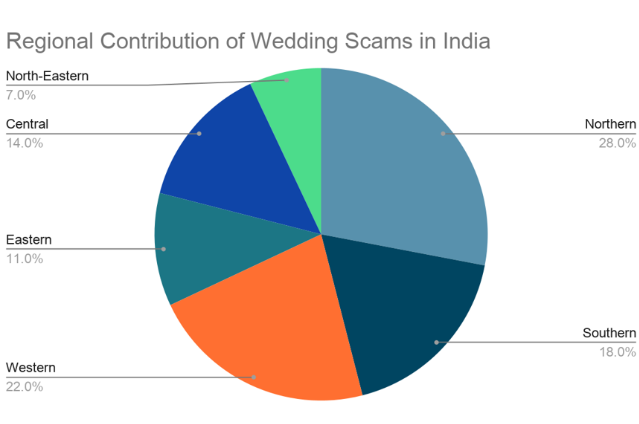
a) Northern India
With highly skewed gender ratios and heavy societal marriage pressures, the primary scam typology involves forced extortion rings and runaway systems.
b) Western India
Destination vendor fraud and digital NRI matrimonial fraud are the primary scam types; the escalation drivers of this region include affluent urban centres as well as the desire to settle overseas.
c) Southern India
With the rapid adoption of unverified niche apps as well as the high concentration of tech professionals being targeted, the most common wedding scam involves gold scams and tech-driven matrimonial identity fraud.
d) Central India
Here, interstate bride-buying rings and fake family staging rings are the most common scam escalation drivers; the influence for it lies with deep rural pockets and the exploitation of economically vulnerable families.
e) Eastern India
Here, both inter-state and cross-border trafficking rings pass through remote sectors, due to which there is a prevalence of human trafficking disguised as marriages in this region.
f) North-Eastern India
With the exploitation of tribal laws, lineage benefits, or property ownership rules play a crucial role in these region-specific wedding scams, which mainly involve documentation scams and forced fraudulent unions
When analysing the regions more regarding the wedding scams, we can expand a bit more on the regional factors and causes, as written in the following points:
- Northern & Central Regions: Skewed child sex ratios have created a severe deficit of marriageable women in states like Haryana, Punjab, and parts of Madhya Pradesh. Syndicates capitalise on this deficit by bringing women from economically distressed regions, staging weddings, and executing runaway robberies.
- Western & Southern Regions: High digital footprint and aspiration for rapid upward social mobility fuel scams here. Victims are easily lured by fabricated luxury lifestyle representations. Scammers weaponise rapid trust-building mechanisms over encrypted messaging channels to bypass traditional family background checks.
- Eastern & North-Eastern Regions: Socio-economic vulnerability, high rates of missing women, and cross-border migration corridors make these areas hotbeds for trafficking rings operating under the guise of legitimate wedding proposals.
The Evolution of Wedding Scams in India
The structural shift in how marital scams are executed over the decades aligns with socio-demographic changes and technological advancement.
Pre 2000s - The Localised Deception Era
In the era before the Internet, the deception was local and was highly dependent on social misrepresentation. These typically involved hiding a prospective spouse's pre-existing marriage, mental or physical illnesses, or fabricated employment details. These were carried out by individual rogue marriage brokers (bicholiyas) operating within specific community circuits.
2000s to 2010s - NRI Phishing and the Rise of Looteri Dulhans
During this time, there were big changes in how marriages worked in some parts. One thing that stood out was the shortage of brides in places like Punjab and Haryana. It seems families started looking elsewhere for matches because of that. This led to groups that arranged marriages from other states where money was tight. They would ask for a lot in return, and then sometimes the new wife would leave right after taking things. The whole setup felt rushed in a way that was hard to spot right away.
Another shift came with more people using sites to find partners from abroad. That made it easy for fake profiles to pop up claiming to be NRIs. Families paid fees thinking it was for visas, but it was all a scam, I think. Maybe the prestige part made everyone overlook the risks at first.
2010s to 2020s - The Customs Trap and Digital Identity Era
With cheap mobile internet spreading across India, wedding scams turned into organised cybercrime operations. Scammers act like wealthy people from abroad and spend months building trust with victims without ever meeting. It seems they then say they sent gold jewellery or electronics, but the package got held by customs. Victims end up sending large amounts of money, thinking it is for clearance fees, and the accounts are just personal ones run by the scammers. This part gets a bit confusing sometimes because the trust builds so slowly. Some people might see it differently, though.
2024 to 2026 - Orchestrated Mass Event Era and the Mass Exploitation
Wedding fraud has grown into something bigger now. Syndicates target lots of people at once through volume-based scams rather than single cases. They take advantage of families who are struggling with money by setting up fake institutions like orphanages or community places. It seems they also create mass wedding platforms to reach dozens of desperate grooms in one go. This approach feels more organised than before, but I think some details about how they operate still get missed in reports. The whole thing relies on that financial pressure, which makes it harder to spot early.
Legal Provisions In India
Following structural updates in India's criminal jurisprudence via the Bharatiya Nyaya Sanhita (BNS), 2023 (which replaced the Indian Penal Code, 1860), dedicated legal channels address both traditional and digital matrimonial frauds (Sheoran, 2025):
Firstly, the law under Section 83 of BNS addresses cases where men use fake marriage promises or deceptive tactics, which include hiding their existing marriages to force women into living with them or having sexual contact (Sheoran, 2025). The law now addresses structural deficiencies, which courts have previously handled through IPC Section 493/376.
Adding to the first one, the law under Section 84 of BNS makes it a crime for people to attend marriage ceremonies through dishonest means when they understand that the marriage lacks legal validity (Sheoran, 2025). The law applies directly to situations where runaway bride syndicates arrange staged marriages.
Thirdly, the law under Section 318 of the BNS replaces IPC Section 420 to serve as the main legal provision that handles cases where matrimonial fraudsters use false identity and work information and fake intentions to steal money from victims and their families.
Lastly, the BNS operates with the IT Act 2000 Sections 66C and 66D to fight digital scams. The law establishes penalties for people who steal identities through photo and password theft and those who use computer resources to impersonate others for deceptive purposes.
The May 2026 Indore case — where 42 families arrived in sherwanis with marigold garlands only to discover the “Matru Chaaya Ashram” brides never existed — exposes how wedding fraud has evolved into industrialised, multi-state exploitation. This wasn’t a lone con. It mirrors the Ghaziabad syndicate that duped 50 grooms of ₹10 lakh+ through a fake “government mass marriage” scheme, the Gujarat-Maharashtra ring extracting ₹3 lakh per farmer before brides fled with arranged cars, and the Hyderabad cyber-app that used stolen Bengaluru tech-professional photos to scam 30+ families simultaneously. From Jhansi’s call centre duping 610 men for ₹30–40 lakh using AI-generated brides, to Bengaluru’s ₹38.8 lakh “UK investment family” matrimonial fraud, the data shows scale: individual losses range from ₹12,000 registration fees to ₹38.8 lakh life savings, with syndicates now targeting dozens of victims at once.
These scams thrive because they weaponise India’s deepest vulnerabilities: skewed sex ratios in Northern and Central states creating desperate grooms; digital aspiration in Western and Southern metros enabling NRI “customs trap” frauds; and economic distress in Eastern and North-Eastern corridors allowing trafficking to hide behind marriage proposals. As one senior police officer noted off-record in Bihar, “Such crimes are increasing due to the skewed sex ratio in Rajasthan, Haryana and Madhya Pradesh, making middle-aged unmarried men particularly vulnerable.” With the Bharatiya Nyaya Sanhita, 2023, now directly criminalising deceptive marriage promises under Section 83 and staged sham weddings under Section 84, the legal tools exist. But until verification replaces desperation, and escrow replaces instant transfers to “orphanage coordinators,” the next marigold garland will still be laid for a bride who was only ever a WhatsApp profile.
Citations
- 42 grooms, 0 brides: The making of a mass wedding scam in Madhya Pradesh | India News - The Indian Express
- Mass Wedding Scam in Madhya Pradesh Leaves Families Humiliated and Cheated - The420.in
- ‘Brides’ never arrived: Couple held for conning 42 grooms in mass wedding scam | Bhopal News - The Times of India
- https://doi.org
- https://doi.org
- Access Publication on Taylor & Francis / Deviant Behaviour.
- Access Publication on Bridgewater State University.
- Access Publication on Mary Ann Liebert Publishers.
- Article on The Standard.