
One of the most interesting facts about cockroaches one knows about is that they are ancient, resilient insects capable of surviving extreme conditions - after all, they have existed for over 300 million years, predating dinosaurs and surviving mass extinctions.
However, these omnivorous insects of the order Blattodea gained their momentum in India, particularly on May 15, 2026, when the nation’s Chief Justice Surya Kant remarked during a Supreme Court hearing, comparing certain individuals (mainly the current population constituted as youth) to "cockroaches and parasites of society." In response, Abhijeet Dipke, a 30-year-old PR professional, Boston University graduate and former AAP social media strategist sitting in Chicago, launched the Cockroach Janata Party (CJP). Using AI tools, a Google Form, and a cockroach logo, he built an entire satirical political movement in under 48 hours.
The internet did the rest.
Despite not being a registered party, with its AI-generated party anthem, Google Form, and the following presented as the manifesto presented in a humorous way alongside a cockroach logo, it amassed over 20 million Instagram followers and over 1 lakh signed up as members, with some even including certain opposition members.
- Judicial accountability: No post-retirement Rajya Sabha seats for Chief Justices
- Electoral integrity: Action against deletion of legitimate votes.
- Gender equality: 50% reservation for women in Parliament and Cabinet.
- Media independence: Cancel licenses of media houses owned by Ambani and Adani; investigate bank accounts of biased anchors.
- Political defection: 20-year ban on legislators switching parties
Membership criteria are tongue-in-cheek, requiring participants to be unemployed, lazy, chronically online, and capable of professional ranting.
Beyond the online realm, CJP volunteers have participated in protests and clean-up drives dressed as cockroaches to symbolically embrace the label to highlight resilience and critique societal neglect.
Psychology behind the Phenomenon
The rapid adoption of the "Cockroach" identity by millions of young Indians is rooted in distinct psychological and behavioural triggers. It starts with the casual stigma reclamation through the “De-weaponisation Effect”, a phenomenon that occurs when an outgroup uses a derogatory term in order to marginalise a group by causing intense hurt, the target group will collectively “reclaim” the word in order to strip the insult of its power.
Adding to the effects lies the fact that traditional political discourse in India has become highly polarised, tense and legally risky. Therefore, in this politically sensitive climate, satire offers one psychological safety. In this case in particular, people expressing their anger through a “Secular, Socialist, Democratic and Lazy” manifesto allows users to participate in systemic critique through humour that bypasses the emotional exhaustion of traditional dissent.
The situation also presents itself as the classic example of practices related to shared precarity and existential dread. While India boasts high macroeconomic growth, the graduate unemployment rate stands near 29%, creating a microcosm of mental and emotional anxiety regarding their future. Hence, CJP turns this personal isolation into collective solidarity.
The loudest symptom of a very real disease
A nation that celebrates its burgeoning IT Sector and technological advancements is grappling with an alarming crisis that is tarnishing its global reputation. The rise of scams, driven by a large number of skilled but unemployed youth, is creating a disturbing narrative. This problem is not only affecting the victims of these scams but also devastating the lives of those who are pushed into this unethical world. It all begins with India producing a pool of highly educated and highly skilled graduates. However, the job market is unable to absorb this talent at the required pace. As a result, a significant portion of this educated youth remains unemployed or underemployed. With desperation and financial pressures that make them vulnerable, enter the senior scammers, a.k.a individuals or groups that will offer minimal salaries and a few incentives to lure the unemployed youth into their operations. However, the senior scammers pocket the majority of the profits, leaving the recruits with peanuts and a tarnished professional reputation.
To add another layer, it is a well-known fact that education is the path for achieving such skills, for the job market has been plagued by corruption, jeopardising millions of futures. From NEET to IIT-JEE and CAT, leaked papers, cheating rings, and nepotism have become shamelessly endemic.
A part of the Global Weaponised Humour
“The CJP isn't completely unprecedented; it fits into a global and historical playbook of programmatic activism and weaponised humour.” - Adgully.
The very first parallel about the CJP can be found in Poland during the 1980s. The tenure was governed by oppressive communist regimes and hence gave birth to a movement called the Orange Alternative. It used surrealist humour (a form of comedy that relies on illogical scenarios, bizarre juxtapositions, and irrational situations to evoke laughter) and nonsense to protest. They painted dwarves on walls and staged massive peaceful marches dressed as mythical creatures.
How are they similar? Because the movement was inherently absurd, making the police look ridiculous for arresting people for "carrying dwarf-shaped signs." Similarly, the CJP uses a suit-and-tie cockroach avatar to critique complex corporate and state structures, making aggressive institutional crackdowns look overblown.
Another, rather recent parallel can be drawn through Asia during 2020 via the Milk Tea Alliance. With an informal, cross-border digital solidarity movement through the netizens in Thailand, Taiwan, Hong Kong, and Myanmar came internet memes, shared digital iconography, and algorithmic amplification to challenge as well as tackle authoritarianism.
How are they similar? Both the CJP and Milk Tea Alliance proved that a decentralised Gen-Z identity could form almost overnight without physical party offices or traditional cadre structures, relying purely on digital fluency.
More such instances can be found across the world, and here, to add another example, can be derived from Kenya, where the government proposed steep tax hikes on essential goods and digital services. The country’s youth initiated massive, decentralised protests organised primarily on TikTok, X, and Instagram. Here, they implemented performance subversion just like the CJP; they weaponised joy and absurdity rather than adopting the sombre, traditional aesthetic of political picketing. Videos went viral where the protestors were dancing, twerking and filming high-energy TikTok transitions directly in front of armed riot police.
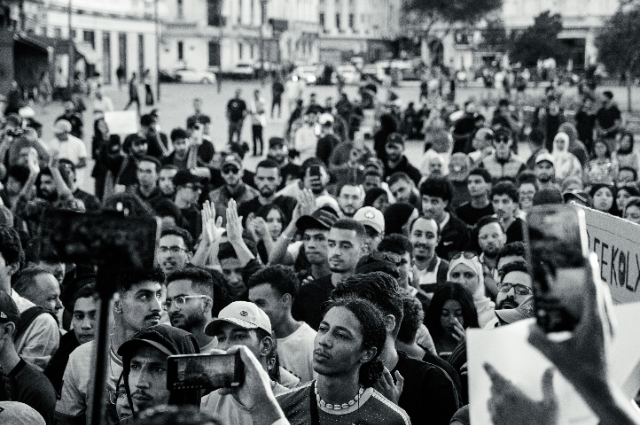
Lastly, when recent economic and political demonstrations in Morocco, like CJP, the young citizens targeted the legitimacy of institutional punishment (relying on the psychological weight of fear and shame to deter dissent) by turning their interactions with the law enforcement into a curated content loop. Here, the protestors, when being arrested, would flash grins and smiles, flash the signs of peace or take group selfies from the back of police transport vans, uploading them on Instagram like laughbdarija.
The ultimate takeaway from these global examples is that the internet is a magnifying glass, not an engine. It can amplify an existing emotion, but it cannot construct a policy. For digital subversion to mature into structural reform, movements must transition through a specific cycle:
Structural Flaws Within the Movement
Despite the historic virality, one has to ensure that both sides of the same coin exist in order to have a balanced opinion. Here, critics and political scientists alike have highlighted the critical flaws within the “party” model; one has to introspect as well as reflect.
The first flaw lies with relatively social media-oriented issues that have emerged with the rise of social media, as well as easy (global) awareness regarding various socio-political or socio-cultural concerns - the "Instagramisation" of Politics. When the CJP was analysed by political commentators, they found that this movement risks substituting actual political organising with performance for the sake of aesthetics. By clicking "follow," sharing a slickly designed AI graphic, or, in this case, filling out a Google Form, creates an illusion of civic participation—a psychological phenomenon known as slacktivism.
“(blend of slacker and activism), Slacktivism refers to the activity that uses the internet to support political or social causes in a way that does not need much effort, for example, creating or signing online petitions ” - Cambridge Dictionary.
The second flaw is something that even a casual social media doom scroller could find when observing the official pages of the CJP - the movement, like most, if not all, of current social media movements, predominantly exploded among the urban, English-speaking, digitally connected middle class. Critics have pointed out that this demographic largely ignored the structural struggles of rural farmers, manual labourers, and marginalised communities for years. The outrage was sparked only when economic precarity and institutional insults directly touched the relatively privileged, educated youth.
Lastly, Social media algorithms reward high emotional intensity and outrage, but internet attention spans are notoriously short. Generating millions of views via a 12-second reel is easy; translating that fleeting digital attention into sustained policy change, legislative demands, or structural reform is historically very difficult.
Lessons to Learn
The CJP phenomenon firstly highlights that while humour is an excellent entry point, it cannot be the destination. Here, one has to channel viral energy into existing institutional frameworks. The movement’s recent pivot should be aimed towards encouraging followers to actively file Right to Information (RTI) regarding employment data and paper leaks. This is perfectly presented, with reels that showcase several exam copies of the recent CBSE examinations of grades 10th and 12th that have been checked unfairly, converting a meme into a civic tool.
The crisis also highlights a deep rot in our economic ecosystem. Rather than relying on superficial, multi-crore public-private "soft skills" and personality development workshops that act as a smoke screen for high unemployment, youth must demand systemic updates to foundational, technical, and vocational education that map to actual job creation.
Lastly, for a real change to occur, the decentralised digital youth must eventually engage with the boring, unglamorous side of democracy: local governance, consumer forums, student unions, and policy drafting. Digital platforms can dominate the daily conversation, but policy is still written in legislative assemblies.
In conclusion, CJP may fade next week. But the frustration that built it? That's not going anywhere. And in a democracy that stopped listening to its youth, cockroaches don't just survive. They multiply. Also, by providing the flaws, the CJP phenomenon can provide us, the citizens, a profound blueprint for how future civic engagement in India can evolve constructively.
Bibliography
- Cockroach Janta Party and the Crisis of Urban Gen Z Politics in India
- Weaponised humour, AI avatars, digital rage: The viral anatomy of the Cockroach Janta Party
- Santy Sharma says the Cockroach Janata Party 'feels more like internet drama than a serious movement', cautions Indians in a strong-worded post - The Economic Times
- Cockroach Janta Party’: Top Indian judge’s comment sparks satire, protest | Politics News | Al Jazeera
- How memes and humour are fueling Gen Z’s global uprisings | Waging Nonviolence
- The New Cockroach Janata Party: A Symbol of Youth Pushback | The Shillong Times