
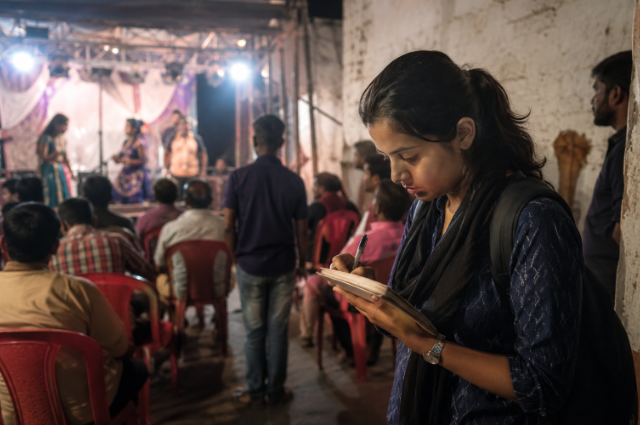
Growing up in the heartland of India, in the state of Bihar in particular, one knows that a wedding isn't really a wedding, or rather, a celebration is incomplete until you hear the shenai cut through the evening air, followed by the thump of the dholak and the bright clang of cymbals. The sounds? Rolling out the latest Bhojpuri hits with a bit of Bollywood, making the kids rush in front to dance, women in their sarees clap along from the side, and the elders sitting on the plastic chairs nodding, remembering their own wedding thirty years ago.
Yet another aspect of these orchestras is something that is indeed driven for the male gaze of the nation known for “being allowed to piss in public but not to kiss in public (especially if it includes consent)” - scantily clad women dancing to tunes, fearing that if they are subjected to non consensual touching among many, like coercion and even gunshot their tales would remain unheard, leaving them soulless to numb their pain, shame and disgust.
In short, these orchestras hold their own skeletons - while being groups being called on weddings and even religious gatherings at times, are actually a clandestine backdrop for the abuse and exploitation of young souls, with the recent highlight emerging on 16 September 2023 when a video emerged across various social media platforms where an orchestra band dancer, visibly frightened and seemingly a minor, was forced to dance at gunpoint by two men in Shankpur village of the Danaput subdivision that is not far from Bihar’s state capital of Patna.
The Network of Exploitation and Neglect
Continuing its crackdown on organisations, the Association for Voluntary Action and Narayani Sewa Sansthan, on these orchestra groups (13 groups were raided in particular) to exploit young girls, police rescued 21 girls, including 7 Nepalese girls, and arrested 11 in the Saran District alongside Gopalganj and Siwan. These children, aged 15 to 17, had been trafficked from Assam, West Bengal, Odisha, Madhya Pradesh, Jharkhand and Nepal.
One of the key players whose reporting led to increased awareness and administrative action was a journalist from Dainik Bhaskar, one of the largest Hindi newspapers, named Mahima Singh. She did what many are scared to do - went undercover, infiltrated dangerous people, and adapted herself to their environment, spending 5 continuous days among them to expose the dark reality. On one of her findings, it was seen that they were lured from poor families with promises of legitimate jobs. However, diving deep into this information, it has been found that these operations go far beyond the simple promise of a standard job, where traffickers use calculated psychological, social, and economic strategies to trap minor girls and young women, while building systematic barriers that make escaping nearly impossible.
While a legitimate job is the hook, as mentioned, yes, traffickers employ highly personalised tactics tailored to the specific vulnerabilities of young girls from impoverished backgrounds.
The first, and the most common trope they use, is the “Lover Boy” method, where the local agents or handlers are tasked with building fake romantic relationships with the vulnerable or runaway girls by isolating the victim from her family with a promise of marriage or a shared future. Then, they transport her across state lines (frequently found in West Bengal or Assam) only to sell her directly to an orchestra operator.
The Second method they employ is where the traffickers employ the massive popularity of the regional entertainment industry. Enticed with the promises of stardom, fame, and guaranteed acting roles in Bhojpuri films or mainstream music videos, they are told that dancing in the orchestra is merely a “stepping stone” temporarily to get noticed by talent scouts.
To add to the success rate, the recruiters actively look for young girls who are already in volatile domestic situations, such as fleeing an abusive home or handling a severe family debt, positioning themselves as “saviours” offering immediate financial independence, personal freedom and physical safety.
Lastly, the organised syndicates set up front offices across multiple states, where local handlers use cultural familiarity and localised language to gain the trust of poor families in order to convince them that their daughters are being sent away to reputable event management companies.
What Made the Escape so Difficult in the First Place?
Once a girl enters an orchestra house, the environment shifts from an employment setting to a prison-like confinement. Dancers were routinely locked in single rooms and heavily guarded compounds, strictly prohibited from going out until they were being transported directly to the venue to perform. To add to this imprisonment, their mobile phones, identification papers, and money are confiscated upon arrival. The operators then fabricate arbitrary “debts”, claiming the girls must work off the cost of their advance transit, food, clothing, and shelter. Because they are never paid their promised wages, this debt can never be mathematically cleared.
Forcing them to wear revealing clothes in tandem with the Madonna-Whore Complex (thanks to the purity culture of the patriarchal society), Operators use this weaponisation of vulgarity and stigma to systemically break down their self-esteem, telling these dancers that they are now “compromised” or “ruined”. This, in return, creates a psychological barrier where the victims fear that if they return home, their families and/or communities will reject them.
What if she simply refuses to perform, wears conservative clothes, or simply objects to late-night private clients? Simple. Become a subject of severe physical assault, starvation, or sexual violence.
Also, while performing publicly, as hinted before, these girls are exposed to highly volatile crowds where celebratory firings, physical molestation and abductions are frequent. Adding fuel to the fire, the local administration has historically been negligent or slow to regulate these unregistered groups; it is nothing but natural to feel complete isolation with no trusted authority to turn to. In fact, it was only in 2025 that the scale of this crisis prompted swift legal intervention. Through Public Interest litigations, the Patna High Court directed the Bihar government to urgently formulate a comprehensive, multi-state action plan to permanently monitor and regulate these entertainment groups, recognising them as fronts for structured child labour and commercial sexual exploitation.
About the Journalist
Mahima Singh is an investigative and data journalist who has prior experience in undercover reporting, data-driven stories, and international media coverage. She started her journey in journalism in the year of 2012, when she was working for a student-run news website at Manipal University. She covered topics ranging from technology to the environment and extended her experiences as a data editor at The Globe and the Mail, reporting on legal systems, war, crime, politics, business, and natural disasters through a data lens. Her experiences also consist of automating news at Digital Data Desk (D3) for the Canadian Press, as well as working on the investigative team at Palm Beach Post, where she covered topics such as school shootings, hurricanes, the drug epidemic, and political figures, including former President Trump. Lastly, in 2019, she was a visual and data journalist with the BBC covering South and East Asian Media.
Praise to Cover Up Reality
A calculated technique often used by systemic actors is the weaponisation of selective praise. By loudly celebrating individual heroes like Mahima Singh, institutions and mainstream platforms can construct a deceptive narrative: "Look how vibrant and free our media is; we openly honour those who expose uncomfortable truths."
This tokenism serves as a dual, counterintuitive purpose.
- Deflection: It shifts the public focus away from the structural failure of the Godi Media (lapdog media), which largely ignores complex, deep-seated issues like human trafficking and rural exploitation in favour of highly profitable, polarised sensationalism.
- The “Exception” Trap: It frames journalism as a rare heroic anomaly, rather than an everyday civic duty. While the spotlight shines brightly on one celebrated case, hundreds of other rural stringers and regional journalists who attempt to report on illegal mining, local corruption, or systemic cartels are quietly silenced through corporate pressure, physical intimidation, or localised legal threats without ever receiving a national voice.
Irony… or a Stepping Stone?
Mahima Singh’s undercover investigation was celebrated on World Press Freedom Day (03 May 2026) as one of the bravest acts of journalism in recent Indian media. However, the situation also highlights a paradox in the modern Indian media landscape, as these individual acts of bravery are being performed against a backdrop of a sharply deteriorating systemic environment for the press as a whole.
The core irony simply lies with the fact that we are celebrating the immense bravery of journalists precisely because the system has made reporting so incredibly dangerous. If the framework of a free press were robust, revealing the truth would not require a reporter to risk their life, liberty, or physical safety. The data supporting this lies with the World Press Freedom Index released by Reporters Without Borders. India’s rank has hit a critical low, dropping to 157th out of 180 nations from its 2025 rank of 151st. This places the “World’s Largest Democracy” below several of its neighbouring regions, indicating an environment marked as “very serious”. The decline is largely driven by a sharp rise in the criminalisation of journalism, where independent reporters face judicial harassment, defamation suits and arbitrary applications of national security laws simply for exposing localised criminal-political syndicates.
In conclusion, this situation must not merely be a moment of passive applause; it needs to be treated as an urgent stepping stone towards institutional reforms. To convert individual bravery into systemic safety where structural changes are necessary. It should start with a simple fact - freedom of the press should not be a luxury or a professional privilege. Rather, it should be treated as the central nervous system of accountability, and without it, organised crimes like child labour, interstate trafficking, and sexual exploitation remain completely invisible, hidden behind the walls of private "orchestra compounds" and protected by local corruption.
Not only that, the legislative environment must shift. Criminal defamation and overbroad security statutes should not be deployed as tools to muzzle reporters. The judiciary must actively penalise frivolous lawsuits meant to financially bankrupt independent newsrooms.
Lastly, all grassroots and regional journalists require robust legal aid and institutional backing. Mainstream national media networks must step up, co-publish and physically protect their local stringers who do the dangerous legwork on the grounds.
Overall Synopsis: As eloquently described by Mahima Singh’s editor, the investigation is a pinnacle of courage, patience and passion. But it is also a perfect symbol of how true press freedom is achieved when uncovering human rights no longer requires a journalist to act as a martyr, but simply as a professional doing their job within a safe, protected society.
Citations
- Mahima Singh
- Mahima Singh – Humber StoryLab
- Orchestra Trafficking in Bihar: A Dark Tale of Exploitation and Neglect - IndiaTomorrow
- Trafficking, crime and exploitation in the lives of orchestral dancers
- 21 children rescued from the orchestra units
- Bihar orchestra network busted; over 40 minor girls rescued, 22 arrested - The Hindu
- दैनिक भास्कर की महिमा सिंह ने वो कर दिखाया जो ज्यादातर पत्रकार पूरे करियर सोच भी नहीं पाते! | No. 1 Indian Media News Portal
- पांच दिन रेड लाइट एरिया में रहकर पत्रकार महिमा सिंह ने खोली मानव तस्करी की भयावह सच्चाई
- Patna HC Seeks Urgent Bihar-Wide Action Plan To Curb Child Trafficking In Orchestra And Dance Groups | Patna HC Seeks Urgent Bihar-Wide Action Plan To Curb Child Trafficking In Orchestra And Dance Groups
- World Press Freedom Index 2026