
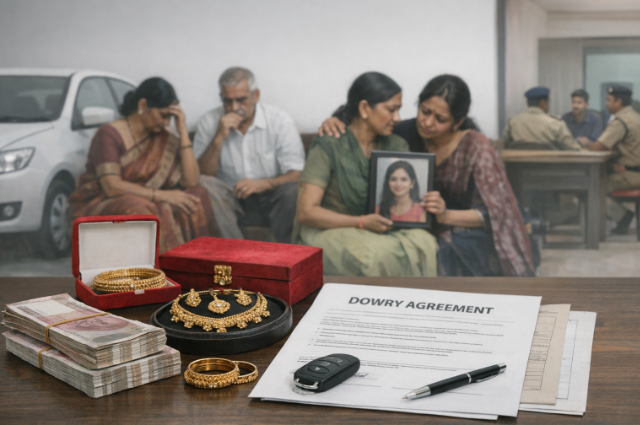
“Any young man who makes dowry a condition to marriage discredits his education and his country and dishonours womanhood.” - Mahatma Gandhi.
To start with this article, I would like to narrate a story that resonates with all women in India, unfortunately. A girl, for the past 25 years, was told by her parents to study hard, to stand on her own two feet. After all, there is an element of truth that financial independence is crucial, despite your gender. Being the ideal daughter, the girl followed so - topped her class, won every debate and even tutored kids to pay for her own fees, thinking that she was indeed holistically building her own worth.
However, this illusion shatters on a Sunday when a boy with his family arrives at her natal home with prospects of marriage. Yes, the family praised her degree, but asked about her culinary skills and went to the room with her mother. She heard it finally - the numbers the boy’s family demanded. The girl feels shocked that her entire salary for two years was being weighed against a car and a “gift” for the boy to become her groom. However, it was only after her mother confided in her about her father saying something along the lines of “kitna dena padega?” to the matchmaker about the prior suitors.
In conclusion, the girl came to the horrific realisation that, despite being a date on her birth certificate, it was only in that room with her father talking to the boy’s family that she was born, by deciding her price as if she was a commodity.
Tracing the Roots and Legal Against the Evil
The text below traces the profound historical evolution of the dowry system in India, breaking down how a voluntary token of financial security morphed into a coercive, fatal demand. It further highlights the rigid legislative and judicial framework designed to dismantle this practice, alongside the persistent societal failures that allow it to endure under the guise of "custom."
“the money, goods, or estate that a woman brings to her husband in marriage” - Merriam-Webster’s Dictionary
To explain a bit more, dowry refers to the money, goods or estate a woman brings to her husband or his family during marriage. It is most common in cultures that are strongly patrilineal, where women are expected to stay with or near their husband’s family (patrilocality). However, in some cultures, the meaning of dowry extends beyond the money transfer. Hindu Brahmin priest, Stantosh Babu, explains - “The custom is that you never go anywhere empty-handed”, implying that dowry acts as a gift from the bride’s family to the groom’s family as a kind gesture to welcome her into the new family that she shall be spending with for the remainder of her life.
The person responsible for paying the dowry varies from culture to culture. For example, a Hindu bride’s family typically gives the groom a dowry. However, in Muslim cultures, it's the groom who offers a gift to the bride. The dowry amount may shift as well, as it often depends on the family's class and income.
However, to know more about the dowry system better, one has to understand how this system in India, in particular, has evolved significantly over time. During ancient times (especially during Vedic times), it was labelled as “streedhan”, which was intended as voluntary gifts to the bride for her financial security. Gradually, during the medieval era, this evolved into a compulsory payment demanded by the groom’s family, especially among royal or upper-caste families.
The dowry system got its spotlight during the British colonisation. When the authority came into effect, women were not allowed to own property. They were also not allowed to purchase land or any kind of assets, and as a result, males started grabbing the possessions of all gifts that were reserved for the bride by her family. The dowry system was made compulsory, bringing in a lot of financial pressure and stress on the bride’s family.
Observing these evils by our lawmakers, several prominent laws were introduced and added into our constitution that prohibit dowry in our nation:
- The Dowry Prohibition Act, 1961: It was enacted on May 1, 1961. This Act prevents the giving and taking of dowry, and if any person engages in so, shall be punishable with imprisonment of at least five years and a fine.
- Bhartiya Nyaya Sanhita, 2023: While Section 80 deals with dowry death with a prescription of up to life imprisonment for said crimes, Section 86 addresses the cruelty angle imparted by the husband or relatives with up to three years of imprisonment alongside a fine.
- Bharatiya Sakshya Adhiniyam, 2023: Section 118 shall presume a dowry death if a woman was harassed for the extraction of dowry before her demise.
These laws were further given weightage with landmark cases that served their role as an aid to strengthen these legal provisions:
- Arjun Dhondiba Kamble v. State of Maharashtra (1995): The Court held that dowry means any demand for property or security linked with marriage.
- Bhoora Singh v. State of Uttar Pradesh (1992): The in-laws burnt their daughter-in-law alive. The court declared it a dowry death.
- Pandurang Shivram Kawathkar v. State of Maharashtra (2001): The Court held that mere demand of dowry is punishable even if made in the name of rituals or ceremonies.
- Rajeev v. Ram Kishan Jaiswal (1992): The Court held that any property given by the bride’s parents in connection with marriage constitutes dowry.
However, despite such laws, Dowry persists but with a different name - “gifts”. Why?
To answer in short, as to what made the Dowry system in India what it is today, as well as why this social evil is not stopping claiming the lives of thousands of women, is:
- Greed - It was noticed that it was always expected of the groom’s family to receive a large sum of gold, money and other assets for compensation for the groom’s education and wealth. Nowadays, this same sentiment is carried forward, where families marry off their sons to families who are ready to give dowry, proving the union they claim as a “sacred bond of seven lifetimes” is actually done for greed and not happiness.
- Social Status - Losing a marriage from the bride’s side in India is considered a matter of shame for the family, due to which the bride’s family are forced to give dowry to save their social status, regardless of their financial status.
- Lack of Education - Education is still a luxury to many people who are unable to afford it, hence leaving them uneducated and unaware of the laws. It leads to the mistreatment of brides and financial pressure on families.
- Weak Implementation of Dowry Laws - Several legal provisions exist that were made and amended as well to protect these brides and their families legally, but the enforcement of these laws is weak, due to which demand for dowry persists.
The Case of Twisha Sharma
Twisha Sharma was a 33-year-old MBA graduate and a former model who was found dead at her matrimonial home in Bhopal on 12 May 2026 (her last rites being observed at Bhadbhada Cremation Ground in Bhopal on May 24). From May 15 to May 16 of this year, an official FIR was registered by the police against her in-laws for dowry-related harassment (alleging that she endured a long mental torture as well as a forced abortion at the hands of her husband Samarth Singh and her mother-in-law, a retired district judge), alongside constituting a Special Investigation Team (SIT) to probe the case. During this period, CCTV footage of the night of her death showed a suspicious three-hour gap between when she was last seen alive and the reporting time of her death.
Twisha’s kin later on May 19 sought an independent probe, demanding to end the "posthumous character trial” by the press. The Supreme Court on May 25 2026, took a suo motu cognisance of this case, registering a suo motu case concerning the alleged dowry death while asking the media to exercise restraint while reporting developments on this case. The case, since then, has seen multiple legal developments, including the anticipatory bail that was secured by the mother-in-law, being challenged by Twisha’s family in the Madhya Pradesh High Court. Her husband, on the other hand, fled and is now a fugitive, with police offering a 30,000 reward for his arrest. A Lookout Circular has also been issued to stop him from fleeing the country.
The Deepika Nagar Case
On May 17 2026, Deepika Nagar, a 24-year-old B.A., B.Ed graduate hailing from Greater Noida, was found dead after allegedly falling from the terrace of her in-laws’ three-storey home in Jalpura. She was married to Ritik Tanwar in late 2024, 18 months before her death, where her family allegedly spent 1 crore rupees on the wedding with additional gifts, including gold, cash and an SUV.
Despite these “presents”, post-marriage, her in-laws allegedly had demanded additional dowry, with the amount ranging from 45-50 lakh INR, with additional jewellery and gold. It was reported that this phase was emotionally, physically and mentally abusive towards Deepika, inflicted by the in-laws. The strain was amplified when it was reported that Deepika underwent two abortions and complained of fatigue due to the excessive domestic workload, with her mother-in-law’s mistreatment exacerbating the workload. Coming back to May 17, Deepika had contacted her father,, Sanjay Nagar, describing the abuse by her in-laws due to which her father,, along with relatives, had come to resolve the matter, and it was hours only after this moment, at around 12:30 AM,, that her family was called upon again, at the hospital this time to share the news of her demise.
According to autopsy reports, external injuries included severe bruising and wounds on the face, thighs, forearms, chest, abdomen, arms, knees, and lower back. Circular bruises and haemorrhages were observed, along with bleeding from the left ear, with internal injuries including a ruptured spleen with significant internal bleeding. A hematoma in the brain was also found, along with other organ damage. It was noted that some injuries could have occurred before death, while others could have resulted from the fall.
On May 18 2026, Ritik and his father, Manoj, were arrested following a formal complaint by Deepika’s family. The police then formed multiple teams to locate five people, in this case, who are allegedly involved and absconded.
In conclusion, both these cases expose a brutal truth - In India, no social status, education, or wealth protects a woman from the institution of Dowry.
A Solutions List
The recent, tragic deaths of Twisha Sharma in Bhopal and Deepika Nagar in Greater Noida have once again shattered the dangerous illusion that dowry harassment is a relic of the past. Despite legal advancements, both cases highlight a devastatingly familiar pattern: young women dying under highly suspicious circumstances, heartbroken families alleging brutal torture and extortion (ranging from cash demands to luxury SUVs), and the accused claiming "accidental falls" or "suicide" to evade the stringent anti-dowry legal frameworks.
To permanently eradicate this systemic violence, we must look beyond isolated criminal trials and execute structural, multi-layered solutions. This can be done firstly from the primary battlefield, where justice lies, a.k.a police stations and local courts, where dowry complaints must be handled with unwavering precision and aggression. It can start from fast-track justice, especially with cases involving unnatural deaths within seven years of marriage, to prevent witnesses from being bought out or intimidated. It can also be achieved by preventing institutional collusions, where internal bodies must penalise any police official who commits any delay of FIR registration, failure to preserve physical evidence or alter preliminary crime scene data to favour the influential or wealthy. To ensure a holistic development in this aspect, police must treat such cases with the same severity as extortion or attempted homicide and not as a "private family dispute.”
The second line of responsibility lies with the media due to its immense power in shaping public perception that often defaults to toxic sensationalism for clicks or views. It can start from penalties to prevent the character assassination attempts, where they muddy the victim’s character to press councils strictly enforcing guidelines that prohibit turning a horrific tragedy into a “prime-time circus.” Reporting should strictly be on investigative facts and legal accountability rather than speculative rumours regarding the victim’s personal life or mental health.
Another aspect that we can include in these cases can be done through financial and institutional safeguards. It can start from digital trail audits where financial intelligence units streamline the tracking of sudden coercive money from a bride's family to her in-laws as dowry demands are increasingly hidden as “household help” or “loans” through online banking, digital payments, and transfers. One can also expand heavily funded localised crisis centres where women can instantly escape an abusive home if family intervention is a hurdle.
Lastly, to ensure true prevention, there has to be a severe dismantling of the deeply entrenched cultural mindsets that view women as economic commodities. It starts with society stopping its treatment of marriage as a fairy tale or survival metric for young women, as pointed out by activists. Rather, a woman must be raised to value independence and financial, as well as overall agency, above social conformity. Also, it is high time that the social stigma of a broken marriage must be stopped, where women are urged to “compromise and go back” to their abusive homes. Parents must understand that if their daughter is calling, crying about the harassment, the immediate response must be physical rescue and not negotiation. Society can also prevent this situation by de-escalating the ostentatious display of wealth during weddings that implicitly normalise transactional unions.
The systemic rot that took Twisha Sharma and Deepika Nagar cannot be cured by the legal system alone. It requires a collective, unforgiving refusal by the government, the media, local communities, and families to ever treat a woman's life as a bargaining chip again.
Conclusion: The Quantifiable Cost of Coercion
The chilling real-world accounts of Twisha Sharma and Deepika Nagar are not anomalies; they are individual entries in a vast, institutional ledger of violence documented heavily by the Government of India. According to the National Crime Records Bureau (NCRB) Crime in India reports, despite a gradual long-term decline from over 8,000 annual cases a decade ago, India recorded 5,737 dowry deaths in 2024 alone. This means that approximately 16 women die every single day across the country because of matrimonial financial extortion.
Furthermore, the data exposes systemic blockages within our legal pipeline. At the close of 2024, the police carried an investigative backlog of 2,765 pending dowry death investigations. When these cases finally reach the judiciary, the battle remains uphill: court trial data from 2024 indicates that 50.1% of completed trials still ended in acquittal, while convictions stood at 46.2%. This data directly mirrors the realities of the Twisha and Deepika cases—where absconding suspects, delayed FIRs, and lengthy litigation create immense legal friction for grieving families.
To permanently eradicate dowry, India must abandon one-size-fits-all enforcement and implement stratified solutions tailored to specific socio-economic pressure points. Be it in affluent circles, where dowry is masked behind real estate and luxury assets by tax authorities mandating financial transparency audits for high-net-worth weddings, or for the urban middle class, where professional women are still reduced to financial commodities, independent media ombudsmen must legally penalise sensationalised "yellow journalism," and local registries should enforce the absolute containment of Streedhan in individual, groom-inaccessible bank accounts. Finally, in rural and economically vulnerable communities where social exclusion and low legal literacy drive high volumes of dowry deaths, the government must bypass centralised, easily influenced administrative structures by funding decentralised legal aid cells at the Gram Panchayat level and empowering local women's collectives to enforce strict community-led social boycotts of families demanding transactional marriages.
Citations:
- Dowry | Definition, Examples, & Facts | Britannica
- What Is a Dowry?
- From Tradition to Exploitation: The Evolution of the Dowry System in India - Legal Service India - Articles
- Dowry System in India, History, Causes, Laws, Impact
- Twisha Sharma case so far: A timeline of events as the Supreme Court takes cognisance
- Twisha Sharma Case Explained: Dowry Allegations, Family Claims And The Supreme Court’s Intervention - Oneindia News
- Deepika Nagar's dowry’ death case: From ruptured spleen to brain clot, what chilling autopsy report reveals – Firstpost
- Dowry Deaths in India - GS SCORE
- Dowry Deaths Decline, But Thousands Still Die Each Year - FACTLY
. . .