
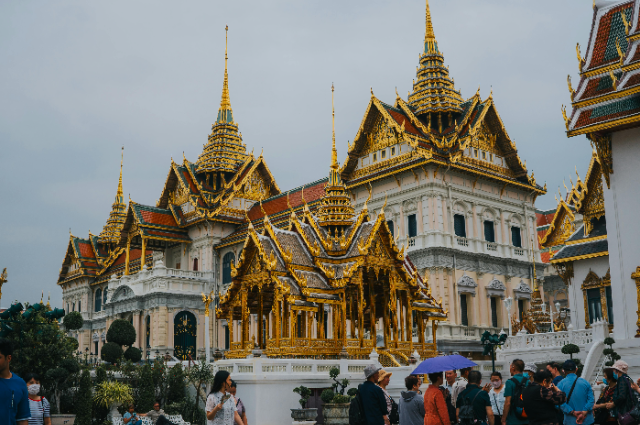
Imagine that you land in Bangkok with a DSLR, a list of temples, and a job interview at a tech park in Chonburi. Your itinerary included the Grand Palace at sunrise, the floating markets, and the street food at Yaowarat. Not this.
By 9 PM on Soi 4, the architecture you wanted to know about wasn’t from the Ayutthaya era. Neon signs were flashing “Ping Pong Show” and “Indian Menu Available.” Men from my flight — the ones who asked about SIM cards at the airport — were now being pulled into bars by girls who looked younger than your sister. A tout grabs your arm and asks, “Indian? Come, low price for you, brother.” You said no and kept walking to your hostel. However, the smell of skewers mixed with something heavier — the weight of knowing why so many tourists actually come here. While you came here for temples and job offers, you were leaving with a pit in your stomach, because the skyline you’d admired all day was built on two economies, and one of them was watching you walk past.
About the Industry
The topic for today, from the introduction I wrote above, is an industry that contributed almost 3.2% of the country’s GDP in 2022, while supporting 450,000 direct jobs and 2.3 million international trips — sex tourism. It is:
“The act of travelling to another country for the purpose of paying to have sex, especially with children” — Cambridge Dictionary
To understand this meaning further, let’s analyse another definition that expands more upon it. According to the United Nations World Tourism Organisation (UNWTO), sex tourism refers to:
“Trips organised from within the sector, or from outside the tourism sector but using its structures and networks with the primary purpose of effecting a commercial sexual relationship by the tourist with the residents at the destination.”
The primary types of sex tourism include:
a) Traditional / Hard-Core Sex Tourism
Here, travellers plan trips with the explicit, primary goal of purchasing commercial sex. It often involves men from developed nations travelling to countries with lower costs of living, where exchange rates make local sex work significantly more affordable. Southeast Asia, Eastern Europe, and certain areas in Latin America are infamous spots for it.
b) Situational and Romance Tourism
Here, one travels where sexual encounters are not the initial motive, but rather an added amenity or a romantic holiday “fling.” It commonly involves women or men seeking romantic or intimate connections, in which local individuals are supported with money, gifts, or other forms of support rather than explicit cash transactions. Local male workers involved with these types of work are labelled as “gigolos” or “beach boys.” Coastal, tropical, or resort regions in the Caribbean, parts of Africa, and Costa Rica have been infamous for this.
c) Child Sex Tourism (CST)
The agenda for travelling here, internationally or domestically is to engage in sexual activities with a minor. It predominantly occurs in regions plagued by poverty, high levels of corruption, or weak child protection rights. It is widely classified as a severe violation of human rights and a severe offence in most jurisdictions. Global organisations and law enforcement heavily target these networks.
d) Domestic Sex Tourism
In this type of sex tourism, the tourist travels within their own country, avoiding international travel. Here, the tourist travels to large metropolitan areas, resort hubs, or regions within a country where the legal landscape or local social norms permit the sex trade.
e) Non-Transactional / Identity Tourism
Travellers cross borders or take trips to experience a different culture’s sexual liberties, explore their own sexual identity, or find partners in a locale where they feel less stigmatised than in their home countries. The target audience here mostly includes LGBTQ+ individuals.
The History of Thailand in This Industry
For this nation, the chronology of the concerned field can be traced back to the Ayutthaya Period (1351–1767), where prostitution was legal and regulated by the government. Sex workers had to register with local authorities and were subject to periodic health checks to prevent the spread of sexually transmitted diseases. Taxes were collected from brothels and prostitutes by the government, and the industry was viewed as an important source of revenue.
The workers were called “phrai luang,” which translates to “royal servants,” and were trained in music, dance, and other arts while also being expected to entertain their clients and provide sexual services. Some rose to prominence to the point of becoming wealthy, with stories of powerful men who fell in love with them and elevated them to positions of influence.
In 1905, King Chulalongkorn (Rama V) introduced several social and legal reforms intended to modernise the nation and improve the lives of citizens. One of these included the abolition of state-controlled prostitution. Under this new system, prostitution was no longer regulated by the government and became illegal.
However, prostitution during this era continued to exist, but it was driven underground and became more dangerous for the women involved. Women were no longer able to access health checks or legal protection and became more vulnerable to exploitation and abuse.
King Mongkut (Rama IV), during his reign, recognised the negative impact prostitution was having on society. He believed prostitution was a moral and social issue that needed to be addressed rather than simply a matter of law enforcement. He implemented several measures to reduce the prevalence of prostitution and improve the lives of sex workers.
One of these included “protection houses” for women who wished to leave the sex trade, where they were given shelter, education, and vocational training so they could earn money through other sources. He also issued a royal decree prohibiting the use of force or deception to recruit women into the sex trade, and he encouraged condom use to prevent the spread of sexually transmitted diseases.
Once again, prostitution still thrived, but the lives of sex workers improved slightly.
However, the major turning point for the modernisation of prostitution was the Vietnam War, which took place from 1955 to 1975. The US military stationed tens of thousands of troops in Thailand, many of whom sought the services of Thai sex workers. As a result, demand for prostitution increased, especially near US military bases, and the sex industry rapidly expanded in Thailand.
Women moved from rural areas to Bangkok and Pattaya to work as prostitutes so they could earn money to support their families. However, on the flip side, organised crime increased, particularly in areas like Pattaya, where prostitution became rampant. This, in turn, led to an increase in corruption and violence, negatively impacting Thai society.
In today’s time, Thailand’s sex tourism industry is projected to reach USD 50 billion in revenue by 2027, with a sector worth about THB 1.1 trillion.
Legal Status of Prostitution in Thailand
Prostitution and sex tourism in Thailand exist in a legally grey area. The actual exchange of sexual services for money is not strictly illegal, but the Prevention and Suppression of Prostitution Act technically criminalises associated activities like solicitation, operating brothels, pimping, and organising commercial sex.
To explain in simpler words, Thai law criminalises the solicitation of prostitution “openly and shamelessly” but tolerates the private exchange of sexual services between consenting adults, thereby allowing the industry to operate on a wide scale and making Thailand — formerly known as Siam — a globally known destination for sex tourism.
However, to add more complexity, sex workers do not possess labour rights due to prostitution being classified as restricted or illegal work. Therefore, they are excluded from government benefits and cannot unionise to demand safer working conditions.
Authorities strictly prosecute certain offences in the sex trade regardless of adult consent, including child exploitation and human trafficking.
Lawmakers have periodically drafted legislation aimed at fully decriminalising and regulating sex work. These proposals seek to treat sex work as legal labour, which would provide social protections, health regulations, and taxation frameworks for sex workers, though these efforts remain debated and have yet to be fully passed.
Impact of Prostitution in Thailand
The reported “good aspects” of this industry in Thailand are often framed as economic and policy arguments, as prostitution is tied to tourism revenue and employment, as discussed earlier.
To specify, it has become a major source of income for many women, particularly those from impoverished rural areas. For these women, prostitution offers a way to support themselves and their families and often represents their only opportunity to escape poverty.
However, on the other hand, prostitution has also hurt Thai society.
One such negative can be understood with the help of a 2026 cross-sectional study of Thai and migrant sex workers published on February 1, which found significant depression and quality-of-life impacts, with the homicide rate for female sex workers being 17 times higher than that of women in the general population.
Adding to this data, it has been found that among female sex workers in Thailand, 15% reported physical or sexual violence in the previous week alone, with urban Bangkok showing 20–29% of workers operating outside venues facing the same.
Perpetrators included partners, police, pimps, and clients.
Not only that, but another 2026 Bangkok study of male and trans sex workers found that 57% reported at least one harmful event, with the most common being emotional harm, stigmatisation, and robbery.
With key barriers being fear of stigma, judgment related to sexuality, and masculinity norms, only 20% had ever accessed support resources. To specify further, only 16.5% of male and trans sex workers who experienced harm contacted the police, 5% approached NGOs, and 37% confided in family or friends.
Blame the Thai Dramas
While hardcore fans might claim that Thai BL dramas — one of the most internationally popular forms of media the nation produces — do not promote the sex industry, links can still be documented between BL-driven tourism and the broader sex and nightlife economy.
To understand this better, it is crucial to look at how traditional sex tourism and modern BL-induced tourism diverge in intent and demographics.
| Attribute | Historic / Traditional Sex Tourism | Modern BL-Induced Tourism |
| Primary Target Demographic | Historically older, cisgender heterosexual males, or niche gay male demographics (Graves, 2022). | Predominantly working-age women (aged 20–50) and a rapidly growing subset of the global LGBTQ+ community (Pongsapitaksanti, 2026). |
| Core Intent of Visit | Physical consumption of adult entertainment services. | Visiting specific drama filming locations, purchasing consumer goods, and attending star-studded fan meetings (Chidprasert, 2025; Yuliarti, 2024). |
| Indirect Impact on Sex Work | Directly fuels nightlife districts like Patpong, Nana Plaza, and Soi Cowboy. | Subcultural overlap. While tourists visit for media, the idealised imagery sanitises and desensitises the underlying adult entertainment infrastructure, creating safe curiosity about Thai queer spaces (Ulla & Pernia, 2022). |
The first prominent example can be attributed to Sotus: The Series (2016) and together: The Series (2020). together achieved a record-breaking 100 million views on LINE TV and catalysed an explosion of “Thai drama tourists” globally, particularly from conservative societies like China and Indonesia (Yuliarti, 2024).
These shows often establish the trope of “pan-East Asian soft masculinity” through neat, well-coiffed, and androgynous male aesthetics. However, this highly aestheticised romantic fantasy serves as a sanitising layer because it separates male-male intimacy from the historically transactional adult nightlife culture of Bangkok, shifting international tourist expectations toward romantic idealism rather than commercial sex.
The second prominent example is the series Dark Blue Kiss (2019). The series effectively showcased urban Bangkok life, café culture, and modern riverside landscapes. Fandom practices like “shipping” — imagining real-life actors in romantic or sexual relationships — have driven massive female-dominated crowds to travel to Bangkok for fan meets.
This influx of female tourists with progressive ideologies has forced commercial hospitality venues, including historic nightlife hubs, to adapt their marketing away from explicit adult tourism and toward inclusive, K-pop-style fandom spaces.
Lastly, the 2020 BL drama I Told Sunset About You, filmed in Phuket, depicted a deeply emotional and visually cinematic coming-of-age queer romance. It successfully decentralised tourism away from Bangkok, directly driving international audiences — such as Vietnamese and Japanese travellers — to visit the exact geographical landmarks shown in the series.
By embedding queer romance into pristine natural environments and local heritage, it rebranded Phuket as a romantic destination for all sexual orientations.
Citations
- Thailand Sex Tourism Statistics | 2026 Edition
- Sex Laws in Thailand: What Foreigners Must Know - Harwell Legal International
- Sex Tourism - Definition, Nature, and Risk of Sex Tourism
- https://en.wikipedia.org/wiki/Female_sex_tourism
- https://onlinelibrary.wiley.com
- https://pmc.ncbi.nlm.nih.gov
- https://www.emerald.com
- Prostitution in Thailand: History, Legal Status & Societal Impact
- pubmed.ncbi.nlm.nih.gov
- frontiersin.org
- state.gov
- Bunyavejchewin, P. (2026). *Thai boys love series and idols: a new facet of soft power diplomacy in Thailand*. Frontiers in Communication, 11, Article 1758167.