
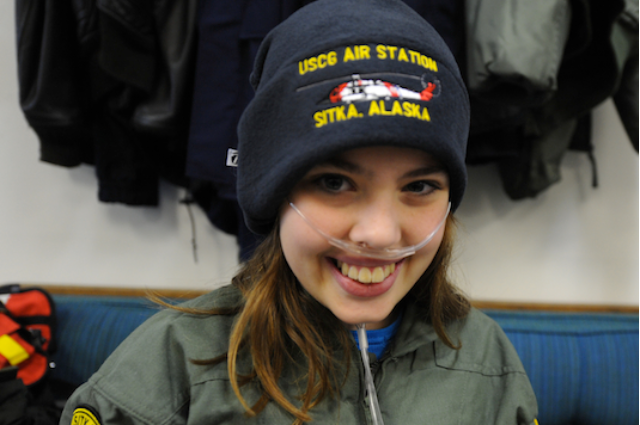
Numerous tubes were attached all over her body. She was fighting to breathe, feeling closer to death with every passing hour. Her lungs had failed, leaving those who loved her hopeless. She lay in a medically induced coma, unable to speak, unable to move, while the rest of the world went on. Little did anyone know that this same girl - fragile, oxygen-dependent, bound to a hospital bed - would go on to inspire millions of people across the world to be grateful for their lives and to live every single day with intention and joy.
“You are never gonna be happy with what you get unless you are happy with what you have”
Imagine living every day knowing that you could die at any moment. Imagine waking up, and the first thing you do is not check your phone, but start a breathing treatment that will take hours out of your morning. Imagine that a simple cold could land you in the intensive care unit. Imagine that your lungs - the very organs that keep you alive - are slowly, relentlessly being destroyed from within. That was Claire Wineland's reality, from the day she was born until the day she died. And yet, she never stopped living. She never let her illness become the whole story.
Claire's Early Life
Claire Lucia Wineland was born on April 10, 1997, in Austin, Texas. She was diagnosed at birth with Cystic Fibrosis, a chronic, progressive, and life-threatening genetic disease that has no cure. At the time of her birth, the life expectancy for a child diagnosed with Cystic Fibrosis was approximately ten years old. Think about that for a moment - her parents were told, from the very beginning, that their daughter might not live to see her teenage years.
Cystic Fibrosis is far more than a lung disease. It is a genetic condition that quietly wages war on almost every system in the body - the lungs, liver, pancreas, sinuses, digestive tract, sweat glands, and even the reproductive system. It is caused by mutations in the cystic fibrosis transmembrane conductance regulator (CFTR) gene, which causes the CFTR protein to malfunction. This protein is responsible for regulating the movement of chloride in and out of cells. When it fails, chloride becomes trapped inside cells, disrupting the balance of water on cell surfaces - and the result is mucus that is far thicker and stickier than normal.
This abnormal mucus does not clear. It does not move. It collects in the airways, becoming a breeding ground for bacteria and chronic infection. Over time, these repeated infections scar the lungs, slowly and relentlessly stealing breath until they can no longer sustain life. According to the Cystic Fibrosis Foundation, more than 30,000 people live with Cystic Fibrosis in the United States, and over 70,000 people worldwide are affected. The median survival age today is approximately 35 years - a significant improvement from earlier decades, but still a number that carries the weight of mortality.
Living with Cystic Fibrosis means a daily routine built almost entirely around survival. Patients spend up to five hours a day on breathing treatments. Hospital visits are not occasional inconveniences; they are a regular, unavoidable part of life. Medications can cost more than most people earn in a month. The body demands constant, exhausting attention to keep functioning. And despite all of this, Claire Wineland faced every single day with a spirit that most healthy people never manage to find.
The Coma That Changed Everything
When Claire was thirteen years old, she underwent what was meant to be a routine surgery. But the surgery did not go as planned. What should have been a straightforward procedure triggered a cascade of complications that would push her body - and her family - to their absolute limits. Her health began to deteriorate rapidly. Her lungs failed.
For sixteen days, Claire lay in a medically induced coma. Her family sat beside her, holding vigil, not knowing whether she would come back. During those sixteen days, something extraordinary happened on the other side of that hospital room: the internet rallied. Thousands of strangers from online communities flooded her family with love, prayers, messages, and support. People who had never met her, who lived in different cities and different countries, showed up for her family in ways that no one had expected.
When Claire finally emerged from the coma and spent the next three months recovering in the hospital, she learned about the support that had poured in during those dark days. And it changed something in her. Coming out of that coma, Claire saw something she had not been able to see before. When a child is fighting for their life, what a family needs most is not always medical - it is the ability to simply be there. To not have to choose between paying rent and sitting beside your sick child. To not collapse under the weight of fear with no one to lean on. Many families, she realised, were doing exactly that - fighting the disease on one front, financial survival on another, and emotional exhaustion on a third, with no one to turn to when all three became too much at once.
Claire's Place Foundation: Born from the Darkest Days
Most people, after surviving something as traumatic as a sixteen-day coma at age thirteen, would simply be grateful to be alive. Claire did something different. She turned her most painful experience into a non-profit organisation.
At the age of thirteen, Claire Wineland founded Claire's Place Foundation, a 501(c)(3) non-profit organisation dedicated to providing support to children and families affected by Cystic Fibrosis. The foundation offers both financial assistance and emotional support - helping families who are overwhelmed by the cost and chaos of caring for a child with Cystic Fibrosis. It provides grants to families while a loved one is hospitalised, recognising that a medical crisis does not pause rent, groceries, or the needs of siblings at home.
“When I was going through it, people supported my family. And I just realised - not every family has that. So I wanted to be that for someone else”
The foundation grew steadily, earning recognition and awards along the way. It was named the Small Nonprofit of the Year by the Los Angeles Business Journal - a remarkable achievement for an organisation started by a teenager. But for Claire, it was never about the awards. It was about the families who could keep their children close during the worst moments of their lives because of the support her foundation provided. It was about taking the love she had received and giving it back, multiplied.
A Voice That Carried Across the World
Claire did not just want to live an inspiring life - she wanted to inspire people with her words. And she had a gift for it. She was warm, funny, sharp, and unflinchingly honest. She spoke about death without melodrama. She spoke about pain without self-pity. And she did it in a way that made people feel less afraid of their own lives.
She gave her first TEDx speech on October 13, 2011, in La Jolla, California, when she was just 14 years old. She went on to become a keynote speaker at the AARC Congress - the American Association for Respiratory Care - speaking to medical professionals about what it truly feels like to live inside a body that is slowly failing. She spoke at leading events across the globe, at top universities, and at companies like Zappos. Everywhere she went, she brought with her a perspective that most people in those rooms had never been asked to consider: what it means to be fully, consciously alive.
In 2012, she co-authored the book “Every Breath I Take: Surviving and Thriving with Cystic Fibrosis” alongside her friend Chynna Bracha Levin. The book was published on September 21, 2012, and offered readers an intimate, unflinching look at what daily life with Cystic Fibrosis really means
Recognition and Awards
The world took notice of Claire. In 2015, she was honoured as a Fox Teen Choice Award honoree - recognition that put her story in front of a generation of young people who needed to hear it. In 2016, she was listed as one of Seventeen magazine's 17 Power Teens - a list that celebrated young people making a genuine difference in the world. She also received the Gloria Barron Prize for Young Heroes and the World of Children Youth Award for her foundation's work. These were not just awards. She had actually built something real from scratch, spoken on some of the biggest stages and moved people genuinely, and faced the fact that she was dying without ever letting it break her. That deserves recognition.
YouTube and the Power of Showing Up
On July 25, 2017, Claire launched her YouTube channel. She showed up - with her oxygen tubes, her hospital room Christmas lights, her laugh that seemed physically impossible for someone who could barely breathe - and she talked about what it was actually like to live the way she lived.
Her videos explored everything: the grief of watching friends with Cystic Fibrosis pass away, the strange gift of learning to love the hospital as a second home and the kind of deep questions about life, death, and purpose that most people only confront much later in life. She decorated her hospital rooms with posters and fairy lights, making them feel alive. She travelled the world between hospital stays, refusing to let the illness determine how her life should be.
“I don't want to just survive. I want to actually live. There's a difference, and it matters”
Her videos were seen by millions. People who had never heard of Cystic Fibrosis before watched her and came away changed. People who were suffering from Cystic Fibrosis, from other illnesses, from grief, from ordinary human despair - found something in Claire that they had not expected to find. She showed that it’s okay to admit things were hard - and to still laugh in the middle of it. She showed that a life the world might call tragic could still be lived with colour and purpose.
I would encourage whoever is reading this article to spend an afternoon with her YouTube channel or her TEDx talks. Her energy is contagious. Her humour is genuinely funny. And her wisdom has the rare quality of actually changing the way you see things.
Five Feet Apart: A Legacy Written in Film
In 2014, Claire participated in the CW Network documentary series My Last Days, directed by Justin Baldoni - a series that followed people living with terminal illness who were determined to make a positive impact before they died. Baldoni was by the experience of filming Claire. She became like a little sister to him.
It was Claire who told Baldoni something that lodged itself in his mind and never left: that two people with Cystic Fibrosis cannot be close to each other, because the risk of cross-infection is too high. Cystic Fibrosis patients must remain at least six feet apart. For Baldoni, a self-described hopeless romantic who had grown up with Romeo and Juliet as his favourite play, this was the seed of a story. What would it feel like to fall in love with someone, knowing that you could never safely touch them?
The result was the movie Five Feet Apart, released on March 15, 2019, starring Haley Lu Richardson and Cole Sprouse. Claire sat in on table readings, coached the actress Haley Lu Richardson on what it physically feels like to live inside a body with Cystic Fibrosis, and worked closely with Baldoni to ensure that every detail - the placement of scars, the G-tube, the ports - was medically accurate. A Cystic Fibrosis nurse was on set every single day. The film's marketing campaign alone caused Cystic Fibrosis mentions across the internet to increase manyfold, bringing the disease into public consciousness in a way it had never been before.
She never got to see the final cut of the film. She passed away before Baldoni finished editing it. But she knew it was coming, and she was proud of it - proud that people with Cystic Fibrosis would finally see themselves represented on a cinema screen, that the disease she had lived with every day of her life would finally be something the world could see and understand.
“Death is inevitable. Living a life you are proud of is something you can control”
Claire's Last Days
By 2018, Claire's lungs had deteriorated to the point where a double lung transplant was her only remaining option. It was a terrifying, high-stakes surgery - but it also carried within it the possibility of more years, more speeches, more videos, more life. On August 26, 2018, Claire underwent a double lung transplant at a hospital in California. The surgery itself was considered successful.
But one week later, on September 2, 2018, Claire suffered a massive stroke. She was taken off life support that evening. She passed away when she was just 21 years old. According to Laura McHolm, chairman of the board of Claire's Place Foundation, the medical staff described her passing as the most peaceful they had ever witnessed.
She had known, from the time she was a child, that her life expectancy was measured in years rather than decades. She had outlived every prediction. She had been told she would not live to 10, then 13, then 18 - and each time, new treatments had bought her more time. She had used every hour of that borrowed time with a ferocity and a joy that most people never find in a lifetime.
On September 2, 2019 - exactly one year after her death - YouTube Originals released a documentary about her life, directed and produced by Oscar-winning filmmaker Nicholas Reed and Ryan Azevedo. It was called Claire.
What Claire Leaves Behind
Claire Wineland did not just survive a life of illness. She built something with it. She built a foundation that continues to support families living with Cystic Fibrosis long after her death. She has released videos on her YouTube channel, given speeches at numerous events, written a life-changing book on Cystic Fibrosis, and worked on her life documentary, which continues to reach people. She inspired a film that brought Cystic Fibrosis into living rooms and cinema halls across the world. She launched a resource for children who needed to understand their own disease.
But perhaps the most important thing she built was a way of thinking. She refused, consistently and with great deliberateness, to allow her illness to be the definition of her life. She did not pretend that the pain was not real, or that the grief of watching friends die was not devastating. She acknowledged all of it - and then she chose, every single day, to live anyway. Not despite the illness, but alongside it. Not by denying the weight of it, but by refusing to let that weight be the only thing she carried.
“The goal isn't to be sick and also be happy. The goal is to be a complete human being. And complete human beings feel everything”
We live in a world where people complain, often and loudly. We stress about things that, measured against a life like hers, are almost absurdly small. And yet - Claire never made people feel guilty for their smaller problems. She was not preachy. She did not lecture. She simply showed up, in all her complicated, funny, honest, oxygen-tubed glory, and modelled what it looked like to be alive with everything you had.
She was 21 years old when she died. In those 21 years, she founded a non-profit organisation, wrote a book, gave TEDx talks, launched a YouTube channel with millions of views, consulted on a major motion picture, received national awards, and built a community for people who suffer from Cystic Fibrosis. She has created a huge impact in a shorter time.
Claire Wineland is gone, but her foundation is still running. Her videos are still being watched. The film she helped bring to life is still being seen. The children whose families were supported by her foundation are still alive, in part because of what she built at age 13 from a hospital bed.
She had the choice - the choice every person with a terminal illness faces, and honestly, the choice every person alive faces - to shrink her life down to the size of her suffering, or to make her life as big and loud and beautiful as she possibly could. She chose the latter, every single day, with a smile on her face.
That is not an easy thing to do. It is, arguably, the hardest thing any human being can do. And she did it while fighting to breathe.
The next time life feels impossibly heavy, it is worth remembering a girl from California who spent a quarter of her life in the hospital and somehow found time to change the world. Who decorated her hospital room with fairy lights? Who laughed in the face of a prognosis that would terrify most adults. Who looked at a life that others might have called tragic and said - This is mine, and I am going to live it.
“I have cystic fibrosis. It doesn't have me”
References
- Wikipedia - Claire Wineland: https://en.wikipedia.org
- Claire's Place Foundation - Claire's Story: https://clairesplacefoundation.org
- Cystic Fibrosis Foundation - Remembering Claire Wineland: https://www.cff.org
- Washington Post - Claire Wineland, who inspired millions on YouTube chronicling her cystic fibrosis battle, has died after a lung transplant: https://www.washingtonpost.com
- World of Children - Claire Wineland Youth Award: https://worldofchildren.org
- Five Feet Apart (Wikipedia): https://en.wikipedia.org
- Hollywood Reporter - Director Justin Baldoni on the Personal Story Behind Five Feet Apart: https://www.hollywoodreporter.com
- CF Warrior Project - Remembering CF Warrior, Claire Wineland: https://www.cfwarriorproject.org
- Entertainment Tonight - Claire Wineland, YouTube Star Who Chronicled Cystic Fibrosis Battle, Dies at 21: https://etonline.com
- YouTube - Claire Wineland TEDx Talk: https://www.youtube.com
- YouTube Claire Wineland at Zappos All Hands Meeting: https://www.youtube.com
- YouTube - My Last Days: https://www.youtube.com
- YouTube - Claire Documentary: https://www.youtube.com
- IMDB – My Last Days – Season 2 Episode 1 – Meet Claire : https://www.imdb.com
- YouTube - How To Think About Death With Claire Wineland: https://www.youtube.com
- Men’s Health - Five Feet Apart Doesn't Measure Up to Other Teen Romances: https://www.menshealth.com
- BBC News - Claire Wineland: Cystic fibrosis activist dies at 21: https://www.bbc.com