
The first thing that surprises many visitors to Indonesia isn't the beaches or the volcanoes.
It's the temples.
You land in the world's largest Muslim-majority country expecting to hear the call to prayer, and you do. But you also come across towering Hindu temples decorated with fresh flowers, centuries-old Buddhist monasteries, churches filled on Sunday mornings, and Chinese temples glowing with red lanterns during festivals.
For many people outside Indonesia, it doesn't seem to add up.
How can a country where almost nine out of every ten people are Muslim also be home to one of the largest Hindu populations outside India?
The answer isn't hidden in a tourist brochure. It's written into the country's identity.
That identity has a name... Pancasila.
Indonesia became independent in 1945 after centuries of Dutch colonial rule. It wasn't just creating a new government; it was trying to hold together an incredibly diverse country. More than 17,000 islands, hundreds of ethnic groups, hundreds of local languages, and people following different religions all had to imagine themselves as one nation.
Choosing one religion as the foundation of the state could easily have divided the country before it had even begun.
Instead, Indonesia adopted Pancasila, a set of five guiding principles that still shape the country today. The first principle speaks about belief in one supreme God, but it doesn't declare that one religion should rule over everyone else.
That decision continues to influence Indonesia almost eighty years later.
Religion is visible almost everywhere. School students study religion. National holidays celebrate festivals from different faiths. Government leaders attend ceremonies across religious communities. Faith is part of public life, but the state officially recognises multiple religions instead of giving exclusive constitutional status to just one.
Perhaps nowhere is this easier to understand than in Bali.
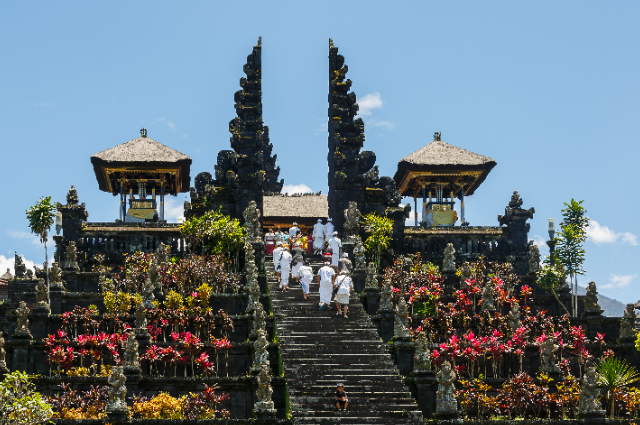
Although Indonesia is overwhelmingly Muslim, Bali remains predominantly Hindu. Temples are everywhere. Small offerings made from flowers, rice, and incense appear outside homes, restaurants, shops, and even on motorcycles parked along the roadside. Religion there isn't reserved for special occasions. It quietly becomes part of everyday life.
The famous Besakih Temple, often called Bali's Mother Temple, has stood on the slopes of Mount Agung for centuries. Every year, thousands of worshippers gather there while visitors from around the world watch respectfully from a distance.
Move away from Bali and Indonesia tells another story.
In Jakarta, the country's capital, the massive Istiqlal Mosque stands directly opposite Jakarta Cathedral. The two buildings almost face each other across the road. During major religious celebrations, they even coordinate traffic and parking so that worshippers from both communities can pray without unnecessary disruption.
It's a small gesture, but one that says a lot about how Indonesia wants to see itself.
That doesn't mean everything works perfectly.
Indonesia has experienced communal violence, disputes over church permits, attacks on minority communities, and criticism over how some laws have affected religious freedom. Human rights organisations continue to raise concerns about blasphemy laws and the challenges faced by smaller religious groups in certain regions.
Indonesians know these debates well.
The country is still trying to balance religious belief, democracy, and diversity in a nation of more than 280 million people.
Yet despite those challenges, Pancasila remains one of the few ideas that almost every government, regardless of political differences, continues to defend.
Maybe that's because Indonesia understands something many diverse countries eventually discover.
Unity isn't created by making everyone believe the same thing.
It's created by giving people enough space to believe different things while still belonging to the same nation.
In a world where religion often becomes a reason for division, Indonesia's story is more complicated than most headlines suggest. It isn't perfect, and Indonesians themselves continue to debate where the country succeeds and where it falls short.
But the sight of Hindu temples standing safely in the world's largest Muslim-majority nation reminds us that national identity doesn't always have to be built around a single faith.
Sometimes, it can be built around the decision to make room for many.
References:
- Pancasila Ideology Development Agency (BPIP): https://bpip.go.id
- Encyclopaedia Britannica – Indonesia: https://www.britannica.com
- Indonesia Ministry of Religious Affairs: https://kemenag.go.id
- UNESCO World Heritage Centre – Cultural Landscape of Bali Province: https://whc.unesco.org
- Pew Research Center – Religion in Indonesia: https://www.pewresearch.org
. . .