
If somebody had warned you twenty years ago that the world might someday struggle to find enough sand, you probably would have laughed.
Not oil. Not water. Sand.
It sounds ridiculous.
After all, sand feels infinite. It's on beaches. It's in deserts. Children build castles with it. Tourists spend money to lie on top of it. Every time we come back from a vacation, we spend the next three days finding grains of it in our bags and shoes.
Nothing about sand feels rare.
Which is probably why very few people have noticed that the world has quietly become addicted to it.
Modern civilisation runs on sand.
Not metaphorically. Literally.
Take a look around any city. Apartment buildings, office towers, highways, flyovers, railway stations, airports, shopping malls, bridges, stadiums, and even the sidewalks beneath our feet all owe their existence to enormous amounts of sand.
Concrete, the material that built the modern world, is mostly sand and gravel held together by cement.
Glass comes from sand. Solar panels need sand. Computer chips need sand. Even the smartphone in your pocket depends on highly purified silica.
Human beings have become so good at building things that we now consume around 50 billion tonnes of sand and gravel every year. According to the United Nations Environment Programme, it is the second most exploited natural resource on the planet after water.
Fifty billion tonnes is such a ridiculous number that it almost stops meaning anything.
So imagine this instead.
Humanity now uses enough sand every year to build a wall 27 meters high and 27 meters wide around the entire equator.
Suddenly, the scale becomes harder to ignore.
And yet, the strange part isn't how much sand we use.
It's where we get it.
Most people assume deserts solve the problem. After all, the Sahara alone stretches across eleven countries. Surely all that sand can be used.
Except it can't.
Desert sand is almost useless for construction.
Thousands of years of wind have polished those grains into smooth little particles that refuse to bind together properly. Builders need rougher, sharper sand found in rivers, lakes, coastlines, and seabeds.
Which means the kind of sand we need is much rarer than the kind we don't.
And that's where things begin to get messy.
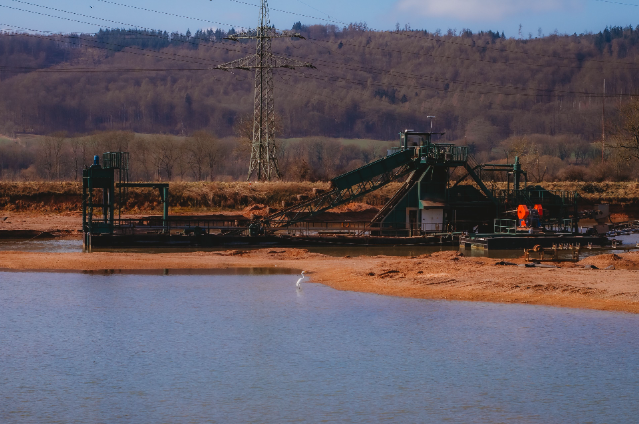
Around the world, rivers are being dredged deeper. Coastlines are changing shape. Entire ecosystems are being disturbed because the appetite for construction never really slows down.
Countries are expanding. Cities are growing. People need homes. Governments need roads. Businesses need warehouses. Nobody wakes up one morning and decides to stop developing.
India is a perfect example.
The country is building highways, metro lines, industrial corridors, ports, and smart cities at a speed previous generations could hardly imagine. Every one of those projects requires millions of tonnes of construction material.
That demand has created an industry worth billions.
It has also created something darker.
Illegal sand mining has become one of India's least discussed but most powerful underground businesses. Across several states, rivers have been stripped beyond sustainable levels. Local communities have complained of damaged farmland and falling groundwater levels. Environmental activists and journalists investigating these networks have faced threats, intimidation, and sometimes violence.
All this because of sand.
Think about that for a second.
Not gold.
Not diamonds.
Not oil.
Sand.
Perhaps that's why the crisis still struggles to attract attention. Environmental disasters usually come with dramatic images. Forest fires. Melting glaciers. Oil spills. Dead fish floating in polluted rivers.
Sand doesn't offer that kind of symbolism.
Its disappearance is quiet.
A river becomes slightly deeper.
A beach becomes slightly narrower.
A coastline retreats a few more meters.
Nothing looks catastrophic until years later, when scientists begin connecting the dots.
By then, the damage is already visible.
Researchers have warned that excessive extraction can increase coastal erosion, damage habitats, disrupt aquatic ecosystems, and even worsen flood risks. Communities that depend on rivers for farming and fishing often pay the highest price.
Meanwhile, demand keeps climbing.
The irony is difficult to miss.
Humanity is racing to build the cities of tomorrow while slowly exhausting one of the materials that make those cities possible.
And perhaps the strangest thing about the entire crisis is that almost nobody talks about it.
Politicians don't campaign on sand.
People don't argue about it on television debates.
Nobody posts angry rants about it on social media.
It doesn't inspire documentaries in the way climate change does, and it certainly doesn't dominate election speeches.
Sand is simply too ordinary to seem important.
Until one day, perhaps, it isn't.
The next time you see a skyscraper rising into the sky, or drive across a newly opened expressway, it's worth remembering that before there was steel, before there was glass, before there was concrete, there were billions of tiny grains pulled from somewhere.
For centuries, humanity treated sand as if it were limitless.
History has a habit of punishing us whenever we assume that about anything.
References
- UNEP, Sand and Sustainability: 10 Strategic Recommendations to Avert a Crisis https://www.unep.org
- UNEP Global Sand Observatory https://www.unep.org
- World Economic Forum, Why the World Is Running Out of Sand https://www.weforum.org
- BBC Future, Why the World Is Running Out of Sand https://www.bbc.com/future
- National Geographic, The Deadly Global War for Sand https://www.nationalgeographic.com