
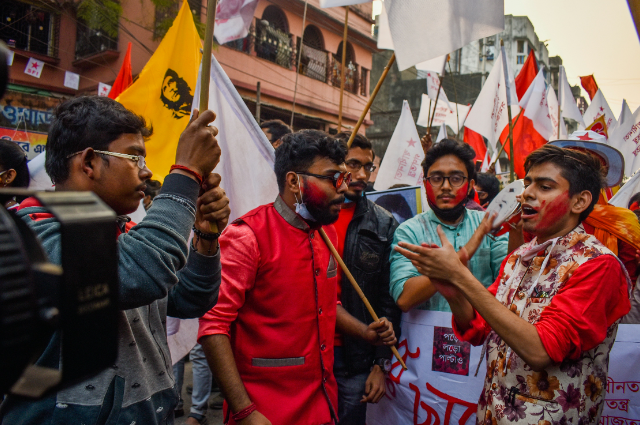
The 2026 West Bengal Assembly election was supposed to mark a major political shift in the state. Instead, within hours of the results, several parts of Bengal witnessed violence, firing, vandalism, and political clashes that left people across the country disturbed.
One of the most serious incidents happened in Sandeshkhali, a region that has remained politically sensitive for years. During late-night patrolling in Bamangheri, three police officers were shot while trying to control the situation after the election results. Bharat Prasun Kar, the Officer in Charge of Nyajat police station, was among those injured. Two central force jawans were also hurt during the attack.
According to reports, security personnel were conducting patrol rounds after tension began spreading across nearby areas. Suddenly, armed attackers opened fire. The shooting created panic in the region, forcing security forces to launch overnight raids to identify those involved.
The incident quickly became one of the biggest talking points of the post-poll violence because attacks on police during election duty are rare and seen as a sign of how unstable the situation had become.
The violence came right after the BJP secured a historic victory in Bengal. The party crossed the majority mark comfortably, ending years of All India Trinamool Congress dominance in the state. BJP leader Suvendu Adhikari, defeating Mamata Banerjee once again, became one of the biggest headlines of the election.
But even before voting began, the political atmosphere in Bengal had already turned extremely aggressive.
One of the biggest controversies before the election was the Special Intensive Revision of voter lists. Around 90 lakh names were removed from the electoral rolls, creating a huge political debate across the state. TMC leaders claimed genuine voters were being targeted, while the BJP defended the move by saying fake and illegal entries needed to be removed.
The issue became emotional for many people because questions around identity, citizenship, and migration were already dominating political discussions in Bengal. Campaign speeches from both sides further increased tension, especially in border districts and communally sensitive areas.
Despite concerns over violence, Bengal recorded one of the highest voter turnouts in its history. More than 92 percent voting was reported across the two election phases in April 2026. Security arrangements were also massive, with lakhs of personnel deployed throughout the state.
Still, violence could not be completely controlled.
During the voting itself, clashes were reported from districts like Howrah and Hooghly. Repolling had to be ordered in some booths after allegations of EVM tampering surfaced. Videos and complaints related to blocked buttons and damaged voting machines spread heavily online during polling days.
After the final results on 4 May, the situation worsened.
Several districts reported attacks on party offices, vandalism, arson, and street clashes between rival supporters. In Kolkata, tension rose in areas like Tollygunge, Kasba, and Baranagar after party offices were allegedly damaged by mobs. Videos from New Market showing bulldozers near political offices went viral on social media and added to public outrage.
In Birbhum, a local TMC worker was hacked to death during a violent confrontation. In Murshidabad, another political worker suffered bullet injuries after unidentified people opened fire. Violence was also reported from Asansol, Jamuria, Dinhata, and surrounding regions.
What worried many people even more was the communal angle attached to some incidents. Reports claimed that certain Muslim-owned shops and establishments were targeted during the unrest. A mosque vandalism report also increased tension in several districts.
Amid all this chaos, another major incident shocked the state.
On the night of 6 May, Chandranath Rath, the close aide of Suvendu Adhikari, was shot dead near his housing complex in Madhyamgram. According to investigators, attackers intercepted his vehicle before opening fire from close range. Rath died on the spot after being hit multiple times, while his driver was seriously injured.
Police officials later suggested that the attack appeared planned and may have involved surveillance over several days. The murder happened just before the swearing-in ceremony of the new government, making the political atmosphere even more tense.
The 2026 Bengal election is now being discussed not only because of the political result but because of the violence that followed it. From voter list controversies and aggressive campaigning to post-poll clashes and shootings, the election exposed how deeply divided the political environment in the state has become.
For many ordinary residents, the biggest concern now is safety. Businesses shut early in several areas after the violence. Families stayed indoors, fearing clashes. Security forces continued patrols in sensitive districts days after the results.
Political changes are a normal part of democracy. But when police officers are shot during patrol duty and political workers are killed within days of the election results, it leaves behind fear much bigger than politics itself.
References:
- Election Commission of India – https://eci.gov.in
- The Indian Express – https://indianexpress.com
- India Today – https://www.indiatoday.in