
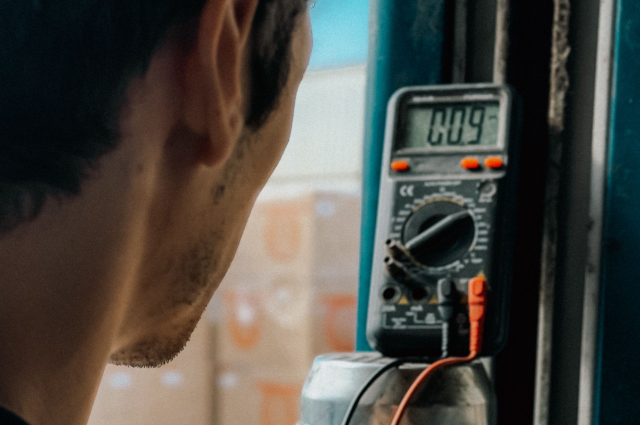
Arif was repairing a ceiling fan when I entered the electrical shop near the bus stop. The fan lay upside down on the counter, its cover removed, screws scattered beside a glass of tea. A little radio played an old Bengali song, but every time a bus passed, the engine noise drowned it out. Arif had a screwdriver in one hand and his phone in the other.
"Look at this," he said, turning the screen towards me.
It was a video of a young man explaining how he had started an online business and was now earning more money than he had ever imagined. The video had bright captions, quick cuts and a photograph of an expensive car. Arif watched until the end, locked his phone and returned to the fan.
"Everyone seems to be earning money online now. I am still sitting here with these old machines."
He laughed. I knew he was joking, at least partly.
I had known Arif since school. He was always curious about things that other people simply used. Once, he opened an old radio at home because he wanted to know where the voices came from. His father was not impressed. The radio was never quite the same again, but Arif spent the next several days explaining to anyone who would listen how it was supposed to work. At school, he said he would become an engineer. I remember believing him.
We all had plans like that. One boy wanted to fly aeroplanes. Another was convinced he would become a famous cricketer. I wanted to do so many different things that I probably would have needed several lifetimes. Our ambitions changed whenever we heard an interesting story or watched something on television. We did not know much about salaries, entrance examinations or the cost of higher education. We simply liked imagining what might be possible.
I am not suggesting that childhood was easier. There were power cuts, muddy roads and families who had to calculate every household expense. Some of our classmates left school early because their families needed them to work. Poverty was not an abstract word to us. We saw it around us. Still, there was a certain carelessness in the way we imagined our futures, and I sometimes miss it.
I left the village for my studies. Soon, my own conversations began to change. Instead of talking about what I wanted to become, I found myself discussing examination results, college fees and employment. At family gatherings, someone would inevitably ask about my next step. The question was rarely about what I had discovered or enjoyed studying. It was usually about what job my education would lead to.
I understood the concern. My family had responsibilities, and I could not pretend that earning a living was unimportant. A person who has to think about household expenses cannot make every decision according to personal interest. I began to see why my parents had always preferred a secure profession.
What I did not notice at first was how easily the practical question took over every other question.
When I returned to the village after several years, I found the same concern among the younger boys. At the tea stall near the bus stop, a group of them were discussing examinations. One had filled out a Railway Recruitment Board application. Another was preparing for SSC CGL, although he had not yet decided whether office work was something he would enjoy. A third was thinking about going to Kerala for work because his cousin had found employment there.
They were discussing application fees, age limits and the number of vacancies. One boy kept refreshing a website on his phone because he was waiting for an update. There was a half-empty packet of biscuits on the table, and the tea had gone cold while they argued about which examination was more difficult.
I asked one of them what he really wanted to do.
"First, let me get a job," he replied. "Then I'll think."
The others nodded. It was a familiar answer. I had heard it from students in towns and cities too.
The desire for a secure job is not the problem. The problem is that we have started treating a particular kind of employment as the main evidence that a young person has succeeded. A government position can bring stability and respect. A job in a city can help a family pay its debts. These are serious achievements. But when every conversation about a child's future eventually ends with a discussion of a government vacancy, something has gone missing.
I see it in the way people respond to different ambitions. Tell a relative that a boy is preparing for a competitive examination and the conversation usually continues with questions about the syllabus, coaching and expected salary. Tell the same relative that he wants to write stories, learn music or build a small business, and the first response is often a warning.
"What will you do with that?"
It is a small sentence, but it can close a conversation very quickly.
Arif faces this problem in his own way. He works at a relative's electrical shop and has become quite good at repairing fans, switches, chargers and other household equipment. When I visited again, he was explaining to a customer why buying a cheap replacement part might cause trouble later. He knew what he was talking about.
His examination books were kept on a shelf behind the counter. I asked whether he had been studying regularly.
"At night, when there is time," he said.
"Which examination?"
He mentioned a government recruitment examination. Then he began complaining about the number of applicants and how difficult it was becoming to get selected. He had already spent money on forms and study materials. His family wanted him to keep trying.
I asked whether he still wanted to work with electrical equipment.
He looked at the fan he was repairing. "I like this work. But there is no guarantee. What if the shop doesn't run properly? What if I don't earn enough?"
I could not tell him that he was wrong. The uncertainty was real. Yet I wondered why a person who had developed a useful skill had to regard it as a failure simply because it did not come with the title of a government employee. He could have been encouraged to improve the shop, learn more advanced repair work or explore technical training. Instead, the conversation around him kept returning to one examination.
There is a particular kind of disappointment that comes from having an interest but never taking it seriously because everyone around you has already decided it is impractical.
The internet has made this feeling more complicated. I see young people watching videos about online businesses, freelancing, content creation and people who claim to earn large amounts of money from their homes. A boy who has never used professional design software may watch a video about someone earning through graphic design and immediately wonder whether he should start doing the same. Another watches a creator showing a new car and begins thinking that his own progress is painfully slow.
The videos move quickly. Real life does not.
I have seen boys spend an evening watching one business idea after another without actually trying any of them. The next morning, they return to their usual routines. I am not saying this to make fun of them. I have done something similar myself: watching people explain how to become successful, saving the videos and telling myself I will start properly next week.
The strange thing is that the internet gives us access to more possibilities while making us feel that we are running out of time. Somebody is always younger, richer, more confident or apparently more successful. Even a student who is working hard can begin to feel that he has achieved very little.
And the comparison is not fair. We compare our unfinished lives with somebody else's edited presentation. We rarely ask what happened before the camera was switched on.
A few days later, I visited our old school. The walls had been repainted, and some new benches had arrived. The corridor still had a long crack running from one classroom towards the staircase. Outside, students were discussing their examination results. One boy was trying to calculate whether his marks would be enough for the subject combination he wanted. Another was asking a friend about coaching classes.
I remembered how I used to stand in that same corridor, looking at the noticeboard. In those days, a good result seemed like a door that would open into a clear future. Now I know that examinations are followed by more examinations, and that passing one does not necessarily answer the question of what to do next.
A student can spend years preparing for something and still be uncertain when the result arrives. That uncertainty is rarely discussed openly. We celebrate successful candidates, share their photographs and congratulate their families. We do not hear as much about those who missed the cut-off by a few marks, ran out of money for another attempt or had to take a job because there was no time left to prepare.
Yet those students are part of the same story.
Our schools often become places where marks matter more than questions. A child may know how to reproduce an answer from a textbook but have no idea how to explore a subject beyond the syllabus. There are students who are genuinely curious about machines, computers, agriculture, history or literature, but they rarely find enough time or guidance to pursue those interests. Everything becomes preparation for the next examination.
I do not blame teachers alone. They have their own pressures, and many work with limited resources. But I wish education gave students more opportunities to try things without immediately asking how many marks they would receive for doing them.
Not every interest needs to become a profession. I know people who enjoy drawing but have never wanted to earn money from it. Some play football simply because they love the game. Others write poems that nobody outside their family will ever read. There is value in these things, even when they do not appear on a résumé.
The pressure to turn every ability into an income source can be exhausting. A child should be allowed to enjoy something before being asked whether it has a market.
I sometimes think about the difference between the questions we asked as children and the questions we ask now. We once wondered how an aeroplane could remain in the sky. Now we ask how much a pilot earns. We wondered how a radio worked. Now we ask whether repairing electronics can provide a stable income. The newer questions are not foolish, but I wish they had not pushed the older ones out completely.
Financial pressure is not going to disappear because we write a thoughtful article about dreams. Some families cannot afford expensive courses. Some young people have to work before they finish their education. Others leave their homes to find employment because there is simply not enough work nearby. These are not failures of imagination; they are difficult realities.
What bothers me is when those realities become permanent limits in people's minds. A student who cannot afford an expensive course might still be able to find a scholarship or a lower-cost route, but someone has to help them look. A young person who is good with machines might benefit from technical training rather than being told that the only respectable route is a competitive examination. Someone who wants to write or create might need time and guidance instead of being laughed at.
We need more than motivational speeches. We need libraries that are actually used, schools with functioning laboratories, affordable skill training and adults who know how to guide students towards opportunities. A young person should not have to discover every possibility by accident through a video on a phone.
There is also something adults must admit: we sometimes want children to achieve the dreams we were unable to achieve ourselves. A parent who could not secure a stable job may push a child towards government service. A family that struggled with money may see artistic interests as unnecessary risks. It is understandable, but the child can end up carrying the fear of an entire household before having the chance to discover what they are good at.
I have seen this in conversations with parents. They ask about marks, examination dates, coaching centres and career options. They rarely ask their children what they enjoy doing when nobody is telling them what to study. Perhaps they assume the answer is unimportant. Perhaps they are simply too worried about the future to think about it.
I do not know what will happen to Arif. He is still working at the shop and preparing for his examination. The last time I met him, he was trying to find a small component for a customer's fan. He had searched two nearby shops and was getting irritated because neither had the right size. His examination book was open on the counter, with a pen lying across the page.
I asked him how his preparation was going.
"Some days good, some days not," he said.
Then he asked what I planned to do after my own studies. I started answering, stopped halfway and laughed. I was not sure how to explain it.
He went back to looking for the component. I left without asking anything more.
Perhaps this is what I find most troubling about the way we talk about young people's dreams: we speak as though they should have a definite answer at an age when many of us are still trying to find one ourselves. We demand a plan, a career choice and a clear direction, while the world keeps changing around them.
A secure job may be Arif's first priority. It may remain his priority, and I hope he gets the opportunity he is working for. But I also hope he does not begin to think that the years he spent learning to repair things were wasted. There is knowledge in his hands that no examination result can measure.
I have no idea whether he will ever open his own shop or whether he will eventually leave for another job. I suspect he has not decided either.
Perhaps next time I visit, the fan on his counter will be a different one, and his examination book will still be there. Or perhaps things will have changed. For now, he has work to finish, a family to think about and another examination to prepare for.
That is what his future looks like at the moment. Not a grand dream, not a success story. Just a young man trying to work out what to do next.