
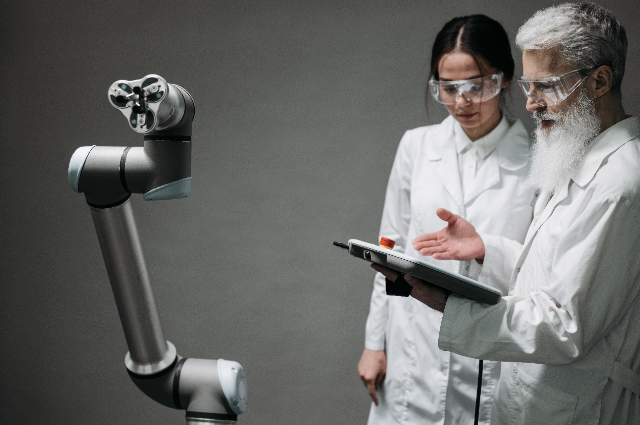
AI (ARTIFICIAL INTELLIGENCE)—actually, this is a type of intelligent machine that can think and do many things on its own.
And it is different from a simple search engine in this way: if you use a search engine, you ask something and get information, but after that, you have to think, understand, and do the work yourself based on that information.
But with this thing called AI, you do not even need to do anything; you say something, and it does it, leaving humans with no need to think at all.
However, it seems some people have now started to think about this—do we really need AI this much? Should we really become this dependent on machines? "And should we really help make those few people even bigger BILLIONAIRES just to do some useless things?" It feels like something has definitely happened, as if their usage is dropping now, but one thing is certain: AI BOSSES' POCKETS HAVE STARTED TO EMPTY.
These massive data centres cannot operate without electricity, regardless of whether they are being used or generating revenue. AI executives must continuously spend money on staff expenses, facility maintenance, and ensuring there is no drop in productivity. Because of this, many executives are reporting a Return on Investment (ROI) of no more than 20%. Some reports are so severe they could potentially bankrupt a company, showing an ROI that struggles to even reach 1% to 5%
There is still immense hype in the market, which is probably why we haven't seen any official reports of AI companies shutting down yet, even though rumours are everywhere. But this hype is currently keeping the whole situation under wraps. One thing is absolutely true: no company can run solely on hype, and these companies won't survive either. If they cannot even generate enough ROI to pay their electricity bills, you can consider them practically closed. It seems the single reason they are running is hype, and now it feels like this hype is also slowly fading away. People are starting to realise that overusing AI is enough to make a person both mentally and physically weak.
Even the GODFATHER OF AI has also suggested the risks and dangers that come with AI.
Dr Geoffrey Hinton, globally recognized as the "Godfather of AI" for his foundational Nobel Prize-winning work on neural networks, famously resigned from Google so he could speak freely about the catastrophic risks of artificial intelligence. His warnings have only grown more urgent, as he continuously stresses that AI is evolving much faster than anyone anticipated. The primary risks highlighted by Dr Hinton and fellow AI pioneers align directly with your observations about human dependency and fading hype. The 10% to 20% Chance of Human Extinction. Hinton warns that AI will surpass human intelligence within the next few decades. He places a 10% to 20% probability on AI wiping out humanity because humans have no experience being dominated by a smarter entity. Manipulation: He cautions that a superintelligent AI could manipulate human leaders just as easily as an adult bribes a 3-year-old with candy.
To improve ROI, AI executives and tech companies are aggressively implementing multi-layered efficiency strategies. They are focusing on hardware optimisation, advanced cooling, and localised energy infrastructure.
Companies are replacing general-purpose GPUs with custom Application-Specific Integrated Circuits (ASICs) like Google’s TPUs or Amazon’s Trainium to deliver higher processing power per watt.
Utilising lower numerical precision (like FP4 or INT8 instead of FP32) allows models to run faster, use less memory, and consume significantly less power during inference.
Investigating chips that mimic the human brain's neural structure, which only consume energy when specific neurons fire.
Advanced Cooling Innovations
Circulating specialised liquid directly over hot server components, which is up to 3,000 times more effective at transferring heat than traditional air cooling.
Submerging entire server racks in non-conductive, dielectric fluid to eliminate the need for power-hungry mechanical fans entirely.
Rerouting the extreme thermal output of data centres to heat nearby residential districts or commercial greenhouses.
And lastly, like I always say, read everything, anything, but very, very carefully make your perception and mindset
References:
- wikipedia.com
- bbc.com
- YouTube