
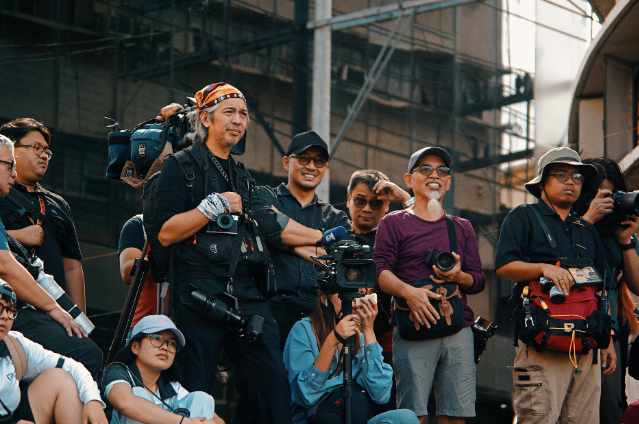
Journalism probably started several thousand years ago. This is because there are many such examples of journalism within our Sanatana Dharma. It is even mentioned in our religious stories that journalism existed among the gods as well. They also needed someone who could bring them all kinds of information, and this workload was taken on by Deva Rishi Narada. He is also called the "God of Journalism.
Journalism likely originated several millennia ago, as evidenced by numerous examples within Sanatana Dharma. Ancient religious texts indicate that a form of journalism existed even among the deities, who required an intermediary to gather and disseminate critical information. This vital responsibility was undertaken by Deva Rishi Narada, who is traditionally revered as the pioneer of journalism.
Because his primary role involved facilitating communication and intelligence sharing among the gods, a common misconception arose that he merely engaged in gossip. However, this interpretation is entirely inaccurate; he was, in fact, the foundational figure of the profession. Following the era of Rishi Narada, rulers, emperors, and queens throughout Indian history continuously required reliable informants. Consequently, the necessity for journalism persisted, and while these ancient practices differed from contemporary media structures, their core function remained identical.
Journalism likely originated several millennia ago, as evidenced by numerous narratives within Sanatana Dharma. Ancient religious texts indicate that a form of intelligence gathering and dissemination existed even among the deities, who required an intermediary to manage critical information flow. This vital responsibility was undertaken by Deva Rishi Narada, who is traditionally revered as the foundational pioneer of this communication model. Because his primary role involved facilitating strategic communication among the gods, a common misconception arose characterising him as a mere gossip. However, this interpretation is entirely inaccurate; he was, in fact, an early practitioner of investigative and diplomatic reporting. Following this era, monarchs, emperors, and queens throughout Indian history continuously relied on intelligence networks. These operatives functioned discreetly as a conduit for public grievances, conveying the opinions of the populace to the state apparatus without public detection, while simultaneously disseminating royal decrees back to the citizens. While these ancient practices lacked contemporary institutional frameworks, their core function aligned precisely with modern media objectives.
However, the historical evolution of this field underscores a fundamental truth: robust journalism cannot exist without stringent security measures and institutional safeguards. If journalists are denied legal protection, their capacity to investigate, challenge power, and expose the truth is severely compromised. Regardless of personal dedication, when reporters face existential threats or physical violence for their investigative work, their ability to perform their duties with absolute honesty and objectivity is systematically undermined.
Consequently, freedom of the press is highly critical to a functional democracy. In the Indian context, while the Constitution does not explicitly mention the press, this liberty is legally anchored within Article 19(1)(a) of the Indian Constitution
, which guarantees the Freedom of Speech and Expression. The Supreme Court of India has repeatedly affirmed that a free press is an implicit and indispensable component of this fundamental right. Globally, this principle is recognised as a cornerstone of democratic accountability, heavily measured by international benchmarks like the World Press Freedom Index. Without formal protection against censorship, intimidation, and legal harassment—such as the misuse of defamation or sedition laws—journalists encounter insurmountable systemic obstacles in gathering authentic information and serving as the fourth pillar of democracy.
The Supreme Court of India has vigorously upheld this right through landmark judgments. In the seminal case of Romesh Thappar v. State of Madras (1950), the Court established that "freedom of speech and of the press lay at the foundation of all democratic organisations," famously asserting that "without free political discussion no public education... is possible." Furthermore, in Indian Express Newspapers v. Union of India (1985), the Court reinforced this by stating that the press plays a crucial role in the democratic process and that "freedom of the press is the heart of social and political intercourse." Globally, this principle is recognised as a cornerstone of democratic accountability, heavily measured by international benchmarks like the World Press Freedom Index. Without formal protection against censorship, intimidation, and legal harassment—such as the misuse of defamation or sedition laws—journalists encounter insurmountable systemic obstacles. In gathering authentic information and serving as the fourth pillar of democracy.
There is one more case of freedom of the press.
On December 6, 1984, the Supreme Court of India heard his case and carefully considered legal issues regarding freedom of speech and expression and freedom of the press. The applicants, Indian Newspapers (Mumbai) Private Limited and Others, protested the government’s decision to export the printed material, claiming that it violated the fundamental right to freedom of speech and expression under Article 19(1)(a) of the Constitution of India. The court made a comprehensive assessment of various issues, including the functioning of customs, notifications issued under the Customs Act 1962 and the impact of payment duty on information and knowledge. He emphasised the state’s responsibility to promote popular education through the press and the need to strike a balance between taxation and constitutional freedom. Finally, the court ruled in favour of the petitioners, ruling that the tax imposed on foreign publications was illegal because it violated their rights to speech and expression. The controversial decision reiterates the important role of the media in democratic societies and emphasises the need to comply with the rule of law when making policy.
CASE DETAILS
Judgement Cause Title indian Express Newspapers v. Union of India, Case Number SCC 641, Judgement Date/12/1984, Court Supreme Court of India, Quorum VENKATARAMIAH, E.S. (J) REDDY, O. CHINNAPPA (J) SEN, A.P. Author. S. VenkataramiahCitation1986 AIR 515Legal Provisions Involved constitution of India Article 19(1)(a) Article 13(2) Customs Act, 1962
In the 2026 World Press Freedom Index published by Reporters Without Borders (RSF), India is ranked 157th out of 180 countries. This marks a six-place decline from its 2025 rank of 151st. RSF places India in the "Very Serious" zone due to an escalating global phenomenon of the "criminalisation of journalism" and the misuse of national security laws.
Top and Bottom Countries (2026 Index)
Rank Type Country 2026 Global Rank RSF Classification top 5 (Best Performance)Norway 1st Good Netherlands 2nd Good Estonia 3rd Good Denmark 4th Good Sweden 5th Good Bottom 5 (Worst Performance)Saudi Arabia176thVery SeriousIran177thVery SeriousChina178thVery Serious north Korea179thVery SeriousEritrea180thVery Serious
Notable Global Shifts
- Norway's Streak: Norway maintains the 1st position for the 10th consecutive year.
- Historical Low: For the first time in the history of the index, over half of the world's assessed countries (52.2%) are categorised as having a "difficult" or "very serious" landscape for independent media.
- Less Than 1%: Fewer than 1% of the global population currently resides in nations where press freedom conditions are designated as truly "good".
Particularly, small and independent journalism offices are subjected to immense political pressure. While no journalistic endeavour is inherently superior or inferior, the core issue pertains to their level of impact; major media corporations possess the resilience to withstand significant external pressure. Conversely, smaller journalistic establishments face heightened vulnerability and operate under severe restrictions on press freedom, and lastly, as I always say, read everything, get to know everything, anything, but carefully make your perception and mindset.
Reference -
- wikipedia.com
- RSF.ORG
- Indiannewspaper.com
- The Times of India