
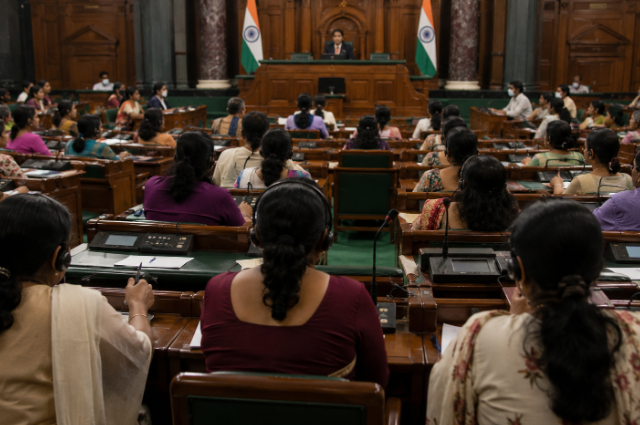
Historically, there were many battles for the rights of women and the ethical continuity of their part in the local, state levels of legislation, law and order and execution. From the very beginning of society, many of them also tried to maintain their benefits in these kinds of battles, so it may happen this time too.
But this time, the battlefield was not any kind of ground or dirty, but the Temple of making rules affected by this monarchial battle.
THE NARI SHAKTI VANDAN ADHINIYAM
The NARI SHAKTI VANDAN ADHINIYAM (officially the Constitution 106th Amendment Act) is a landmark law aimed at correcting the gender imbalance in Indian politics. However, its journey from a 2023 bill to a 2026 reality has been complex and politically charged.
From its very first beginning to today's rejection story is quite impressive, suspicious, and full of hopeful behaviour.
The BJP GOVERNMENT, or you can say that the present government of the 2023rd year of the INDIA Maintain to pass this law from the parliament.
The one hundred and twenty-eighth Constitution Amendment Bill aimed to reserve 33% of seats for women in the Lok Sabha, state legislative, and the Delhi assembly for the next fifteen years means IF it were implemented from that year, then from 2023 to 2035.
The Constitution (One Hundred and Sixth Amendment) Act, popularly known as the Women's Reservation Bill, 2023 (ISO 1591 NARI SHAKTI VANDAN ADHINIYAM was introduced in Lok Sabha on 19 September 2023 during the special session of Parliament. This legislation seeks to allocate 33 per cent of the seats in the directly elected Lok Sabha, State legislative assemblies and Delhi Legislative Assembly for women. ALTHOUGH these could be the best part of the new building of our country's parliament and a remarkable event in the history of politics in India, the hopeful nature of politics and political persons did not make this happen. Even that's why, after being passed in 2023, it didn't come into force till today. The rage battle between the opposition leaders and the ruling party leaders has forgotten the benefit of a particular bill or amendment to the nation and the billion people in it.
Here is something to remember.
So, friends, there's one thing worth noting about this rule—specifically, this Women’s Reservation Bill. Although it is meant to increase the number of women in Parliament, this increase will actually enable them to present their views more effectively. Furthermore, they will be able to push for new rules concerning women across the entire country and ensure they are implemented.
Before revolting against the failure of the Nari Shakti Vandan Adhiniyam bill to pass, we must also consider why it didn't pass and what ultimately happened. What is the actual reason for the bill not passing?
Even if the opposition revolted against this bill for their own benefit—because they are always worried about their own positions and want to ensure nothing happens that could enhance the ruling party's image, even if it means changing important national decisions—they will never support it, no matter how much the country loses. All these manoeuvres aside, when this bill (the one hundred sixth) amendment was defeated this April, some critical questions were raised, specifically regarding Delimitation and the population census.
The Nari Shakti Vandana Adhiniyam (Women's Reservation Bill) was passed in 2023.
To pass this bill, although the full capacity of the Lok Sabha is 543 (often rounded to 550), the following rules apply:
To pass a normal bill in the Indian Parliament, a simple majority (more than 50% of members present and voting) is required in each house. This necessitates a minimum quorum, which is one-tenth of the total membership (55 in the Lok Sabha and 25 in the Rajya Sabha) to hold a sitting.
However, many members might not attend, either due to personal reasons or because of pressure from certain political parties.
"In 2023, this bill was passed in the Lok Sabha with 454 votes; although 2 votes were not in favour, it didn't matter because the Women's Reservation Bill received a majority in the Lok Sabha. In the Rajya Sabha, the One Hundred Sixth Amendment Bill received 214 votes in favour, and no one there opposed it.
However, it did not come into force because delimitation is required for it. Delimitation means the number of MPs in Parliament has to be increased. For that, a population census must be conducted, which is currently ongoing. But this April, while passing it, the BJP government called for delimitation to be done using old census data. This is even though the recent population census data is still weeks away."
The government also introduced the 131st Amendment Bill, which proposed expanding the Lok Sabha seats from 543 to 815 (out of a total proposed strength of 850). To pass this offering, the 'magical number' required was a special majority of two-thirds (approximately 360 votes). Because it was a special bill, a special majority was necessary rather than just a simple majority. However, when the voting took place, it received 298 votes in favour and 230 against. Although it had a simple majority, it fell short of the required supermajority, and the bill was defeated on April 17, 2026".
Here are some views on this bill
Prime Minister Narendra Modi's view on this: Prime Minister Narendra Modi has said that reservation for women in legislative bodies is the need of the hour to make Indian democracy more vibrant and participative. Expressing his thoughts in an Op-Ed, Mr Modi said that any delay in bringing this reservation will be deeply unfortunate. Sharing a video, the Prime Minister said that Parliament has been convened on the 16th of this month to discuss and pass an important bill that advances women’s reservation.
The Prime Minister said that women constitute nearly half of India’s population and their contributions to the nation are vast and invaluable. In his Op-Ed, Mr Modi said that the reservation for women in legislative bodies is a reflection of the aspirations of crores of women across India and an affirmation of the principle that society progresses when women progress.
Opposition party's view on this-
In April 2026, major opposition parties in India, unified under the INDIA bloc, voted against the Constitution (131st Amendment) Bill, 2026. While they maintained that they support women's reservation in principle, they strongly opposed several conditions and riders attached to this specific version of the bill.
Key Concerns Raised by Opposition Parties
Linkage to Delimitation and Census:
The opposition, led by the Congress, DMK, and Left parties, criticised the government for linking the 33% reservation to a fresh census and a delimitation exercise.
They argued that this linkage is a "delay tactic" and that reservations should be implemented immediately within the current House strength of 543 members.
Rahul Gandhi and other leaders labelled the bill a "trap" and a "distraction tactic" to avoid immediate implementation.
Regional Representation and the "North-South" Divide:
Opposition parties from the south, particularly the DMK and BRS, expressed fears that population-based delimitation would unfairly penalise southern states that have successfully controlled their population.
They argued that the proposed increase in Lok Sabha seats (from 543 to 816 or more) would disproportionately favour the Hindi-speaking heartland, further diminishing the political voice of the south and northeast.
"The NDA government is pushing the idea that the Nari Shakti Vandan Adhiniyam will give women a stronger voice in Parliament and bring a fresh style to administration. This bill is a huge deal because it finally clears a hurdle that’s been stuck for decades. The hope is that it’ll change how women view politics and get them more involved.
At the same time, people are talking about how this helps the NDA, since women are a huge part of their voter base. It’s a smart move—by adding more women to the mix, they might be securing their spot in the government for the next 10 or 20 years."
Everything has its pros and cons, the very indian political ground is also not untouchable from this truth.
We should respect every bill, and it's our responsibility to read everything carefully before forming any kind of perception and mindset.
Reference -
- Ministry of Home Affairs
- Women's Reservation Bill docs
- PIB.gov.in