
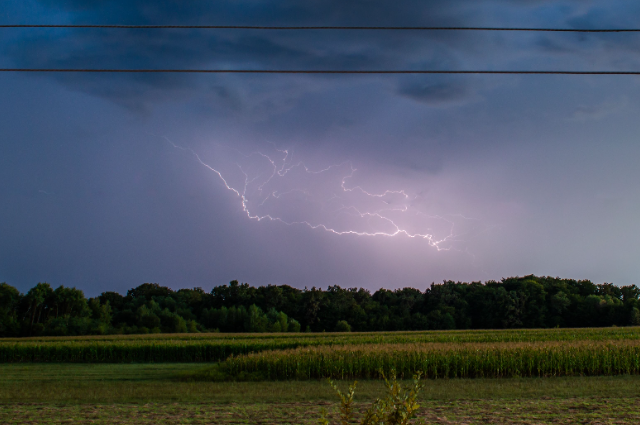
Before human beings learned, synthetic fertilisers like urea existed; lightning was the planet's primary mechanism for fixing atmospheric nitrogen into a form that could be used by plants. During a thunderstorm, intense electric heat shatters the stubborn double bonds of atmospheric nitrogen, forcing the atoms to combine with oxygen to form nitrates that wash directly into soil with rain. However, intensive modern agriculture requires massive amounts of fixed nitrogen, which led to the creation of the Haber- Bosch process in the early 1900’s to produce synthetic urea and ammonia at scale. Lightning increases the amount of usable nitrogen in the soil through a process called atmospheric nitrogen fixation.
Lightning drives abiotic nitrogen fixation, converting atmospheric nitrogen into plant usable nitrates NO3 . The immense heat around 30000c of a lightning strike provides energy to break the strong triple bonds of N2 gas, allowing it to fuse with oxygen into Nitrogen oxides NOx . These nitrogen oxides dissolve in rainwater to form weak nitric acid, carrying s nitrates directly into the soil. While this only accounts for about 5-10% of global fixation–the rest is by soil bacteria. It is a vital mechanism for enriching soils and ecosystems.
Lightning is essential for plant growth, as they need to survive , because photosynthesis is the process of converting light energy to chemical energy, they need to grow, bloom and thrive. Without adequate light, they do not survive.
Lightning forms- lightning builds up and discharges static electricity – similar to when we rub a balloon on our hair. The main difference arises from the release of the built-up energy. Electrons( negatively charged particles) are moved from our hair to the balloon, leaving the balloon negatively charged, our hair positively charged and causing our hair to stand up. In contrast, when energy build up within a thunderstorm cloud , it is released through a lightning bolt from the cloud to the ground.
Lightning in Nitrogen Fixation – the release of energy not only balances the clouds electrical charge, but also breaks apart nitrogen molecules in the atmosphere. Approximately 78% of earths atmosphere is composed of Nitrogen gas, a form unusable by plants. When a cloud releases a lightning bolt , the heat and energy split atmospheric nitrogen. This allows it to combine with oxygen to form nitrogen compounds, which are carried down by rain. This process is called nitrogen fixation, which turns nitrogen gas into compounds plants can use. On average lightning fixes 3-10 telegrams of nitrogen per year over the earth. That’s like the weight of over half a million elephants. By converting atmospheric nitrogen into plant nutrients, lightning plays a vital role is sustaining ecosystems and agricultural growth. The atmospheric nitrogen in a usable form is vital for producers in a food web, plant growth and ecosystem stability. The nitrogen cycle is the movement of nitrogen through the atmosphere, soil and living organisms. When plants absorb fixed nitrogen, it is transferred to animals; they can eat them. When plants and animals die, decomposers such as fungi break them down and return to nitrogen back to soil. Without lightning, plants would not have adequate nitrogen needed for growth; plants and animals would not have enough food. In this way, lightning is a striking reminder of how interconnected Earth's processes are and the hidden ways that nature maintains balance.
Cloud to ground lightning – where lightning strikes the ground in just one possible result of the charge imbalance in storm clouds, lightning can also jump between the differently charged regions in clouds without reaching down to the ground at all or even between separate clouds.
The balance content is overall – before the industrial synthesis of urea, lightning was a major driver of natural nitrogen fixation. High–energy electrical storms broke down, invert atmospheric N2 allowing it to bond with oxygen and rain down as nitrates.
Urea is the most widely used nitrogen fertilizer in agriculture because it contains about 46% nitrogen, an essential nutrient for plant growth. It promotes healthy leaf development, increases chlorophyll production, and enhances photosynthesis, resulting in higher crop yields
This natural atmospheric balance provided ecosystems with the exact fixed nitrogen required to thrive without o the environment. The overarching conclusion is that lightning was the fundamental energy source – required to jump–start the chemistry of life. Before complex biological molecules like urea and amino acids could naturally form and accumulate in Earths oceans atmospheric electrical discharges , where necessary to break down simple inorganic gases to force them to bond into organic building blocks.
Before the invention of urea fertilizers, lightning played an important role in providing natural nitrogen to plants. Plants absorb these nutrients through their roots to support healthy growth, leaf formation, and protein synthesis. This natural process enriches soil fertility and contributes to the nitrogen cycle. Although modern fertilizers now supply most agricultural nitrogen, lightning still provides a small but valuable source of nutrients for ecosystems.
I will say that we used to know urea before as lightning for plant growth and now by the name UREA.
References: