
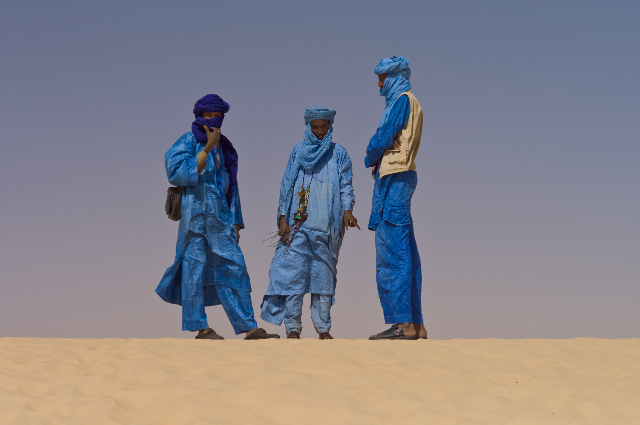
Among the Tuareg people, the men traditionally wear a face veil called the Tagelmust, while women do not, in a striking reversal of regional norms. This indigo- dyed cloth protects against desert elements, marks a boy's passage into manhood, and expresses deep social respect.
The Tuareg people are pastoralists who dominated trade in desert caravans across northern Africa for centuries. They were trying to maintain their important traditions and customs through their language, religion and art. Still, French colonialism in the late 19th century created complications for their culture, economy and lifestyle. The word ‘Touaregs’ is a French spelling variant that reflects the influence of French colonisation during the 19th and 20th centuries. Tuaregs are a people of the Sahara Desert, a vast expanse that spans the northern and western regions of Africa. It is estimated that around 1.2 to 3 million people are identified as Tuareg across the Sahara Desert. The Tuareg people are a Berber ethnic group. They principally inhabit in the Sahara in an area stretching from southwestern Libya to Southern Algeria, Niger, Mali, Burkina Faso, and as far as northern Nigeria, with smaller communities in Chad and Sudan known as the Kinnin. The population is estimated to be 4 to 5 million worldwide. The Tuareg speak the Tuareg languages, which include Tamasheq, Tamahaq, Tamajeq, and Tawellemmet, all belonging to the Berber Branch of the Afro-asiatic family.
They practice Islam, as they are semi- nomadic people, descended from the indigenous Berber communities of northern Africa. They are also credited with spreading Islam in North Africa and to the adjacent Sahel region. Tuareg social structure has traditionally included clan membership, social status and caste hierarchies within each political confederation. They have controlled several trans – Saharan trade routes, which have been an important part of the conflicts in the Saharan region during the colonial an post colonial era. The Tuareg are a sophisticated culture shaped by trade, travel and survival in a desert that could swallow the unprepared in a heartbeat.
Their life in the desert – Families move with herds of camels, goats and cattle, following the scarcity of seasonal grazing and water sources in the empty desert. It has hidden wells, salt flats, and grasses that bloom after rare rains. The knowledge of these is extensive which is passed down orally over generations by the Tuareg, who are built for mobility. The tents, which are made up of leather or woven mats, are loaded onto camels in hours. The entire community moves together, with several animals following the centuries-old routes, and their survival depends on their memory and profound misunderstanding of the d rhythms. Caravans were historically central to the economy of moving salt, gold, dates, and other goods across the Sahara. The T Tagelmust veil is made – as we know p, during past times, the Tagelmust fabric was placed into the indigo dye without water. The characteristic deep blue was achieved through multiple dips in the dye and a subsequent resin treatment. Then the cloth was continuously beaten with a woollen mallet for the final achievement of a shiny, consistent finish. Adult men wear the Tagelmust covering the head and lower face as it protects them from the sun, sand, and wind, but it also represents adulthood and social identity. It rubs off on the skin, giving them the “blue people” nickname.
In contrast, women do not cover their faces, and this inversion of expectation in a desert society is one of many ways the Tuareg defy the typical. Men remove their veils rarely in public, and the fabric and the wrapping style can indicate social status, clan affiliation, or regional origin.
In Tuareg society, women play prominent roles. They are leaders of their society and family, respected, and are sacred to the culture of the Tuareg society. The culture is matrilineal. Women do not wear the veil and are considered among the freest women in the world for keeping all their possessions, including children, and t, men move out of the house. They can initiate the processes that lead to divorce, but in society, divorce is not a stigma of shame. Women own the homes and animals, as they play an important role externally but is important in influencing political discussions, as men consult with their wives and mothers before taking political decisions. If a marriage ends, the husband leaves with the children, but the tent is of mother. This system gives authority and security within communities. Tuareg women are central in cultural life as they preserve oral history, compose and perform poetry, and are the next generation in both practical skills and cultural knowledge. Compared with neighbouring cultures, women enjoy social freedom, such as interacting with men, travelling independently within the group, and making decisions for family and community life in a matrilineal society.
The Tuareg tradition and modernity. Some of them still move seasonally with livestock, while other in urban centres. Men wear Tagelmusts for special occasions and festivals to celebrate music and storytelling. The Sahara may be empty for others, but for the Tuareg, it is home where they do whatever they want to do. It is also harsh for others, but it is a test of resilience for them and their own identity.
References:
- https://en.wikipedia.org
- https://study.com
- https://www.youngpioneers.com
- https://www.ekinkenofficial.com