
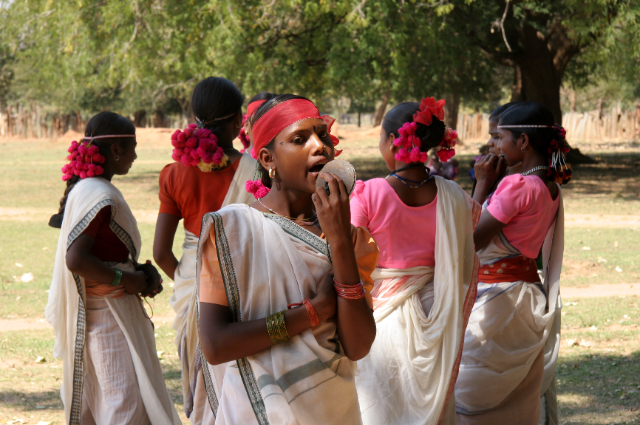
Indian tribes – India is home to over 705 officially recognised ethnic groups collectively known as Scheduled Tribes (STs) – making up about 8.6% of the country’s population. These indigenous communities – often referred to as Adivasis – possess distinct languages, cultures, and socio–economic traditions. They are predominantly concentrated across central India, the North-eastern states and the Western Ghats.
Muria Tribes.
The Muria tribe is an indigenous Dravidian community of the Gondi people, primarily residing in the Bastar district of Chhattisgarh, India. They are renowned for their rich cultural heritage and varied tribal population. They call this area around 40,000 sq. km home. They also have a large presence in the nearby state of Maharashtra – Globally renowned for the Ghotul(youth dormitory) live- in relationship tradition – an egalitarian community institution where adolescents live and learn about social harmony, music, art and relationships. Traditionally, they are economically homogeneous and strive to work as a collective. They have mixed sex dormitories where adolescents are sent to practice premarital sex, sometimes with a single partner and sometimes serially.
Language
The primary tongue of the Muria tribe is the Muria language, which belongs to the Gondi linguistic family. One of the largest indigenous tribal communities in India, the Gond people speak a Dravidian language called Gondi. The Muria tribe inhabits part of Maharashtra and the Bastar district of Chhattisgarh, where the Muria language is extensively spoken.
According to the Muria language, many tribal members are proficient in HINDI and CHHATTISGARHI, which are frequently used in the area of communication and education. Those tribes who live in cities can speak and understand English.
It stands out from other tribes with its vivid and diverse culture in the area. They follow their own customary rights, traditions and beliefs that have been passed down through the generations. Their cultural features include:-
Vibrant dance style, especially the Gaur dance, which is performed during festivals and celebrations, have rich musical heritage.
Practices a hybrid of animistic and other doctrines. They execute religious rites and offerings at village shrines in order to worship a variety of gods and spirits.
The Muria people are organised unusually with the village council. They let the boys and girls meet with each other and can come into a relationship. Then, if the boy comes with a rose to propose to the girl, the girl has the right to deny or accept. No pressure and no force.
They are predominantly agrarian, and the industry that provides the majority of the community's income is agriculture. The agricultural methods that have been handed down through the centuries have a strong connection to the land. They wore a distinctive cloth which symbolised their rural life. Along with a shirt, dhoti and lungi, they wore a turban – a cloth worn around the waist for traditional clothing.
Khasi tribe
A major indigenous community in northeastern India, primarily inhabiting the Khasi and Jaintia of Meghalaya.
Numbering roughly 1.5 million, they are renowned for their matrilineal society, their rare MON – KHMER language and their incredible architectural feat of creating living root bridges. They have a significant population in the bordering state of Assam and in certain parts of Bangladesh. The major population is in the eastern part of Meghalaya, particularly in khasi hills, where they represent 78.3%of regions population. They also comprise about 48% of Meghalaya's population, making them the state’s largest ethnic community.
Khasian is closely related to the Palaungic language of Myanmar. Pre–Khasis migrated through upper Burma to the Brahmaputra valley on the way to Meghalaya. The Khasi language is classified as part of the Austroasiatic language family. The Khasi people also have their own word for the Himalayan mountains, which is KI LUM MANKASHANG, which means that at one point in time, they did cross the mighty mountains. The word ‘khas’ means HILLS, and they have always been people of cold and hilly regions and have never been connected to the plains and regions. The Khasi first came in contact with the British in 1823, after the latter captured ASSAM. The area inhabited by the Khasi became a part of Assam province after the Khasi Hills states entered into a subsidiary alliance with the British. The main crops produced by the Khasi are: betel leaves, areca nut, oranges, pineapple, plums, litchis, and local varieties of rice and vegetables.
The traditional Khasi male ( jymphong) wore a long sleeveless coat without a collar, and the Khasi female ( jainsem) wore a rather elaborate outfit with several pieces of cloth giving the body a cylindrical shape. Weaving Ryndia is an art passed through the generations and treated as an occupation provide livelihood to families in the region.
Un-dyed off-white state or maroon and mustard plaid design is a cultural symbol of the Khasi people, and ERI silk is also famous.
For marriage – they are a part of monogamy. Young men and women are permitted considerable freedom in the choice of partners. It is one kind of arranged marriage, and rare for girls to get property and boys shift, but the normal is girls shift, and boys get property. Divorce is common, with causes ranging from incompatibility to the lack of offspring. Before, the Khasis used to divide like – husband gives 5 paisa, then girl gives 5paisa on her own. Now, by the Indian legal system.
Many indigenous and Adivasi societies have historically practised remarkable gender egalitarianism. Their traditional structure emphasises women’s economic independence, freedom of movement and the necessity of mutual consent long before modern societies codified themselves.
References:-