
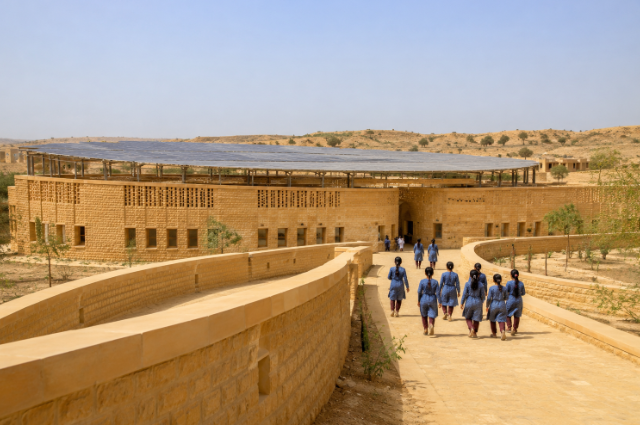
The Rajkumari Ratnavati Girls' School stands in the heart of the mystic Thar Desert in Rajasthan, India, sitting atop numerous acres, a fantastic oval sandstone structure that blends seamlessly into the arid landscape.
New York-based studio Diana Kellogg looked to symbols of femininity for the design of an oval-shaped structure, an all-girls school in India made from local sandstone. It was built to educate and teach over 400 girls between the ages of five and sixteen. Diana Kellogg architects explained the symbols of femininity and also the nearby dunes to create a fort-like structure that would blend into and grow out of the landscape.
As a female architect designing for women, she looked at feminine symbols across cultures and especially symbols of strength. The school will serve more than 400 girls, from kindergarten to class 10, from below the poverty line residing in the mystic region of Jaisalmer where female literacy barely touches32%. The school will be the first in a complex of three buildings known as the GYAAN centre, which will also consist of the Medha – a performance and art exhibition space with a library and museum. The women’s co-operative, where local artisans will teach weaving and embroidery techniques from the region to mothers and other women.
The GYAAN CENTRE will empower and educate women, which will help them to establish economic independence for themselves, families and their communities. Landing on a structure of three ovals to represent the power of femininity and infinity, as well as replicate the planes of the dunes in the region of Jaisalmer.
The Rajkumari Ratnavati from Jaisalmer was the princess of Jaisalmer and the daughter of KING MAHARAWAL RATAN SINGH, who is remembered as the brave girl who thwarted the efforts of enemies by her sheer wisdom and eagerness in the absence of her father. It was vital to Kellogg to include the community in a building made for the community using local material to create infrastructure which helped reduce carbon emissions, and she chose to build a solar panel canopy on the roof as a cooling system where temperatures peak close to 120 degrees. Both the canopy and jalis keep the heat out, and the elliptical shape of the structure also helps in bringing aspects of sustainability in creating a cooling panel of airflow.
After the name of the princess, the school was named, and the commission by the New York-based non-profit CITTA and designed by architect Diana Kellogg serves a school with critically low female literacy rates.
Natural cooling: It was challenging in the heart of the Thar Desert to design a comfortable learning space where climate change is making drought spells longer and more intense. Kellogg, who usually designs high-end residential projects, was motivated on a trip to Jaisalmer in 2014, where she thought of building a symbol of hope and the resilience of the desert by merging the aspects of Jaisalmer architecture in modern design. For the structure, she opted to use locally sourced sandstone, a climate-resilient material that will benefit the school by cooling temperatures; the indoor temperature is approximately 20-30 degrees Fahrenheit lower than the outdoors. It is also used for making buildings, including the Jaisalmer FORT, a part of the city which hosts one-fourth of the total population and is a UNESCO WORLD HERITAGE SITE.
It's abundant in the area, reasonably priced and has talented stonemasons, as it actually keeps the heat out and also keeps the coolness in at night. Among the traditional techniques Kellogg incorporated into the design is lining the inner walls with lime plaster – a porous and natural cooling material that helps in releasing any trapped moisture, resulting from humidity. In the region, by inspiring from other buildings, she also used jali walls – a sandstone grid which enables wind to accelerate in a phenomenon called the Venturi effect, cooling the courtyard as well as providing shade from the sun. High ceilings and windows release rising heat in classrooms, while a solar panel canopy provides shade and energy. The structure, which is angled in relation to the prevailing winds, has an elliptical shape, which is chosen for its ability to capture and circulate cool air.
Air conditioning is not used anywhere in the building, not because of its environmental impact but because it is common in the area. By adopting traditional and natural cooling mechanisms that the students are familiar with. She believes that they get a sense of comfort from their surroundings, leading to greater confidence.
School uniform: As we know, actresses get a chance to wear Sabyasachi-designed outfits, but here the little girls of the school in Jaisalmer are living the Sabyasachi dream. The designer has designed the uniform for the girls through ajrakh- a powerful style in a unique form of block printing, which is famous in Rajasthan and Gujarat. The two–piece uniform consists of a blue knee-length kurta with ajrakh print at the bottom and three-quarter sleeves, two patch pockets, along with maroon cropped elastic waist pants, for the comfort of the girls. This uniform design brings controversy to the traditional salwar kurta that most schools follow in India. These designed uniforms, with sensitive students for local heritage, give a better understanding of culture and sustain craftsmanship. Sabyasachi was honoured to design the uniform, as he believed in the transformative power of education.
The school in the Thar Desert stands as the empowering beacon of change, combining sustainable architecture with social progress. By providing education and breaking deeply rooted literacy barriers, the oval-shaped stone sanctuary champions women's empowerment, climate-resilient design and the preservation of local craftsmanship.
References:-