
PAST RELATIONS
In 1953, America (CIA) and British intelligence (MI6) led a deadly coup that brought down Mohammed Mossadegh, the last democratically elected prime minister.
Due to its strategic location and vast oil reserves, Iran was of special interest to the United States, the United Kingdom and other powers.
The United States took the leading role in Operation Ajax, a covert operation whereby CIA-funded agents were used to foment unrest inside Iran.
When Mossadegh and his government were overthrown, a pro-Western monarch, Mohammad Reza (Shah), returned to power.
In 1979, the Islamic revolution transformed Iran from being a loyal US ally into a declared rival.
This uprising, which was mainly driven by opposition to Western interference and forced modernisation and the autocratic rule of the Shah, led to the Ayatollah Khomeini establishing an Islamic republic and also severing diplomatic ties with the United States.
Current scenario
On 28 February, the US and Israel launched the war on Iran. The US and Israel initiated the military campaign, citing Iran’s ongoing nuclear ambitions and the objective of pushing for regime change in Tehran.
Iranian Supreme Leader Ayatollah Ali Khamenei was killed in Tehran on February 28, 2026. His death was confirmed by Iranian state media following a joint daytime air assault conducted by the United States and Israel. - Al Jazeera
INDIA’S HEAVY DEPENDENCE ON IMPORTS
The Iran war has resulted in high oil prices and shortages of liquefied petroleum gas (LPG) and liquefied natural gas, which are imported from the Gulf region.
India is highly dependent on imports to meet its energy needs, relying on foreign suppliers for over 50% of its natural gas and 88.7% of its crude oil.
Because of this reliance, every $10 rise in global crude prices adds roughly $15 billion to India’s import bill, which directly impacts inflation and the trade deficit.
STRAIT OF HORMUZ
The war lasted several weeks without any break. The Strait of Hormuz is the only sea passage from the Persian Gulf to the open sea.
It measures 24 to 60 miles. It is geographically bordered and primarily controlled by Iran to the north and Oman to the south.
Since the outbreak of conflict between the US and Iran on February 28, the waterway has been effectively closed to commercial traffic. The waterway typically handles 25% of the world's seaborne oil and 20% of its LNG.
Global impact
The closure has immobilised transit for major producers like Qatar, Saudi Arabia, Iraq, and Kuwait.
This has also led to a surge in oil prices all around the globe, causing an energy crisis.
Impact on India
Due to its high dependence on imports, India is highly vulnerable to the effects caused by the closure of the Strait of Hormuz.
The majority of India's oil imports travel through the Strait of Hormuz.
A secure and open strait ensures a smooth and uninterrupted supply, which is vital for transportation industries and overall economic growth.
Disruptions in the strait lead to sharp price spikes.
The tensions in the Strait lead to an increase in crude oil prices and also weaken the Indian rupee.
Thus, the strait is of great importance to India, and these tensions in the strait impact the Indian economy directly.
OTHER FACTORS CONTRIBUTING:
Massive Foreign Investor Outflows
Foreign portfolio investors withdrew $18.5 billion in Indian equities on a year-to-date basis. This flood of capital leaving India sharply increases demand for dollars, weakening the rupee.
Persistent Current Account Deficit
The rupee's fall is linked to years of current account deficits — meaning India consistently imports more than it exports — adding structural pressure on the currency.
A Strong US Dollar
A stronger US dollar, driven by expectations that the US Federal Reserve will keep interest rates elevated, has put pressure on emerging market currencies like the rupee.
Geopolitical Tensions
The rupee has depreciated by over 6.5% since the beginning of 2026 and by 5% since the start of the war in West Asia, which has added geopolitical risk to the mix.
Strict Market Regulation & Shallow Financial Markets
Strict market regulation, offshore-onshore arbitrage trading, and a service export trap contribute to the rupee's structural weakness, beyond just the external oil shock.
RBI's Hands-Off Policy
India's central bank reaffirmed its policy to let market forces determine the exchange rate, though it reportedly intervened aggressively on some days to curb the currency's slide. This inconsistency creates uncertainty.
CURRENTLY
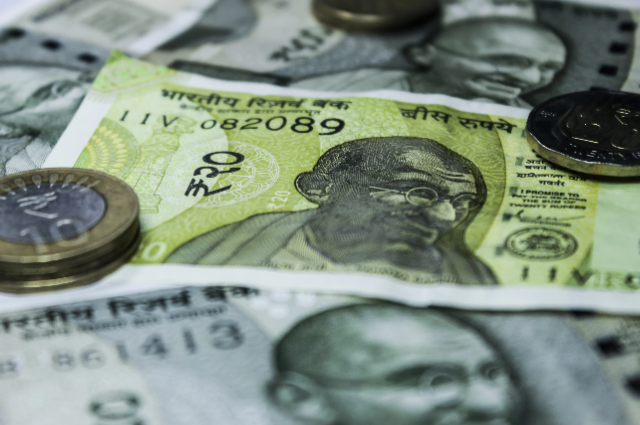
The Indian rupee (INR) is currently weak against the US dollar. It has reached 96 per dollar due to surging global crude oil prices, sustained foreign capital outflows, and aggressive US trade tariffs.
References: