
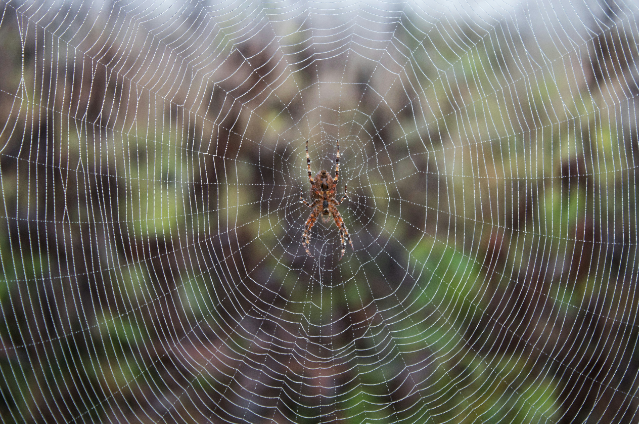
Spiders are a species of arachnids; they have eight legs, and their bodies are divided into two parts. What makes spiders different from insects is the fact that insects have six legs and their bodies are divided into three parts, unlike spiders.
Spiders range in body length from 0.5 to about 90 mm (0.02–3.5 inches). All spiders produce silk, but not all make webs. They use silk to build shelters, cocoon their eggs, fly through the air, dangle from tree branches and reel in prey. Spiders produce silk as an incredibly versatile survival tool used for hunting, shelter, reproduction, and movement. It is made of specialised proteins in the spider's abdomen that turn from liquid to solid thread upon being spun. Not all spiders create webs, but the species that do rely on them for survival.
A spider web is a structure made from spider silk. It is a strong, flexible, protein-based material produced in silk glands located inside the spider’s abdomen. This silk is secreted through tiny nozzles called spinnerets, and depending on the species, a spider may produce multiple types of silk, each with different strengths, stickiness, and elasticity. Some silks are sticky and used for trapping prey, while others are non-sticky and ideal for building strong frames or wrapping egg sacs. This versatility is why spider webs come in so many shapes and styles.
Spiders play a very crucial role in the food chain: they are the link between other insects, such as flies and mosquitoes, and small mammals, such as birds and amphibians. This means that spiders are both prey and predators, so they are an essential part of the food chain. Although spiders tend to be forgotten about when discussing the ecosystem, they are still of great importance to humans.
Spiders are incredibly beneficial natural predators. By hunting or trapping crop-destroying and nuisance insects such as aphids, flies, beetles, and caterpillars, they act as essential controllers for both household and agricultural pests. They consume an immense volume of insects, drastically reducing the need for chemical insecticides. Field ecologists also use spiders as reliable indicators of a healthy, balanced environment, and less than 0.01% of spider species pose a threat to humans, meaning even most indoor house spiders rarely bite.
Spider Venom
Spider venom is a complex, highly specialised cocktail of peptides, proteins, and enzymes primarily evolved to immobilise or kill prey. While its natural purpose is hunting and defence, specific components target human nervous systems or tissues, giving certain bites medical significance. Spider venom is a complex mixture of toxins that primarily attack the human nervous system or destroy local skin and tissues. The specific effects depend entirely on the spider species, ranging from mild, localised pain to severe, life-threatening systemic illness.
Spider venom is a rich source of complex peptides and proteins that scientists are developing into life-saving medicines. Researchers are targeting these compounds to create non-addictive painkillers, heart attack and stroke treatments, cancer therapies, and erectile dysfunction treatments.
If all spiders disappeared, insect populations would explode. Because spiders consume 400 to 800 million tonnes of prey annually, their absence would cause a massive rise in crop-destroying pests and disease-carrying insects. Entire food webs would collapse, starving other insectivores like birds and lizards.
Ultimately, while spiders are among the most universally feared creatures on the planet, they are also deeply useful and irreplaceable. Nearly every ecosystem on Earth depends on them to function as natural pest controllers. By killing billions of insects every single year, including disease-carrying flies and mosquitoes, they keep our shared spaces safer and more comfortable. Without their quiet presence, insect populations would completely explode, leaving our crops devastated. Even beyond the fields, these misunderstood arachnids are quietly revolutionising modern medicine. Researchers are actively unlocking the secrets of their venom, transforming feared toxins into groundbreaking treatments for strokes, heart attacks, and chronic pain. Spiders may not be the most popular neighbours, but our world would be completely unlivable without them.
References