
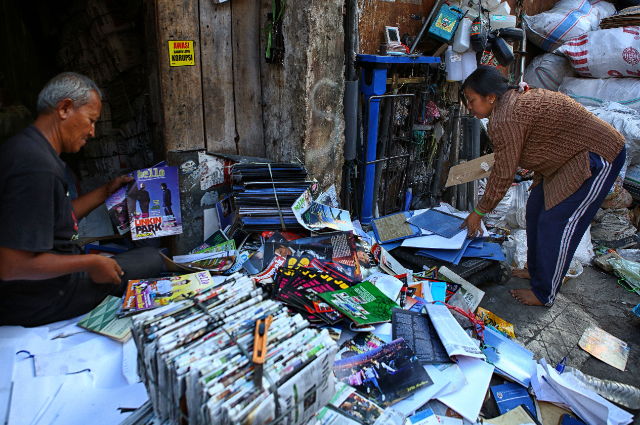
Indians have been recycling for centuries without calling it that.
Sixty per cent. That is the figure that stopped me when I first came across it. India recovers approximately 60% of its plastic waste — compared to a global average of just 14%. I genuinely did not expect that. If you had asked me before reading this how India compares to the rest of the world on recycling, I would have guessed we were behind — probably significantly behind. That is the narrative we are used to. Reports about garbage piling up, overflowing landfills, plastic in rivers. And yet, on this one critical metric — the actual recovery and recycling of plastic waste — India is not behind the world. India is more than four times ahead of the global average. And almost nobody knows this. Including, until recently, me.
The System Nobody Designed — But Everybody Depends On
Here is the part that makes this even more remarkable. This recovery rate is not the result of a government programme, a corporate sustainability initiative, or an international funding project. It is the result of an entirely informal, entirely self-organised network of an estimated 4 million waste pickers and kabadiwalas across India — people who, for generations, have collected, sorted, and sold recyclable material without any formal recognition, training, or institutional support.
For most Indian households, this system is so familiar that it barely registers as a system at all. Old newspapers get stacked in a corner. Glass bottles go into a separate bag. Scrap metal, broken appliances, cardboard — all of it accumulates quietly until the kabadiwala makes his rounds, weighs everything on a hand scale, and pays a few rupees for material that would otherwise go straight to a landfill. Nobody in these households thinks of this as recycling. It is just how things have always worked — a habit passed down without a name, without a campaign, and certainly without a government scheme attached to it.
Six Sigma Without a Single Computer
The dabbawalas of Mumbai are perhaps the most famous example of this same phenomenon operating in a completely different domain — food logistics rather than waste. Every day, an estimated 5,000 dabbawalas deliver approximately 200,000 lunchboxes across Mumbai, from homes to workplaces and back, using a relay system involving bicycles, trains, and a coding system written by hand on the lunch tins themselves. The error rate has been studied and documented at approximately one in six million transactions — a level of accuracy that corresponds to Six Sigma quality standards, the same benchmark used by companies like Motorola and General Electric in their most rigorously engineered manufacturing processes. Harvard Business School has studied the dabbawala system as a case study in logistics efficiency. FedEx has examined it. And it operates with no centralised technology, no formal training programme, and largely illiterate or semi-literate workers who have learned the system through apprenticeship and repetition.
What connects the kabadiwala network and the dabbawala system is not the activity itself — one deals with waste, the other with food — but the underlying pattern. Both are examples of complex, large-scale, highly efficient systems that emerged organically from necessity and local knowledge, without top-down design, without significant capital investment, and without the institutional recognition that their efficiency would seem to warrant.
The Contrast I Cannot Stop Thinking About
This is where I want to connect something to an argument I have made before. When I wrote about the Swachh Bharat Mission, my argument was that the government spent enormous amounts of money — building over 100 million toilets — but the system around those toilets, the maintenance, the cleaners, the water supply, was never built. Money went in. The outcome did not match the investment. Here, with the kabadiwala network, we have almost the exact opposite situation. No government money has gone into this system. No formal investment, no infrastructure budget, no national scheme. And yet the outcome — a 60% plastic recovery rate — outperforms what most heavily-funded formal systems around the world achieve.
I think this contrast says something important about how we think about development and investment. We tend to assume that better outcomes require more money, more infrastructure, more formal planning. But the kabadiwala system suggests that sometimes, the most effective systems are the ones that emerge from people who have an economic incentive and the practical knowledge to make something work — and that government involvement, when it happens, should be about supporting and strengthening what already exists, rather than trying to replace it with something newly designed from scratch.
Why This Should Surprise Us More Than It Does
According to a 2021 report by the Centre for Science and Environment, India's informal waste sector handles a substantial share of the country's total recyclable waste, with waste pickers playing a central role in keeping material out of landfills and within the recycling economy. Globally, the plastics recycling rate remains low — OECD data places the global average recycling rate for plastic waste at around 9%, with significant amounts ending up in landfills, incinerated, or leaked into the environment. Against this backdrop, a developing country with limited formal waste management infrastructure achieving a 60% recovery rate through informal labour is not just impressive — it is a case study that more wealthy, heavily-resourced countries should be studying.
And yet, this system rarely appears in conversations about India's environmental record. When international reports discuss India and waste, the focus tends to be on landfills, pollution, and the scale of the problem — not on the fact that millions of people are, every single day, performing the unglamorous, physically demanding work of sorting and recovering material that keeps the country's recycling rate four times above the global average.
The People Behind the System Deserve More Than Recognition
Here is where the story becomes complicated, and where I think it is important not to romanticise what is, for the people involved, often a story of economic desperation as much as ingenuity. The 4 million people working in India's informal waste sector are, by and large, among the most economically marginalised in the country. They work without protective equipment, often handling hazardous and contaminated waste with their bare hands. They have no formal employment status, no health insurance, no pension, no job security. Many face social stigma due to the nature of their work, and a significant proportion belong to historically marginalised communities. Their children often have limited access to education because the family's economic survival depends on every member contributing to the day's collection.
So when I say this system deserves recognition, I do not mean a feel-good news segment or an award ceremony. I mean something closer to what these workers actually need — formal recognition as workers, which would open the door to minimum wage protections, health insurance, and safety equipment. I mean integration into municipal waste systems as paid contractors rather than informal collectors who are sometimes actively displaced when cities build new, formal waste processing plants that often perform worse than the informal system they replaced. I mean funding that flows not to replace this system, but to protect the people who run it — the same way Mumbai's dabbawalas have, over time, gained recognition, media attention, and a degree of institutional respect that waste pickers largely have not.
What Real Support Would Look Like
A genuinely supportive policy approach would start by acknowledging that India already has one of the most effective recycling systems in the world — and that this system is made up of people, not infrastructure. It would involve registering and identifying waste pickers, issuing identity cards that grant them access to government welfare schemes. It would involve providing protective equipment — gloves, masks, safe sorting facilities — at no cost. It would involve integrating waste pickers into formal municipal contracts, with fair payment structures, rather than treating them as competitors to formal waste management companies. Some Indian cities, including Pune through the SWaCH cooperative, have already demonstrated that this kind of formal integration is possible and that it improves both worker welfare and waste recovery outcomes simultaneously. The model exists. It simply has not been scaled nationally.
India did not need a sustainability movement to build a circular economy, because in many ways, it already had one — built quietly, over generations, by people responding to economic necessity with practical ingenuity. The kabadiwala stacking up newspapers, the waste picker sorting through material at a landfill, the dabbawala cycling through Mumbai's streets with a coded lunch tin — none of them set out to build a sustainability model that Harvard would study or that would outperform global recycling averages. They were just trying to make a living, in the most efficient way available to them. The least we can do, having finally noticed what they built, is make sure that the people who built it are not left behind by it.
References:
- Centre for Science and Environment — State of India's Environment Report, Informal Waste Sector (2021): https://www.cseindia.org
- OECD — Global Plastics Outlook: Economic Drivers, Environmental Impacts and Policy Options (2022): https://www.oecd.org
- Harvard Business School — Mumbai's Dabbawala System: A Case Study in Logistics Efficiency: https://www.hbs.edu
- SWaCH Pune — Cooperative of Self-Employed Waste Pickers: https://swachcoop.com
- International Labour Organisation — Extending Social Protection to Informal Waste Pickers in India: https://www.ilo.org