
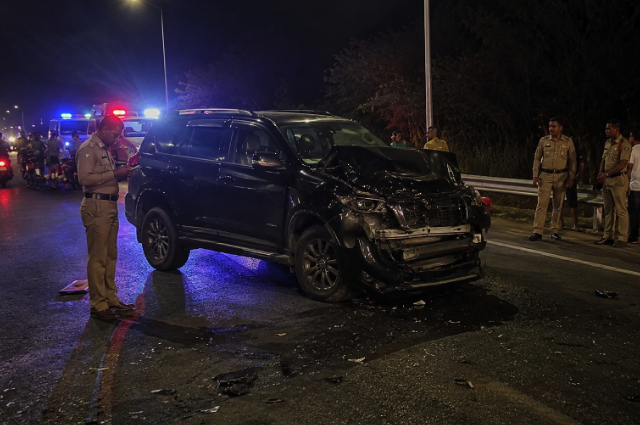
Nine challans. The vehicle had nine pending overspeeding challans registered against it. And it was still on the road. Still being driven. At night. At high speed. By someone drunk. When I read this, my first reaction was not surprise — it was anger. Pure, straightforward anger. Because this was not a freak accident, this was a failure — a complete, total, inexcusable failure of a system that was supposed to prevent exactly this from happening. And because that system failed, Ravi is dead.
What Happened That Night
On the night of May 18, 2026, near Pushkar Ghati on the Pushkar-Ajmer highway in Rajasthan, a speeding Fortuner SUV rammed into three motorcycles. One person was killed — Ravi, a painter from Dholabhata in Ajmer, who was travelling with his brother-in-law Jitendra, also known as Sonu. Four others were injured. The driver of the Fortuner, Digvijay Singh Chauhan, was allegedly drunk at the time of the crash. When police investigated the vehicle, they recovered several cartons and bottles of alcohol from inside the car. Chauhan has since been taken into custody.
Ravi was not just a name in a police report. He was a painter — a working man trying to make a living. He had four sisters. His father, Kishore Kumar, is a retired railway employee who had to walk into a police station and file a complaint about his own son's death. That image — a retired father filing an FIR — stays with me. It should stay with all of us.
The Vehicle, The Temple, and The Nine Challans
This is where this case becomes more than just a drunk-driving accident. The Fortuner that killed Ravi was not registered in Chauhan's personal name. It was registered in the name of the Khatu Shyam Mandir Seva Samiti — a temple trust associated with the famous Khatu Shyam Temple in Rajasthan. Chauhan himself is described as a sevadar, a volunteer associated with the temple committee. Videos circulated online show him performing duties within the temple premises, suggesting a degree of visibility and access that comes with an institutional connection.
But what truly cannot be ignored is the nine pending overspeeding challans against that vehicle. Nine. That is not a one-time lapse — that is a pattern. That vehicle had been flagged by traffic enforcement systems repeatedly, and nothing happened. No licence suspension. No vehicle seizure. No follow-up action. The challans were issued and then simply forgotten, sitting in a database somewhere while the vehicle continued to speed on Rajasthan's highways. Until the night it killed someone.
A System That Only Works for the Powerful
As an Economics student, when I look at this case, I see something beyond a single accident. I see a system that has structurally failed ordinary people while quietly accommodating those with institutional connections. Think about it this way — if this vehicle had been registered to a daily wage worker or a small shopkeeper with nine pending challans, would the authorities have looked the other way for so long? Most likely not. But a vehicle linked to a temple trust, driven by someone with temple affiliations and apparent VIP access — that is a different story. That is a vehicle that moves through a different kind of India.
This is not speculation. This is how institutional privilege works in practice. Religious institutions in India carry enormous social weight, and that weight often translates into informal protection from the kind of accountability that ordinary citizens face every day. I am not saying the temple itself is responsible for what Chauhan did that night. But I am saying that the nine challans going unaddressed for so long raises a serious question about whether that institutional connection created a shield — even an unconscious one — that kept enforcement at bay.
What Nine Challans Really Tell Us About Road Safety in India
India's road safety statistics are already among the worst in the world. According to the Ministry of Road Transport and Highways, over 1.68 lakh people died in road accidents in India in 2022 alone — that is roughly one death every three minutes. Rajasthan alone recorded over 10,000 road accident deaths in the same year, making it one of the most dangerous states for road users. Drunk driving is a significant contributor — the Road Accident Report 2022 found that driving under the influence accounted for thousands of fatalities annually.
Against this backdrop, a vehicle with nine pending overspeeding challans continuing to operate freely is not just an administrative failure — it is a symptom of a much deeper problem. India's traffic challan system generates fines but has very limited follow-through mechanisms. Challans are issued, but licence suspensions, vehicle impoundments, and court summons rarely follow automatically. There is no robust system that flags repeat offenders and escalates action against them. As a result, the challan becomes a tax on recklessness rather than a deterrent against it. You pay — or sometimes do not even pay — and you carry on.
Ravi Did Not Have to Die
This is the part that I keep coming back to. Ravi's death was preventable. Not in the abstract sense that all accidents are theoretically preventable — but in the very specific, documented sense that the warning signs were already there, already recorded, and already ignored. Nine times, the system identified this vehicle as a risk. Nine times, nothing changed. And so when Digvijay Singh Chauhan got into that Fortuner drunk on the night of May 18, he was behind the wheel of a vehicle that the system had already told us was dangerous.
I wonder — and I think it is a fair question to ask — whether Ravi would have survived if he had been on a different road, in a different part of the country, or in a world where nine challans automatically triggered real consequences. I think the honest answer is yes. He probably would have. But Ravi was a painter on a motorcycle on a highway in Rajasthan. He did not have the luxury of a system that worked for him. That is the reality that this case exposes — not just the failure of traffic enforcement, but the quiet, persistent inequality of who gets protected and who gets left exposed.
What Needs to Change
The solution here is not complicated in theory, even if it is difficult in practice. Traffic challan systems need automatic escalation — a second or third challan should trigger a licence review, and beyond that, vehicle impoundment. Repeat offenders should not be able to continue driving simply because they have not yet appeared in court. India needs to move from a passive challan system to an active deterrence model, where the consequences of repeated violations are swift and unavoidable — regardless of who owns the vehicle or what institution it is linked to.
Beyond enforcement, there needs to be genuine accountability for institutional vehicles. If a vehicle registered to a trust, an NGO, a religious organisation, or a corporate entity accumulates traffic violations, the institution itself should be held responsible — not just the individual driver. This kind of institutional liability does not currently exist in any meaningful form in Indian traffic law. It should.
Ravi was a painter. He had four sisters. His father is a retired railway employee who had to file a police complaint to get justice for his son's death. He was not famous. He was not connected. He was just someone trying to get home that night. And the system — the traffic system, the enforcement system, the accountability system — failed him completely. Nine challans were not enough to stop the vehicle that killed him. I hope, at the very least, that his death is enough to start a conversation about why they were not. Because if it is not — if we read this, feel angry for a moment, and then move on — then we are all part of the same failure.
References
- Times of India — Khatu Shyam Temple Sevadar Arrested After Fatal Drunk Driving Crash, Pushkar (May 2026): https://timesofindia.indiatimes.com
- Ministry of Road Transport and Highways — Road Accidents in India 2022: https://morth.nic.in/road-accident-in-india
- MoRTH — Road Accident Report 2022 (Drunk Driving Statistics): https://morth.nic.in
- Rajasthan Police — Traffic Enforcement and Challan Data: https://police.rajasthan.gov.in
- WHO — Global Status Report on Road Safety 2023 (India Data): https://www.who.int