
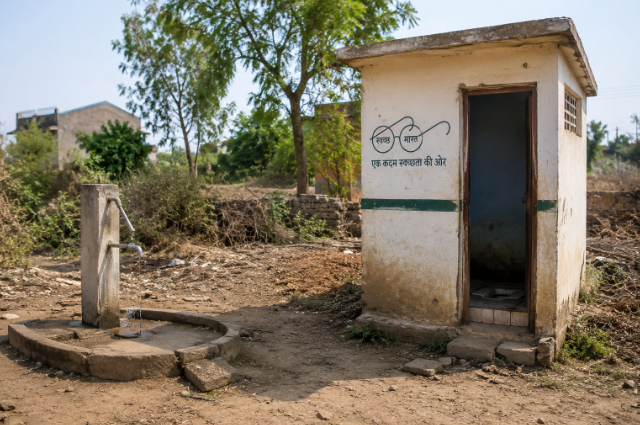
Let me ask a simple question. If you build a toilet but there is no water supply to it, no sewage connection, no cleaner, and no maintenance budget — what have you actually built? The honest answer is: a structure. Not a solution. And I think that is the most important thing to understand about the Swachh Bharat Mission — the world's largest sanitation programme, which built over 100 million toilets across India between 2014 and 2019. On paper, the numbers are extraordinary. In practice, the picture is far more complicated. And the statistics that get celebrated in government press releases are not the ones that tell the full story.
What Swachh Bharat Actually Achieved — And What It Did Not
To be fair, the Swachh Bharat Mission achieved something genuinely significant. According to the Ministry of Jal Shakti, the programme constructed over 100 million individual household toilets, declared more than 600,000 villages open defecation free, and dramatically increased sanitation coverage from roughly 39% in 2014 to over 100% on paper by 2019. The programme won international recognition and was credited with reducing open defecation — a practice linked to serious public health crises, including cholera, diarrhoea, and child stunting. These are real achievements, and it would be dishonest to dismiss them entirely.
But here is what the headline numbers do not show. A 2019 study by the Research Institute for Compassionate Economics (RICE) found that in rural areas where toilets had been built under the scheme, a significant proportion were either not being used regularly or were being used for storage rather than sanitation. A UNICEF report noted that toilet construction without accompanying water supply, maintenance systems, and behaviour change communication frequently resulted in toilets that were unusable within months. The government built the structure. But the ecosystem around it — the water, the drainage, the cleaner, the civic habit — was never built. And without that ecosystem, the toilet is not a solution. In some cases, it is a new health hazard.
The Toilet Without a Cleaner — My Observation
I want to focus on something that I think gets almost no attention in discussions about Swachh Bharat — the question of who maintains these toilets after they are built. In many areas, community toilets and public facilities constructed under government schemes have no assigned cleaner, no maintenance worker, and no operational budget for upkeep. I have seen this myself — toilets that exist, that were inaugurated, that appear in government data as completed assets, but that are visibly unusable because nobody is responsible for cleaning them. And when a toilet is not cleaned, it does not just become unhygienic — it becomes a source of disease. It breeds bacteria. It creates the very health problems that building a toilet was supposed to prevent.
This is a classic example of what economists call incomplete public goods delivery. The government invested in the visible, countable part of the solution — the physical structure — but not in the invisible, ongoing part — the human labour and infrastructure needed to make that structure functional. It is easier to count toilets built than to measure toilets maintained. And so the programme was measured, reported, and celebrated on the metric that looked best, not the one that mattered most.
Poverty and Inequality — The Root Cause Nobody Wants to Name
When people talk about India's cleanliness problem, there is a tendency to blame culture — to say that Indians simply do not care about cleanliness, that civic sense is lacking, that people litter because they choose to. I find this explanation lazy and, frankly, unfair. Yes, civic sense is a real issue — I will come to that. But before we blame individuals, we need to ask a harder question: what choices do people actually have?
A family living in a one-room home in a dense urban slum with no running water, shared toilets that are broken, and garbage collection that comes once a week — what exactly is their option? A daily wage worker in a rural area who earns Rs. 300 a day and has no savings — how is he supposed to maintain a toilet that needs regular cleaning supplies and a functional water connection? Poverty does not make people dirty. Poverty removes the infrastructure and resources that make cleanliness possible. And until we are honest about that, we will keep building toilets that nobody can maintain and blaming the poor for not using them properly.
According to the World Bank, approximately 228 million Indians still live below the poverty line as of recent estimates. India's urban sanitation crisis is deeply linked to the fact that 65 million people live in urban slums — areas where even the most basic infrastructure is often absent or broken. The Swachh Bharat Mission, for all its scale, did not address this underlying inequality. It built toilets in areas that already had some infrastructure. The most marginalised communities — the ones that needed it most — were frequently the last to benefit, and the first to see those benefits disappear due to lack of follow-through.
The Civic Sense Problem — But Context Matters
I do think civic sense is a genuine issue in India — and I say that as someone who cares about the country. Public littering is widespread. People throw garbage from moving vehicles. Religious gatherings leave rivers and public spaces visibly polluted. There is a real gap between how people maintain their private spaces and how they treat shared public spaces. This is not imaginary, and it needs to be addressed honestly.
But civic sense does not develop in a vacuum. It develops when people see that public spaces are maintained, that there are consequences for littering, and that the government treats public infrastructure with respect. When garbage bins are absent, when roads are broken, and when the public toilet is already filthy before you arrive, it becomes very difficult to cultivate the habit of keeping shared spaces clean. Civic education needs to start early, in schools, and it needs to be accompanied by functional infrastructure. You cannot ask people to respect a system that does not respect them back.
The Rivers We Worship and Pollute
No discussion of India's cleanliness paradox is complete without mentioning the Ganga and Yamuna — two of the most sacred rivers in the country and, by multiple measures, two of the most polluted. The Central Pollution Control Board has consistently found that both rivers carry dangerously high levels of biochemical oxygen demand, faecal coliform bacteria, and industrial effluents across large stretches. The Namami Gange programme, launched in 2014 with a budget of Rs. 20,000 crore, has made some progress in building sewage treatment plants but has faced significant criticism for slow implementation and limited impact on actual water quality in key stretches.
What strikes me about the river pollution issue is that it combines every failure we have discussed — incomplete infrastructure, lack of maintenance, poverty preventing access to proper waste disposal, weak enforcement of industrial pollution laws, and the added complexity of religious practices that contribute to pollution even as they reflect genuine devotion. There is no single villain here. But there is a consistent pattern — large amounts of public money being spent on visible interventions while the unglamorous, ongoing work of maintenance and enforcement is neglected.
What Actually Needs to Happen
India does not need more toilet construction targets. It needs toilet maintenance budgets. It needs to hire and pay sanitation workers — the people who actually do the work of keeping public infrastructure clean — with dignity and fair wages. It needs a water supply and sewage connections to follow every toilet that is built, not to be treated as separate projects to be done later. It needs civic education embedded in school curricula from a young age, not occasional cleanliness drives that generate good photographs and then disappear. And it needs honest reporting — not just on how many structures were built, but on how many are actually functional a year later.
Most importantly, it needs to acknowledge that cleanliness is an infrastructure problem before it is a behaviour problem. Fix the infrastructure — give people clean, functional, maintained public spaces — and civic behaviour will follow. Continue to build structures without ecosystems, and we will keep celebrating numbers that do not reflect reality.
Swachh Bharat did not fail. But it did not succeed in the way its numbers suggest either. It built toilets without cleaners, launched campaigns without follow-through, and measured success on metrics that were easy to count rather than ones that actually mattered. India's cleanliness paradox is real — but it is not a mystery. It is the predictable result of treating poverty as a background condition rather than the central problem to be solved. Until the government invests as seriously in maintaining public infrastructure as it does in building it, and until we stop blaming the poor for the consequences of their own poverty, the paradox will continue. The toilets will stand. And many of them will remain, quietly, unusable.
References
- Ministry of Jal Shakti — Swachh Bharat Mission (Grameen) Progress Report: https://sbm.gov.in
- RICE Institute — Swachh Bharat Mission — Behaviour Change Study (2019): https://riceinstitute.org
- UNICEF India — Sanitation and Hygiene Programme Reports: https://www.unicef.org
- Central Pollution Control Board — Water Quality Data, Ganga and Yamuna: https://cpcb.nic.in
- World Bank — India Poverty and Inequality Overview (2023): https://www.worldbank.org
- National Mission for Clean Ganga — Namami Gange Programme Overview: https://nmcg.nic.in