
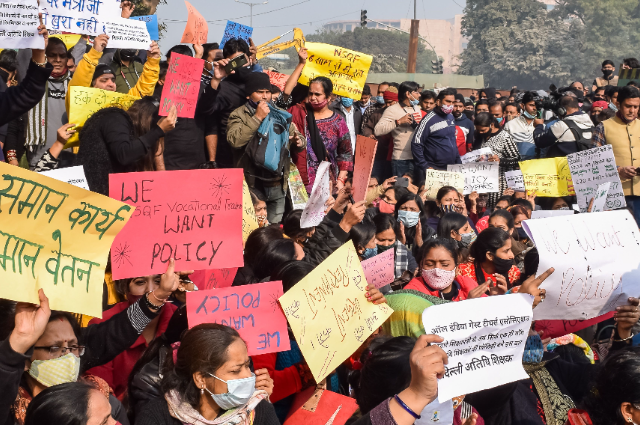
On October 2, the day of Gandhi Jayanti, thousands of young people gathered at Shivaji Park in Mumbai. They had come for a "Jail Bharo" protest led by the Cockroach Janta Party, or CJP. Their demands were clear. They wanted Chief Election Commissioner Gyanesh Kumar to resign, and they wanted the Special Intensive Revision, or SIR, of the electoral rolls to be stopped for now.
The protest almost did not happen. Mumbai Police had refused permission. They spoke of limits on gatherings at the venue, and of worries about traffic and about emergency vehicles being able to move. These are not small worries in a crowded city. Still, the young people came anyway, and the crowd kept growing as the evening went on.
What stood out was the mood. Many placards had memes and dialogues from films on them. One of them read "Gyanesh BRO, JUST RESIGN." To an older eye, this may look like a joke. But for many young people, humour is simply the language they use to talk about serious things. A meme can carry anger, and a film line can say in five words what a long speech cannot.
Some well-known faces joined too. Actor Naseeruddin Shah and musician Vishal Dadlani were present at the park, and reports also name Shabana Azmi and Tushar Gandhi. The same day, the story was moving in Delhi as well. Opposition parties and student groups gathered at Jantar Mantar, even though police had not allowed it. Delhi Police closed metro stations and detained hundreds of people. Rahul Gandhi backed the protests, saying that a baton can stop a crowd but cannot stop questions.
Then came the reaction in Mumbai. A Shivaji Park resident, advocate Siddhi Deolekar, filed a complaint against CJP founder Abhijeet Dipke and three other leaders. She said the group went ahead despite a clear denial of permission and pointed to a 2013 Bombay High Court judgment that limits such gatherings. Police later registered a case against ten named CJP members, including Dipke, and several hundred unidentified people. Some residents and shop owners also said that repeated protests in the area upset their daily lives and business.
At the same time, a group called Gen Next Mumbai held a counter protest. So who are they? The group describes itself as a "youth-led social and political advocacy group." Its counter protest took place near the BR Ambedkar statue at Churchgate, away from the main crowd at Shivaji Park. Who leads it is not publicly clear. Reports say that social media influencer and political strategist Rhea Khanolkar and advocate Yash Mishra were among those involved, but there are no figures on how many members it has.
Gen Next Mumbai said it was there to defend the Constitution. Its members accused Dipke of weakening constitutional institutions, and Khanolkar said they felt the CJP was using the Constitution to mislead people and to reduce trust in the Election Commission. It is important to remember that these are the group's own allegations. They do not prove that the CJP or Dipke wants any such thing, and the CJP has not accepted this description.
The arrival of a counter group tells us something. When a protest grows, people who disagree with it also begin to speak. That is normal in a democracy, and it is healthy that both sides were able to stand in public and say what they felt. It also shows that this issue is not a simple fight between the young and the old, or between one party and another. People of the same age can stand on opposite sides.
At the same time, the right to protest is real, and so is a neighbour's right to peace. The police said no, and thousands still came. That raises an old question: where does a citizen's right to be heard end, and where does a resident's right to a calm neighbourhood begin? I do not think any one side holds all the truth. A good city should find a way to give room to both, perhaps with fixed places and fixed times for large gatherings.
What about the main issue itself? The Election Commission denies the allegations and defends the SIR. It says the changes removed duplicate, dead or ineligible voters. Critics say that millions of real voters were taken off the lists. Until clear facts and figures are put in front of the public, people will keep believing what they already feel.
There are also things we do not know. I could not find any official figure for the size of the crowd in Mumbai, and the reports I read do not describe arrests there. Without such facts, any claim about how big or how peaceful the protest was can only be a guess.
The way I see it, this story is about more than one group or one day. It is about a young generation that wants to be heard, a city that has to balance many needs, and an institution that must keep the trust of the voters. The counter-protest by Gen Next Mumbai does not end the debate. It only shows how deep the questions run. In a healthy democracy, such differences are not a danger. The real danger is when people stop listening to each other.
References:
- Business Today. "Mumbai CJP protest: Abhijeet Dipke demands CEC Gyanesh Kumar's resignation over SIR row." 2 October 2026. https://www.businesstoday.in
- Telangana Today (PTI). "Memes, slogans and celebrity support mark CJP protest at Mumbai's Shivaji Park." 2 October 2026. https://telanganatoday.com
- Al Jazeera. "Indian authorities clamp down as 'cockroach' movement launches new protests." 2 October 2026. https://www.aljazeera.com
- The Pioneer. "SIR row turns Gandhi Jayanti into a day of street protests across cities." 3 October 2026. https://dailypioneer.com
- National Herald. "'Baton can stop a crowd, not questions': Rahul on 'vote chori' protests." 2 October 2026. https://www.nationalheraldindia.com
- The Hans India (IANS). "Case filed against CJP supporters over unauthorised gathering at Mumbai's Shivaji Park." 3 October 2026. https://www.thehansindia.com
- Organiser. "CJP members face complaint over Shivaji Park protest." 3 October 2026. https://organiser.org
- Outlook India. "Who Are Gen Next Mumbai? The Group Which Held Counter-Protest Against CJP In Mumbai." 5 October 2026. https://www.outlookindia.com