
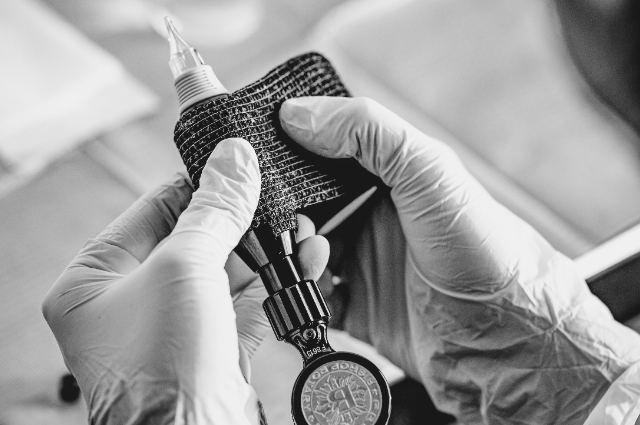
Ever wondered how tattoos became a form of art and expression they are today? Millions of people choose to permanently ink their skin each year, be it tattoos holding a cultural symbol or simply an attractive design. Modern tattoo machines make the process faster, cleaner, and more precise than ever before. But few know that the device responsible for revolutionising tattooing was inspired by an invention that had nothing to do with body art.
The man behind this transformation was Samuel O'Reilly, an Irish-American tattoo artist who patented the world's first electric tattoo machine in 1891. His invention forever changed the practice of tattooing, making it faster, more efficient, and accessible to a wider audience.
Before O'Reilly's breakthrough, tattoos were created entirely by hand. Artists used a technique known as hand-poking, repeatedly piercing the skin with a single needle dipped in ink. The process was slow, painful, and required exceptional patience from both the artist and the client. On average, only two or three punctures could be made every second, making even small designs time-consuming.
O’Reilly found opportunity in a tool that was merely seen to be used in an office. In 1876, inventor Thomas Edison had patented the electric pen, a handheld device designed to create tiny perforations in paper for duplicating documents. Although the invention failed commercially as an office machine, O'Reilly realised that its rapid up-and-down needle movement could serve a completely different purpose.
Instead of copying documents, it could inject ink beneath the skin. He modified Edison's design by adding a small ink reservoir, redesigning the grip to make it more comfortable for long tattooing sessions, and adapting the mechanism to hold multiple needles instead of one. These seemingly simple improvements transformed an unsuccessful office invention into the world's first practical electric tattoo machine.
On December 8, 1891, O'Reilly received U.S. Patent No. 464,801 for his invention, becoming the first person to patent an electric tattoo machine. The difference was remarkable. Instead of making just a few punctures per second by hand, O'Reilly's machine could make around 50 needle punctures every second. Tattoo sessions became significantly faster while also allowing artists to create cleaner lines, better shading, and more detailed artwork.
The invention quickly gained popularity, particularly in New York City, where O'Reilly operated one of the country's best-known tattoo studios. His clients included sailors, soldiers, circus performers, and working-class Americans, all groups for whom tattoos had become symbols of identity, adventure, or personal expression.
Although Thomas Edison's electric pen formed the basis of the machine, O'Reilly's improvements were substantial enough to earn him his own patent. Soon enough, O'Reilly's design was legally recognised as a distinct invention. His patent laid the foundation for nearly every modern coil tattoo machine that followed. By the end of the nineteenth century, O'Reilly had earned an international reputation. Contemporary newspapers and industry publications referred to him as one of the finest tattoo artists in the world, and his machine inspired generations of tattooists to improve and refine the technology further.
More than a century later, the principles behind O'Reilly's invention remain surprisingly familiar. While today's tattoo machines use more advanced materials, quieter motors, and improved ergonomics, they still rely on the same fundamental idea: rapidly moving needles to deposit ink beneath the skin with precision and consistency.
Samuel O'Reilly's story is also a reminder that innovation is not always about creating something entirely new. Sometimes, it comes from looking at an existing invention through a different lens. By repurposing a failed office device into a revolutionary artistic tool, he transformed an ancient craft into a modern profession.
Every tattoo machine buzzing in studios around the world today carries a small part of that legacy. O'Reilly did not invent tattooing itself, but he gave it the technology that allowed the art form to flourish across generations and cultures.
References:
- https://www.smithsonianmag.com/
- https://www.britannica.com/art/tattoo
- https://americanhistory.si.edu/
- https://tattooarchive.com/