
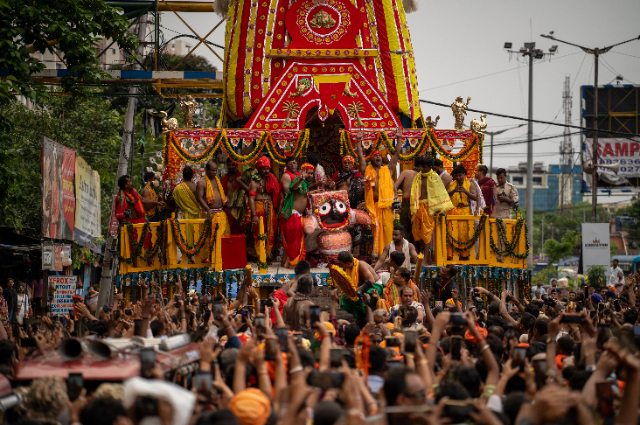
Every year, when the three gigantic chariots of Lord Jagannath, Balabhadra and Subhadra move down the Bada Danda in Puri, all eyes and ears are on the idols, the crowd and the massive wheels. But only very few notice one important detail– who is actually driving the chariots? For in the traditional Hindu sense, no chariot drives itself. It needs a sarathi– a charioteer who wields the reins and commands the horses irrespective of where everyone else's eyes are focused. And surprisingly enough, the three sarathis of the Rath Yatra chariots are far from any mythological characters. They all belong to the same great epic of the Mahabharata, which gave us not only the Kurukshetra battle and Bhagavad Gita but also some of the most illustrious warriors ever imagined by Indians.
The link between Rath Yatra and Mahabharata is one of those wonderful facts which come to light when you start digging deeper.
The Idea of the Sarathi in Hindu Tradition
Even before coming to the question of charioteers in relation to Puri specifically, it will be useful to find out why such people play a certain important role in Hindu mythology. In ancient India, a ratha, or chariot, was not only a means of transportation. It was a symbol of power, skill and divine order. The best fighters from the Mahabharata, Arjuna, Karna, Bhishma, and Drona, fought from chariots. If a fighter managed to defeat ten thousand other soldiers while being in a chariot, he was called maharathi. And behind every great fighter there was a charioteer, who could drive on the battlefield, knew its features, and kept horses calm despite all the circumstances. The god Krishna himself took this place for Arjuna, which shows how important it was.
Thus, if the tradition of Puri temple assigns certain charioteers to each of the three chariots, then it should definitely have significance.
Meet the Three Charioteers of Puri
From the information provided by the Shree Jagannatha Temple Administration, along with that provided on the Odisha government website regarding Rath Yatra, it can be seen that there are different charioteers for the three different chariots.
This is where the link between Rath Yatra and the Mahabharata comes into the picture.
For example, Matali is the charioteer of Jagannath, Daruka is the charioteer of Balabhadra, and Arjuna is the charioteer of Subhadra.
The name Matali, for those who have studied the Mahabharata in detail, should ring a bell.
Matali is mentioned as the charioteer of Indra, the king of the deities, in the Mahabharata in the Adi Parva. So having Matali drive Jagannath's chariot, Nandighosha, is almost like placing the lord's chariot in the hands of the same charioteer who once drove the king of the heavens.
The third of these names is that of Daruka, who was said to be the charioteer of Krishna in epic legends. This particular fact has an exquisite beauty, since the god Jagannath himself is a version of the god Krishna, and the charioteer of Krishna himself is present at the festival through the Rath Yatra chariots.
Finally, the last name Arjuna requires no introductions whatsoever. It should be enough for any Indian person to know that Arjuna was one of the chief characters of the Mahabharata. He was a Pandava prince and friend of Krishna, and his prowess with bow and arrow became legend. Arjuna was traditionally named as the charioteer of Subhadra's chariot, Darpadalana. And this becomes quite logical when we take into account the fact that, in the greater Puranic and folk tradition, Subhadra was considered to be the wife of Arjuna.
A Small Confusion Worth Knowing About
If you try searching for such information online, you'll see an interesting fact. Many articles confuse names and attributes and thus claim that Daruka is from Jagannath's chariot and Matali is from Balabhadra's. Such confusion happens quite frequently, and even those people who have been to Puri many times will likely answer your question in two different ways. Just ask 10 people who visited Puri once, and you'll get at least two different answers to your question.
In order to be completely sure, it is better to rely on the information from the temple administration and the state tourism portal, which are usually the most authoritative sources of information about such an event. As stated there, Matali is from Jagannath's Nandighosha, Daruka is from Balabhadra's Taladhwaja, and Arjuna is from Subhadra's Darpadalana. However, Odia folk tradition has its own interpretation, and local guides and priests will still say something else. It is one of those wonderful contradictions between folk tradition and official documents.
The Chariots These Charioteers Command
An understanding of how important the charioteers are comes only after an introduction to the chariots used. The chariots are quite large, as will be seen below.
The largest is the chariot of Jagannath, known as Nandighosha. This chariot is forty-five feet in height with dimensions of forty-five feet at the wheel level square. There are sixteen wheels, each of which has a diameter of seven feet. The chariot is decked in red and yellow clothes; these colours are typical of Krishna, whom they refer to as Pitambara due to his golden-yellow robes.
The second chariot belongs to Balabhadra. Known as Taladhwaja because of the palm tree that adorns its flag, the chariot has fourteen wheels, each with a diameter of seven feet. It is forty-four feet tall and draped in red and blue clothes.
Lastly, there is Subhadra's chariot known as Darpadalana– which means trampler of pride. This is the smallest of the three; it is forty-three feet tall and has twelve wheels.
Each one of these chariots is drawn by four horses of varying colours, which correspond to the deity riding it. According to news regarding the festival, there are white horses pulling the chariot of Jagannath, black horses pulling that of Balabhadra, and brown or reddish horses pulling the chariot of Subhadra.
Why This Detail Matters
The names of these charioteers can easily be considered insignificant trivia of a mythological nature, which only matters to people studying religion. However, there is something truly beautiful in this concept. Each year, without fail, these chariots are rebuilt anew from scratch using certain types of wood that are gathered in a manner that has not been altered for many years. Each year, the names of the same three people, Matali, Daruka, and Arjuna, are called to help guide these chariots on their paths, as they guided characters of the Mahabharata along their destinies.
It shows one of the major themes of Hindu stories in general– the notion that events happen again and again through time in a symbolic form. In Kurukshetra, the chariots of these deities transported warriors into a war that had a decisive impact on the destiny of the kingdom. In Puri, the chariots transport deities into the very heart of human life, where they pass by shopkeepers, tourists, students, and pilgrims who have come from thousands of kilometres away just to see them.
A Living Tradition, Not Just History
This becomes all the more fascinating as the Rath Yatra festival is not a ritual that exists only in the past. It is celebrated each year with great fervour and draws lakhs of devotees in Puri for the festival. In the midst of all this chaos, colour and devotion, Matali, Daruka and Arjuna carry out their duty without anyone realising it. They are remembered only by a few, but forever carved in the tradition of one of India’s oldest festivals.
Therefore, the next time someone tries to say the Rath Yatra is nothing more than the pulling of three grand chariots along a road, tell them otherwise. Somewhere in the fabric of the red and yellow canopy, in the wheels slowly revolving on the Bada Danda, the presence of the Mahabharata’s charioteers still prevails.
References
- Shree Jagannatha Temple Administration and Government of Odisha official Rath Jatra portal, rathjatra. nic. in
- Svastika.in, "Sarathi of Nandighosh Rath: It's Matali, Not Daruka"
- Hindu Blog, "History Of Ratha Or Chariot In Ancient Hinduism"
- Dynamite News, "Jagannath Ratha Yatra 2025: Know the secret of 3 Rathas of Deity"
- Shreekhetra.com, details on Nandighosha chariot • Art of Puja, "Rath Yatra 2026: Date, Rituals & Significance"