
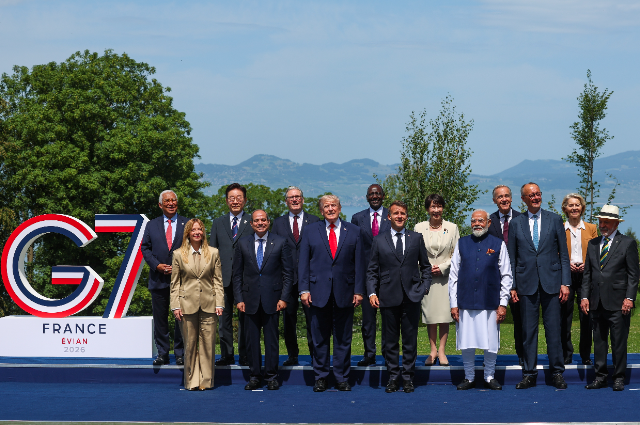
Each time the annual G7 summit convenes, there arises an issue in India regarding why India, being one of the biggest economies in the world and a major global power, is not a part of the G7.
This becomes all the more important due to the fact that the Prime Minister of India are often invited to the G7 summits as a guest member. India takes part in many deliberations, interacts with world leaders, and takes part in the discussion of various issues, including climate change, trade, artificial intelligence, and geopolitics.
The reason behind it can be understood with respect to the history and purpose of the G7.
A group created for the World's Richest Industrial Democracies
The G7 was created at a time when there was a lot of uncertainty in the world economy. In 1975, the leaders of France, West Germany, Italy, Japan, the United Kingdom, and the United States came together in a discussion on the economic issues of inflation, oil shocks, and low growth. A year later, Canada joined them to form the Group of Seven.
At that point, these six countries were some of the most economically influential industrialised nations in the world. They controlled world trade, financial markets, manufacturing processes, and institutions. The G7 was not created to be an organisation for the whole world; it operated like an unofficial forum for economically developed nations to coordinate themselves.
India at that time was a developing nation that played a minor role in world economics. China had not established itself as an economic superpower; several of today's powerful countries did not have that influence.
It was created according to the needs of the 1970s, not those of the twenty-first century.
Why the Membership List Rarely Changes
Another factor that contributes to India’s lack of inclusion in the G7 is the fact that this association has not developed any formal procedure for enlargement.
In contrast to international bodies like the United Nations or the European Union, the G7 has no constitution, nor does it have a system of admission or particular requirements for countries wishing to become members. The G7 is an informal body in terms of its functioning.
As there is no official procedure for enlargement, the inclusion of a new country is only possible if all members agree politically. Political consensus is hard to reach as each new country affects the balance of power within the organisation.
The only significant enlargement happened in the 1990s, when Russia joined the organisation and became a member of the G8. However, Russia’s membership was suspended in 2014 due to the Crimea crisis, and the organisation became the G7 again.
Since then, the membership list has not changed, while the world’s economic balance has dramatically shifted.
India's Rise Changed Global Calculations
There has been tremendous evolution in the world economy since the formation of the G7.
India has evolved from being a rather isolated economy to become one of the fastest-growing large economies in the world. India is currently one of the world's largest economies in terms of GDP, and one of the centres for Information Technology, pharmaceuticals, manufacturing, and digitisation.
India is also the world's largest population and consumer market. The rising influence of India through its economic progress, geopolitical position, and diplomatic power has made it an increasingly important player on the global stage.
With this rising influence, it has become impossible for global bodies to discuss their problems without the participation of India.
Whichever problem relates to climate change, energy transition, supply chains, food security, digitisation, and artificial intelligence, the role of India has become indispensable.
These developments have made it necessary to invite India to the discussions at G7 meetings even though it is not part of the G7 club.
Why G7 Countries Want India at the Table
The repeated invitations to India are not merely acts of diplomacy or kindness. Rather, it is a result of strategic calculation by G7 countries.
India is considered one of the major democracies and an important voice representing the Global South. India is seen as a nation that can convey the concerns of the developing nations to richer countries.
In addition, India's economic clout ensures that global moves need India's cooperation for success.
As an example, it is impossible to meet climate objectives without India's participation because of the high number of people and rising energy requirements in India. The negotiations about international trade and supply chains also involve India due to its rapidly growing manufacturing industry. Conversations regarding artificial intelligence and digital governance have become impossible without India's participation, as it is the home of a massive technological network. Furthermore, geopolitics has ensured that the significance of India has risen.
Most Western nations consider India a partner in ensuring stability in the Indo-Pacific region. Cooperation with India has emerged as an important objective for some of the G7 members due to growing strategic competition in Asia.
The Argument for Expanding the G7
It is widely believed that the G7 should, in due time, be broadened to include India.
Proponents of broadening claim that the present composition no longer represents the nature of global power in today’s conditions. The organisation was established almost half a century ago, and much has happened in the meantime.
The Indian economy is bigger than the economies of several present members of the G7. The population in India exceeds the sum total of populations of a number of developed nations. India has an important role to play in global technological innovations, global trade, global environmental diplomacy, and discussions on global security matters.
In this light, India’s non-participation looks increasingly out of place.
Some specialists have proposed that the G7 be turned into a more inclusive organisation, which will include India, Australia, South Korea, Brazil, and others. But this idea is very controversial.
Why Expansion Faces Resistance
However, while there are good reasons for India's inclusion, expanding the G7 would be politically problematic.
For one thing, there would be the danger that a large number of member states could diminish the effectiveness of the G7. The G7 was created because it was an opportunity to have an informal discussion between a limited number of leaders.
The countries could also feel that their influence would diminish within a bigger organisation. They already have a well-established pattern of relationships, which could change after an expansion.
It would be another problem to decide whom to include after India's admission.
Should India receive a seat at the table, then some of the countries like Brazil, Australia, South Korea, Indonesia, or South Africa would also have some claims.
Because of all these problems, although debates on reform are ongoing, nothing substantial has been achieved yet.
Does India Actually Need G7 Membership?
Indeed, there are numerous experts who believe that India may not require membership in the G7 as much as thought.
The G7continues to remain a powerful group; however, it is certainly not the sole group that impacts policies in the global arena. India is already well entrenched in groups like the G20, BRICS, the Quad, the UN, and other regional organisations.
In many ways, the G20 could be said to represent today’s world better because it comprises both developed and developing countries. India has been able to utilise forums like the G20 to further its foreign policy agenda.
Furthermore, as the G7 has no legal jurisdiction in its own right, membership alone does not necessarily translate into increased influence.
India will still be able to establish diplomatic ties and cooperation via bilateral meetings and summits even without joining the G7, while adhering to its traditional principle of strategic autonomy.
This way, India would be able to work with Western countries as well as others.
The Symbolism of Exclusion
Despite any tangible benefits not being seen, the very issue of membership holds a certain amount of symbolism.
International organisations can be indicative of overall power relations. Being a part of exclusive organisations means getting recognition, status, and influence.
India’s exclusion from the G7 points to the discrepancy between established international institutions and current realities. It is viewed by many as an indication that some parts of global governance have failed to adapt to shifts in power distributions.
On the other hand, India’s consistent involvement proves that one’s influence does not require formal membership in an organisation. India actively participates in all relevant negotiations and plays a role in making decisions concerning world politics. This situation presents a paradox. India is not a member of the club but takes part in all its crucial debates.
A Club Facing a New Global Reality
Discussion on India's position relative to the G7 represents one of the challenges of contemporary international institutions.
All post-World War Two institutions were tailored to the requirements of the world where there was a dominance of a relatively small number of Western states. The current international system is much more diverse, integrated and multipolar.
Nowadays, the emerging economies play an increasingly big role in global economic processes. These countries are necessary partners in addressing global issues.
With the further redistribution of global power, pressure on institutions to become more representative will only grow.
It is not known whether the G7 will eventually enlarge, nor whether it will follow its previous approach to including the significant non-members in its discussions.
It is evident, however, that a country like India has become too important to be ignored. India will be sitting at the high table even if it is not a member of the G7 anymore.
References
- G7 Information Centre. History and Evolution of the G7. University of Toronto. https://www.g7.utoronto.ca
- Government of Canada. What is the G7?https://www.international.gc.ca
- The Diplomat. Why Does the G7 Keep Inviting India to Its Summits? (2026).
- NDTV. Why India Has a Seat at the G7 Table Without Being a Member (2026).
- Asia Times. The G7 Needs India More Than India Needs the G7 (2026).
- Ministry of External Affairs, Government of India. India and G7 Engagements. https://www.mea.gov.in
- International Monetary Fund (IMF). World Economic Outlook Database. https://www.imf.org
- World Bank Data. GDP and Population Statistics. https://data.worldbank.org
- Encyclopaedia Britannica. Group of Seven (G7). https://www.britannica.com
- Council on Foreign Relations. The G7 and Global Governance. https://www.cfr.org
- OECD. Global Economic Governance and the Role of the G7. https://www.oecd.org
- United Nations. Multilateral Cooperation and Global Institutions. https://www.un.org