
For hundreds of years now, humans have gazed up into the heavens looking for answers. We have sent space missions to Mars, mapped far-off planets, taken pictures of black holes, and even placed robots on other worlds. But some of the most fascinating puzzles on this planet are right in front of us, under the sea.
The claim “We know Mars better than our own ocean” may seem outlandish on first consideration. This is because the ocean is around us, affects our weather systems, nourishes billions of people, and makes up more than 70 per cent of the Earth’s surface. Modern science, however, tells us that there are large parts of the ocean that are completely unknown, uncharted, and unexplored.
The Largest Unknown Place on Earth
When the term "uncharted territory" comes up, one would expect it to refer to distant planets or galaxies far from our reach. However, there exists an uncharted territory closer than one might imagine — right under us, on this planet.
While the vast majority of Earth is covered in water, surprisingly little is known about its bottom due to a lack of mapping. To be exact, according to experts, no more than a quarter of the world's seafloor has been mapped. The most interesting fact of all, though, is that the amount of direct observation of deep seafloor by humans is minuscule. Recent research estimates that we have visually explored less than 0.001 per cent of the deep ocean floor.
Consider owning a library of a million books but only ever reading five of them. This is essentially humanity's situation when it comes to the deep ocean.
Why Mars Seems Easier to Study
At first sight, it sounds odd that studying Mars should be simpler than observing the ocean.
Mars is located millions of kilometres away, while the ocean lies underfoot.
It is because of visibility and the development of technology. Space is huge; however, it is also almost completely transparent. Spacecrafts and telescopes allow monitoring planetary surfaces at a distance. Photos with high resolution will capture very large areas on Mars quickly.
Unlike space, water screens off light and signals, creating very severe conditions. Once researchers dive several hundred meters into the depths, they stop seeing the Sun altogether.
Further diving will cause immense pressure, breaking any regular equipment instantly.
To conduct research in the deep sea, specialists have to use special subs, ROVs, sensors, and expensive research ships. However, even then, they are able to explore only a small area per expedition.
A World of Darkness and Pressure
The oceanic deep is one of the most hostile places in the natural world.
Temperatures rarely rise above the freezing mark. Darkness reigns throughout its expanse.
Pressure may go higher than one thousand times the air pressure felt on Earth's surface.
Humans venturing into this environment without proper equipment would perish instantly. It's hardly surprising that exploration of the oceanic deep moves along so cautiously. All expeditions require meticulous preparation, cutting-edge technology, and plenty of money.
But despite all the difficulties, every expedition to the oceanic deep uncovers wonders of nature.
Researchers frequently come across unearthly life forms. Jellyfish emitting light, transparent fish, gigantic squid, vampire squid, and other mysterious creatures dwelling around hydrothermal vents are some examples.
Moreover, many animals identified by scientists exploring the oceanic deep were previously unseen. It is believed that there might be several hundred thousand or even millions of undiscovered marine organisms.
Hidden Mountains, Valleys, and Volcanoes
Most individuals picture the bottom of the ocean as being flat and dull in appearance.
However, this is far from being the case, since this bottom is highly varied.
Mountains, deep valleys, volcanoes, plains, and even cliffs populate the seabed, and some of these formations may actually surpass those located on the dry surface. The Mariana Trench, which is the deepest spot known in the oceans of Earth, is situated at a depth of approximately eleven kilometres.
Even if the peak of Mount Everest were placed inside it, it would not reach the surface, since it would be completely submerged. New underwater formations are continuously discovered by scientists each year, and most of them contain lifeforms not existing anywhere else in the world.
Many parts of the oceans are unknown and unmapped, and there are constant surprises for the experts studying this environment.
Life Where Life Should Not Exist
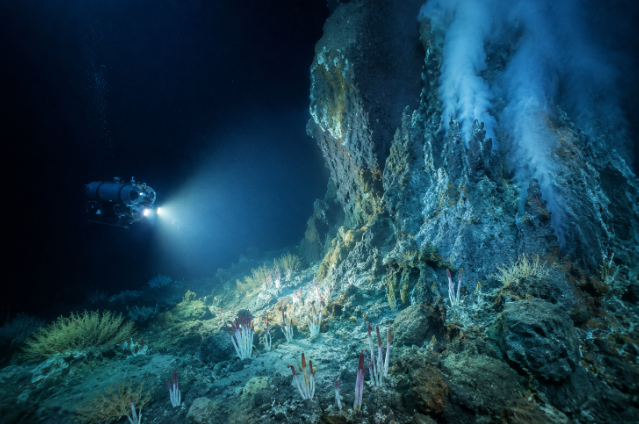
The most fascinating discovery in the study of oceans was made possible by hydrothermal vents.
Hydrothermal vents spew out heated water that is rich in minerals and has been heated by sources below the surface of the Earth’s crust. Water temperatures near hydrothermal vents reach as high as 350 degrees Celsius. It was believed by many researchers that such conditions could not harbour life.
But they were proven wrong.
Ecosystems flourish around the vents, including giant tube worms, peculiar crabs, shrimps, and various microorganisms living without any exposure to sunlight. The source of energy for most of these organisms comes from chemical processes.
The discovery of life around hydrothermal vents revolutionised the science of biology and posed some interesting questions regarding the origin of life on Earth. Some scientists think that such conditions exist on other celestial bodies like Europa and Enceladus.
The Ocean's Role in Keeping Earth Alive
The oceans are more than just a series of enigmatic ecosystems. Instead, the ocean serves as one of the world’s most vital lifeline systems.
The oceans absorb tremendous amounts of carbon dioxide emitted by human activities. The oceans also hold immense amounts of heat that would otherwise contribute further to global warming.
Ocean currents control climatic conditions, affect rainfall, and distribute heat throughout the globe. Ocean fisheries supply nourishment for billions of humans, as well as sustain countless other industries and businesses.
In scientific circles, the ocean is often referred to as Earth’s climate machine. Nevertheless, much remains to be known about this climate machine.
Insufficient understanding of ocean systems makes climate predictions extremely challenging.
The Search for New Medicines
Medicine is another factor highlighting the significance of the exploration of the deep seas.
It has been observed that many marine organisms create certain chemicals due to the difficult environment in which they live.
This chemical creation has helped create many medicines for the treatment of diseases, including cancer, pain, infections, and other diseases.
All ecosystems that have yet to be explored might include living organisms with completely unknown biological functions.
The organism that can be found at thousands of meters depth might very well be one that will solve many of the problems faced by humans in the future.
Threats Arriving Before Discovery
What is possibly the biggest irony about the exploration of the oceans is the way in which humans are already impacting places that we do not yet know much about.
The effects of climate change include warming of the oceans, changes in currents, and disturbances in the ecosystems of the oceans. Ocean plastics contaminate even the deepest parts of the ocean. Overfishing has become a problem for many marine species.
However, there has also been increasing interest in deep-sea mining. Companies want to mine the ocean floor for minerals such as those used in batteries.
There have been warnings that mining could harm ecosystems without giving scientists time to study them. Entire species may be lost before humans ever learn of their existence.
The Future of Ocean Exploration
Luckily for mankind, technology is progressing at a fast pace.
Robotics, autonomous underwater vehicles, artificial intelligence, and modern sonar technology are enabling us to explore the world around us more efficiently than ever.
International endeavours intend to map the whole of the ocean floor with extreme precision within the next few decades.
These discoveries could lead to the uncovering of species unknown to science, to climate studies, to better predictions in case of disasters, and many other areas.
Although there are many secrets yet to be unveiled by the ocean, humanity is slowly uncovering them through expeditions conducted around the globe.
It is easy to believe that all scientific exploration must take place on other planets.
Many explorations are happening right here on Earth, and the discoveries that we are making in our very own backyards might be just as surprising and groundbreaking as those made by scientists exploring space.
References
- NOAA Ocean Exploration – How Much of the Ocean Has Been Explored?
- NOAA Ocean Exploration – Why Ocean Exploration Matters
- NOAA Ocean Exploration – Ocean Exploration: Learning Runs Deep
- Nature (2025) – Guess How Much of the Ocean Floor Humans Have Explored
- Scientific American (2025) – We've Only Seen 0.001 Per cent of Earth's Seafloor
- The Guardian (2026) – The Secrets of the Deep Sea
- United Nations World Ocean Assessment Reporting (2026)