
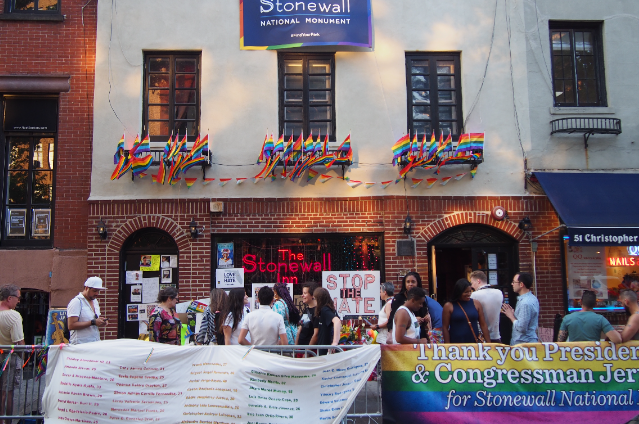
When people think of Pride Month today, they often picture rainbow flags fluttering above city streets, colourful parades stretching for blocks, and celebrations filled with music, dancing, and joy. What many don't picture is a dimly lit bar run by organised crime. Yet that is where one of the most significant moments in LGBTQ+ history began.
The Stonewall Inn in 1969 was not a place anyone would have described as glamorous. A basement space on Christopher Street in Greenwich Village, which was run without a liquor license by members of the Genovese crime family, specifically through a man named Tony Lauria. It operated with watered-down drinks sold at inflated prices to customers who had, in practice, very few other options. The arrangement worked because it was mutually convenient. The family collected the money while the police collected a regular payment from the family in exchange for leaving the bar alone. And gay people in New York, who faced arrest under city law for something as ordinary as dancing with someone of the same sex, paid whatever the bar charged because it was one of the only spaces in the city where they could exist openly, even if only for a few hours. That arrangement held until the night the police came without warning.
State law in New York at the time required people to wear at least three items of clothing matching their assigned sex at birth. Police could arrest someone for dancing with a person of the same gender. Bars that served gay patrons had lost their liquor licenses as a matter of routine enforcement, which is partly why so many operated outside the licensing system entirely. Raids on gay bars were regular enough that they had become almost procedural — the bar would be warned, the lights would go on, customers would straighten up, a few people might be arrested, and life would continue. Stonewall had that warning system in place, except on June 28th, it did not work.
Officers arrived just after midnight carrying a warrant. They went inside, and arrested thirteen people — employees, drag performers, and patrons in violation of the clothing statutes. What the officers did not account for was that the people watching from outside had watched this happen enough times that something had shifted. The crowd started throwing things: coins, then beer bottles, trash. Someone even assembled a bottle with lighter fluid. A group managed to pull a parking meter out of the sidewalk and swing it against the door. The officers, overwhelmed by the response and resistance, retreated into the bar and barricaded themselves inside.
The raid's commanding officer, Inspector Seymour Pine, acknowledged in a 2004 interview that he regretted his role in what happened that night. The NYPD issued a formal apology in 2019, fifty years after the fact. By the time of that apology, the six nights of unrest following the raid had already produced a significant shift in how gay rights organising worked in the United States. The Gay Liberation Front, the Gay Activists Alliance, and the Street Transvestite Action Revolutionaries — founded by Sylvia Rivera and Marsha P. Johnson — all emerged within a year. These were not abstract developments. They represented a change in what organised resistance looked like and where it came from.
Marsha P. Johnson was a 25-year-old Black transgender woman who arrived at the Stonewall around 2 AM on June 28th, after the raid had already begun. In a later interview, she recalled that the place was already on fire when she got there. Sylvia Rivera, a 17-year-old Puerto Rican trans woman, later addressed a myth that had circulated about her role that night. She clarified that she threw the second Molotov cocktail, not the first, and that accounts attributing the "first brick" to her had misrepresented what actually happened. What the two of them went on to do together — run STAR, which operated a shelter for homeless transgender youth in lower Manhattan — had a more lasting effect on trans life in New York than anything attributed to a single moment in a bar riot.
The people who were in the Stonewall that night were not the public-facing part of the gay community — they were the part that the more established advocacy circles preferred not to lead with. Drag queens, transgender people, butch lesbians, sex workers, young people with no fixed address. A large number of them were people of color and another large number were living without financial stability. The organised gay rights community that existed in 1969 had its own sense of who was acceptable to be visible with, and these were not those people. The fact that the first sustained push-back against police harassment of gay venues came from this group, in that bar, on that night, is something the cleaner versions of the story sometimes pass over quickly.
A year after the raid, thousands of people walked from the Stonewall Inn to Central Park in the Christopher Street Liberation Day March on June 28, 1970. Chicago organised what is now recognised as the first gay pride parade in the United States, on June 27, one day earlier. San Francisco and Los Angeles held their own marches on the same day as New York. These were not the kind of events that Pride parades became decades later. They were demonstrations. The official chant used in New York was: "Say it loud, gay is proud." There were no corporate sponsors — no branded floats.
The organising behind that first march came largely from a bisexual activist named Brenda Howard. Howard worked alongside Robert A. Martin and L. Craig Schoonmaker to plan the event and is credited in LGBTQ+ historical records with originating the idea of expanding it into a week-long series of events — the structure that became the template for annual Pride observances around the world. The three of them are also credited with establishing the word "Pride" as the name for these commemorations, rather than "liberation" or "power," which were the terms in wider use at the time. Howard is sometimes called the Mother of Pride. She is also someone who gets left out of most popular retellings, which tend to move from the 1969 riot to the rainbow flag without pausing on the person who built the annual event between those two things.
Today, the rainbow flag is instantly recognisable around the world. Yet the version most people know is not the one created by artist Gilbert Baker in 1978 for the San Francisco Gay Freedom Day Parade. His original design had eight stripes with specific meanings assigned to each colour: hot pink represented sex, red represented life, orange was healing, yellow was sunlight, green was nature, turquoise was art, indigo was harmony, and violet was spirit. The six-stripe version that became standard came about through two separate production problems, not through any decision to revise the design's symbolism.
Hot pink was dropped first. Harvey Milk was shot and killed in November 1978, and in the period immediately following his death, demand for the flag increased sharply. The fabric used for the hot pink stripe was not manufactured in large enough quantities to meet that demand, so it was removed from subsequent production runs. Turquoise was removed afterwards because a flag with an even number of stripes can be divided cleanly along the centre — three stripes on each side of a street, for instance, when hung across a parade route. Before Baker's flag, the symbol the community had used most widely was the pink triangle, originally taken from the badge that gay men were forced to wear in Nazi concentration camps and reclaimed as a symbol of resistance. The community eventually moved toward something that was not defined by that history, which is where Baker's design came in.
June was not designated as Pride Month in the United States until 1999 and 2000, when President Bill Clinton issued proclamations establishing it. That was three decades after Stonewall. In the years between, federal policy toward gay and lesbian people moved through open legal hostility, extended indifference, and — during the AIDS crisis in the 1980s — what many survivors and activists described as a calculated failure to respond to an epidemic that was killing gay men in large numbers. Clinton's designation came with all of that context attached.
The argument about what Pride has become — and whether it has drifted too far from the protest that started it — is a conversation the community has been having in various forms since at least the 1980s. A number of the people who were involved in the original Stonewall uprising have been among the clearest critics of corporate Pride, specifically, the version of it where companies put rainbow branding on their products in June while also donating money to politicians who vote against LGBTQ+ protections during the rest of the year. That is not a theoretical complaint. It is a documented pattern, and it goes to the core of a tension between Pride as a commercial event and Pride as a continuing political project.
Sylvia Rivera, in the years after Stonewall, repeatedly called out the mainstream gay rights movement for taking the language of the uprising and using it to build a movement that was comfortable for some — white, middle-class, cisgender gay men — while leaving behind the people who had been at the Stonewall that night. She made that argument publicly, at rallies, until she died in 2002. At a 2001 rally, she told the crowd: "We are still fighting for the same rights" — basic housing, employment protections, legal recognition for transgender people. Rights that were still not secured in most of the United States, more than thirty years after the night a 17-year-old with nothing to her name decided she was not going home until something changed.
References:
- HISTORY — The Stonewall Riots (What Happened at the 1969 Uprising): https://www.history.com
- HISTORY — Stonewall Riots Timeline: https://www.history.com
- HISTORY — Why the Rainbow Became the Symbol of Gay Pride: https://www.history.com
- Smithsonian Institution — Marsha Johnson, Sylvia Rivera, and the History of Pride Month: https://www.si.edu
- National Women's History Museum — Marsha P. Johnson Biography: https://www.womenshistory.org
- Penn State — The Unsung Heroines of Stonewall: Marsha P. Johnson and Sylvia Rivera: https://sites.psu.edu
- The Advocate — What Happened at the Stonewall Inn in 1969: https://www.advocate.com
- Westport Library — Sylvia Rivera: Biography and Activism: https://westportlibrary.libguides.com
- Smithsonian Magazine — The Woman Who Invented Pride (Brenda Howard): https://www.smithsonianmag.com
- Fox News / AP — NYPD Stonewall Inn Raid Apology: https://noticias.foxnews.com
- The Guardian — Stonewall Riots 50th Anniversary: Key Figures: https://www.theguardian.com