
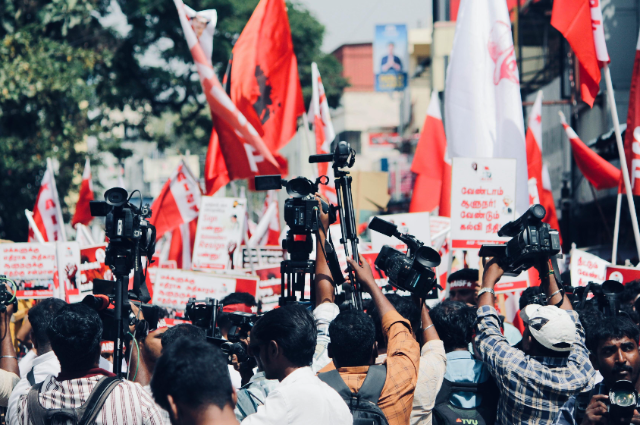
On April 30, 2026, Reporters Without Borders (RSF) released the 2026 World Press Freedom Index — its annual ranking of 180 countries based on how safe and free journalism actually is in each place. India came in at 157. That is six places lower than last year's rank of 151. In 2024, it was 159. So if anyone in the government is using the 2024 comparison to say things are improving, they should look at 2025 again, because the progress went backwards.
Reporters Without Borders put India clearly in the "very serious" category. That is the worst band on their scale. Not difficult. Not problematic. Very serious. And this was not just a bad year for India — the entire global picture has worsened, with RSF noting that the average score across all 180 countries is the lowest it has ever been in 25 years of publishing this index. But India is not just sitting somewhere in the middle of a global decline. It is sitting at 157 out of 180.
Let us talk about the neighbours for a moment, because the regional picture is worth sitting with. Nepal is at 87 on the same index — far into the "satisfactory" zone. Sri Lanka, which went through an economic collapse just a few years ago, still managed to place at 134. Bangladesh, despite its own political difficulties, is at 152. Even Pakistan, which rarely gets praise for democratic institutions, came in at 153, slightly ahead of India. China was behind India at 178, but then China is also an authoritarian state that has never pretended otherwise. India calls itself the world's largest democracy. That distinction should mean something.
The government will call this report biased. In fact, it has been dismissing RSF rankings for years as misinformed, propaganda-driven, and unscientific. That is a familiar response. The thing is, when you dismiss every international press freedom assessment that gives you a bad score, at some point you have to ask — are all these organisations wrong, or is something actually happening that they are consistently measuring and we are consistently not acknowledging?
RSF highlighted three specific problems with India in this year's report. The first is the economic dependence of the media on government advertising. Since most Indian media outlets run primarily on ad revenue, and the government — both central and state — is one of the biggest advertisers in the country, outlets have a financial reason to keep their coverage government-friendly. RSF noted that under Narendra Modi, billions of dollars of public funds have been directed toward advertising, which is, in effect, a way of shaping what gets reported and how.
The second problem is media ownership. Indian media is concentrated in the hands of a small number of owners, many of them with business interests that make confrontational political reporting inconvenient. The third, which the report raised directly, is the diversity problem: journalism in India, especially in senior positions, remains dominated by Hindu men from upper castes. RSF found that women make up less than 15 per cent of guests on major evening talk shows. That is not a minor editorial quirk. It is a structural blind spot that shapes what stories get told and whose experiences get covered.
The sharpest decline in the 2026 index globally was in the legal indicator — the measure of how laws and courts are being used in relation to journalism. RSF found that the legal indicator deteriorated in more than 60 per cent of countries, with governments increasingly using national security laws, anti-terrorism statutes, and what they call SLAPPs — strategic lawsuits against public participation — to silence reporters. India was specifically named alongside Egypt, Israel, and Georgia as countries where this decline was notable. For the first time in the index's history, more than half of all 180 countries — 52.2 per cent — fell into the "difficult" or "very serious" categories.
These rankings do not come from nowhere. They are built on documented cases. And India has accumulated a fairly long list of those over the past several years.
Siddique Kappan was arrested in 2020 on his way to Hathras and held for over two years under the Unlawful Activities Prevention Act before the Supreme Court eventually granted him bail. Prabir Purkayastha, editor of NewsClick, was arrested in 2023 in wide-ranging UAPA raids and was only released in 2024 after Supreme Court intervention. Mohammed Zubair, co-founder of fact-checking outlet Alt News, was jailed in 2022 over a tweet and spent weeks in custody before courts stepped in. These are not isolated incidents — they follow a pattern of using broadly worded security and sedition laws against journalists whose reporting is inconvenient for those in power.
In 2023, according to a report cited by the Deccan Herald, five journalists were killed, and 226 were targeted across the country. In early 2025, two journalists — Mukesh Chandrakar in January and Raghvendra Bajpai in March — were murdered, reportedly in retaliation for their reporting on local corruption. Neither of these was a senior journalist at national outlets. They were working at the local and digital level, which is where the most dangerous reporting in India happens and where protection is thinnest.
During the Operation Sindoor period in 2025, at least 125 people were detained for social media posts deemed "anti-national" or critical of the government's military framing. Kashmiri freelance journalist Hilal Mir was among those detained. The Committee to Protect Journalists recorded two journalists as imprisoned in India as of December 2025. That number sounds small until you look at the broader atmosphere of self-censorship it represents, which is harder to count but probably much larger.
The government's response to all of this — to the RSF ranking, to the individual cases, to the pattern of journalists being arrested under terror laws for their reporting — has been largely silence or deflection. Ministers attend inaugurations. They cut ribbons. They post about India's global rise. When it comes to answering why a reporter was detained for covering a protest, or how a journalist was murdered in a small town without serious follow-through on the case, the silence tends to hold.
RSF noted in this year's report that "legal frameworks are increasingly being weaponised to silence newsrooms" — and India is not an exception to that global trend; it is named as a primary example of it. When the sharpest global decline in the index is in the legal category, and your country is specifically cited in that context, dismissing the ranking as biased is not a counter-argument. It is an avoidance.
Norway has topped this index for the tenth consecutive year. Eritrea is at the bottom for the third straight year. India is at 157 — behind its neighbours, behind countries with far weaker democratic traditions, and still falling. At some point, the number needs a proper answer, and "the methodology is flawed" is not it.
India has journalists. Some of them are doing extraordinary work — going undercover into trafficking networks, covering floods in remote districts, fact-checking claims that larger outlets let pass. That journalism still exists, and it matters. What the 157 ranking tells you is what kind of environment they are doing it in and how much risk they are carrying to do it. That is what needs to change. And it is not changing on its own.
References:
- Reporters Without Borders — World Press Freedom Index 2026: https://rsf.org
- The Wire — India is 157th in the 2026 World Press Freedom Index: https://m.thewire.in
- The News Minute — India Slips to 157 in World Press Freedom Index 2026: https://www.thenewsminute.com
- Free Press Journal — Press Freedom Index 2026: India Drops to 157: https://www.freepressjournal.in
- Drishti IAS — World Press Freedom Index 2026 Analysis: https://www.drishtiias.com
- GK Today — India Ranks 157th in Press Freedom Index: https://www.gktoday.in
- Once in a Blue Moon Academia — Press Freedom in India: A Declining Trajectory: https://onceinabluemoon2021.in
- Committee to Protect Journalists — Journalist Jailings Report 2026: https://cpj.org
- Freedom House — India: Freedom on the Net 2025: https://freedomhouse.org
- Deccan Herald — Press Freedom in India: 5 Journalists Killed, 226 Targeted in 2023: https://www.deccanherald.com
- Counter Currents — Press Under Pressure: India Slips Further in Global Freedom Index: https://countercurrents.org