
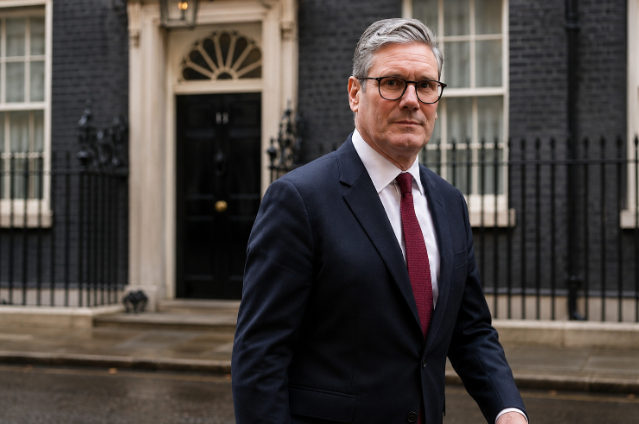
On the morning of May 11, 2026, Sky News reported that at least 70 Labour MPs were demanding Keir Starmer's resignation. By that evening, the figure had moved to 77. Within days, it passed 80, then climbed past 95 by the third week of May. None of this happened quietly. Labour had just lost control of more than 30 councils across England and roughly 1,300 to 1,500 councillors in one week of local elections, while in Wales, the party's First Minister, Eluned Morgan, lost her own seat in the Senedd. Reform UK picked up more than 1,200 council seats on the same night. Nigel Farage posted that betrayed voters had left Labour for good. Whether or not that turns out to be true, a significant number of Labour's own MPs appear to agree with the underlying premise.
Under Labour's internal rules, a formal leadership challenge requires 81 signatures — one fifth of the parliamentary party — nominating a specific rival candidate. As of mid-May, the rebels did not yet have a candidate, only a demand. That distinction matters more than it sounds. Wanting Starmer gone and being organised enough to remove him are two different problems, and the second one has been the harder one to solve. Several names have circulated as potential successors — Andy Burnham, Wes Streeting, Angela Rayner, Shabana Mahmood, David Lammy, Ed Miliband — but as of the crisis's early weeks, none had stepped forward to formally challenge.
Starmer's own response has been to refuse, repeatedly and in public. "I am not running away from the challenge, nor am I going to change course because the political weather has turned," he told the Parliamentary Labour Party after the local election results came in. In a separate statement to Cabinet, he was blunter about what he saw the rebellion costing the country: "The past 48 hours have been destabilising for government, and that has a real economic cost for our country and for families." He has also reportedly told colleagues he has "won every fight I've ever been in," which is the kind of line that either steadies a room or makes the people already plotting against you more convinced you don't understand the scale of what's happening.
The resignations started almost immediately and did not stop at backbenchers. Wes Streeting, who was Health Secretary at the time, resigned and wrote in his letter to Starmer that "it is now clear that you will not lead the Labour Party into the next general election, and that Labour MPs and Labour unions want the debate about what comes next to be a battle of ideas, not of personalities or petty factionalism." Miatta Fahnbulleh, a junior minister in housing and communities, resigned the day after Starmer's rally-the-troops speech and told him directly that "the public does not believe that you can lead this change — and nor do I." Four parliamentary private secretaries quit the same week. By the time the dust from that first wave settled, Home Secretary Shabana Mahmood — one of the more senior figures in Cabinet — had also reportedly urged Starmer to set out a timetable for his own departure.
Jess Phillips, the safeguarding minister, resigned with a line that landed harder than most: "I'm not sure we are grasping this rare opportunity with the gusto that's needed, and I cannot keep waiting around for a crisis to push for faster progress." That is not a resignation letter built around a single policy dispute. It reads like someone who had simply stopped believing the leadership had a plan, and decided that staying inside the tent wasn't helping anyone, including herself.
The roots of the rebellion go back further than the local elections. Starmer's polling had been sliding steadily since the 2024 landslide, hit hard by what critics called austerity-adjacent budget choices, by the resurfacing of the Pakistani grooming gang scandal and accusations of inconsistent policing of speech and protest that opponents branded "two-tier justice," and by the government's decision to proscribe the pro-Palestinian group Palestine Action as a terrorist organisation, which cost Starmer real support on Labour's left at the same time the right was attacking him over immigration. He had managed to be unpopular from more or less every direction simultaneously, which is a difficult position to hold for very long in any party.
A YouGov poll of 4,904 UK adults, published the same week the 70-MP threshold was crossed, found that half of Britons wanted Starmer to step down, against 29% who wanted him to stay. Analysts at Eurasia Group, reviewing his attempted comeback speech, were not impressed either: "Starmer's attempt to quell a rebellion against his leadership has failed. Although he may remain a few more months in Downing Street, he is still fighting for his political life." The speech had been billed internally as the moment Starmer would reset the conversation. By most accounts inside the party, it didn't.
Markets noticed before most voters did. UK 10-year and 30-year borrowing costs rose to 5% and 5.67% respectively, the day after the local election results came in, and the pound slipped against both the dollar and the euro. Deutsche Bank strategists flagged the concern explicitly: a new Labour leader, whoever it turned out to be, might come under pressure to loosen the fiscal rules Starmer and Chancellor Rachel Reeves had been defending, which would mean more borrowing at a moment investors were already nervous about UK debt. Political instability and bond markets rarely mix well, and the markets were pricing that risk in the days before anyone in Westminster had settled on a name to replace him.
Not everyone at the party wanted him gone. By May 12, 103 Labour MPs had signed a letter of support for Starmer, a number The Guardian later reported had grown past 110. Deputy Prime Minister David Lammy dismissed the rebellion's organisational strength bluntly, telling colleagues that "no one seems to have the names to stand up" against Starmer, and urging the party to "take a breath." Chancellor Rachel Reeves rallied behind him too, emphasising his electoral mandate. The party, in other words, was not unified against him — it was roughly split, with the loyalist camp arguing that a leadership contest mid-crisis would do more damage than Starmer's own unpopularity already had.
Work and Pensions Select Committee chair Debbie Abrahams offered one of the more measured rebel positions, telling Sky News that the Prime Minister should "set out a transition" and "step down in the autumn" — not an immediate ouster, but an orderly exit on a defined clock. Backbencher Sarah Smith put it more starkly: "I have regretfully concluded that he is unable to lead us into future elections. I urge the Prime Minister to set out a timetable for an orderly transition by the end of 2026." Alex Sobel pointed to the appointment and subsequent resignation of Peter Mandelson as a specific turning point that had exposed, in his words, deeper concerns about Starmer's leadership and judgment beyond the election results themselves.
The crisis did not resolve itself by staying still. In June 2026, a separate fight broke out over the government's planned defence spending, and it cost Starmer his Defence Secretary. John Healey resigned, followed by junior minister Al Carns and a ministerial aide, Pamela Nash. Healey's departure was described across UK outlets as both shocking and sudden — a sitting Defence Secretary leaving a government already on its knees from a different fight entirely. Whatever specific disagreement triggered that particular resignation, the timing made clear that the original local-election rebellion had not simply faded once the news cycle moved on. It had become the background condition under which the government was now operating.
Scottish Labour leader Anas Sarwar's position became its own subplot. According to LabourList's tracking, Sarwar told Starmer directly that the two had "disagreed" on whether resignation was necessary, a disagreement that caused friction inside Scottish Labour itself — Monica Lennon backed Sarwar's position, while former Scottish Secretary Ian Murray called the intervention a threat to party stability. The SNP's John Swinney and Reform-adjacent figures in Holyrood characterised the entire episode, somewhat predictably, as Labour's "meltdown," which is the kind of line opposition politicians say regardless of whether it's true, though in this particular case, the polling and the council results were doing most of the work for them already.
Labour has never actually deposed a sitting Prime Minister through an internal contest — when Tony Blair stepped down in 2007, it was his own choice, and Gordon Brown succeeded him unopposed. There is no precedent inside the party for what a contested, forced removal of a sitting PM would actually look like procedurally, which is part of why the rebels have moved cautiously, even with the numbers they have. Comparisons to the Conservative Party's recent history of replacing leaders mid-term — four prime ministers in roughly a decade — have been raised by Starmer's own allies as a warning rather than a model, on the theory that voters punish parties that look chaotic more than they reward parties that act decisively against an unpopular leader.
Whether Starmer survives the year is, as of this writing, genuinely uncertain. Betting markets tracking his tenure have swung sharply with each new resignation and each new MP signature, at one point pricing the probability of a June exit as low as 2% before a fresh wave of departures pushed the numbers back up. He does not have 81 signatures against him yet. He also does not have the kind of settled, confident parliamentary party that prime ministers usually need to govern past a crisis like this one. The 70 MPs who first crossed that threshold in mid-May were not, in the end, the peak. They were the number that made the next ninety possible.
References:
- RT News — At Least 70 Labour MPs Demand Keir Starmer's Resignation After Crushing Election Losses (May 11, 2026): https://www.rt.com
- CNN — UK Leader Starmer Fights to Save Premiership as Scores of Labour Lawmakers Urge Him to Resign (May 11, 2026): https://www.cnn.com
- NBC News — Britain's Starmer Refuses to Quit as PM, Challenges Labour Party Rebels to Oust Him (May 13, 2026): https://www.nbcnews.com
- CNBC — UK MPs Are Turning on PM Starmer, Now Analysts Say He's Unlikely to Last the Year (May 12, 2026): https://www.cnbc.com
- LabourList — Which Labour MPs Are Calling for Starmer to Go, and Who Is Still Backing the PM (Resignation Tracker): https://labourlist.org
- Wikipedia — 2026 United Kingdom Government Crisis: https://en.wikipedia.org
- Polymarket — Starmer Out By...? Predictions and Odds 2026: https://polymarket.com