
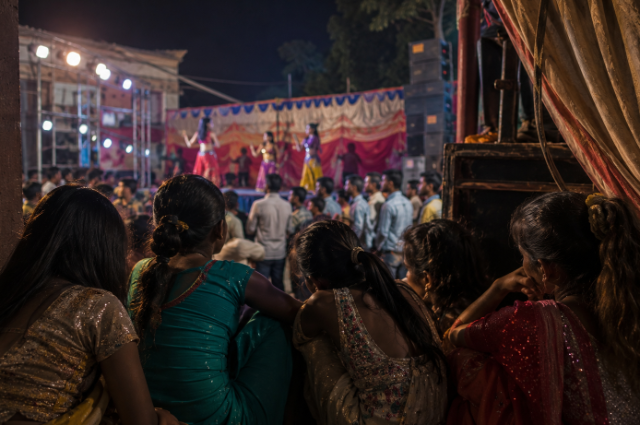
Loud Bhojpuri music. A temporary stage. Men standing in rows, some with drinks, watching. Under the lights, a girl who could be twelve or thirteen is dancing. This is a wedding in the Siwan district. No one in the crowd is doing anything wrong, technically. Nobody is going to call anyone. This is just what these parties look like now.
Bihar's orchestra groups have never been secret. They take bookings. They have rates. They show up at weddings and pujas across the state's districts. What they do to the girls inside those groups — that part stayed quiet for a long time. Child-rights workers and local journalists had been raising it since at least 2023. But it took Mahima Singh, a reporter with Dainik Bhaskar, to go in herself to see how bad the situation was.
In May 2026, Singh spent five straight days undercover inside orchestra networks in Siwan. She posed as a dancer. In those five days, she was beaten. Guns were pointed at her. She was transferred between three different handlers — not introduced to them, not negotiated over, just moved. Each time she changed hands, she understood a little more about how this pipeline runs. Who finds the girls, who transports them, who assigns them to shows, and who collects the payments?
Her editor at Dainik Bhaskar, Manish Mishra, talked about her work on World Press Freedom Day, May 3, 2026. He said it was the kind of thing most journalists would not try in their whole career. That is fair. But what she came back with was not just a personal story. She named the structure — brokers, agents, local officials reportedly being paid to ignore what was happening, medical workers who, in some accounts, helped conceal injury marks. This was a working system. Different people, different roles, same outcome.
The girls inside these troupes had injuries on their bodies. Singh's reporting documented rape as routine. Some girls had become pregnant. Activists following the case alleged that children born to some of the trapped girls were also trafficked — those claims have not yet been confirmed by courts. When the story went public, Siwan police moved fast. Twenty-one girls were freed. Two operators were arrested. The youngest girl was reportedly ten years old.
The recruitment process is simple. Traffickers go to poor areas like West Bengal, Jharkhand, Odisha, Assam, Uttar Pradesh, sometimes across the Nepal border — and make offers. Film work. Dance training. A stable income. Some present themselves as marriage prospects, build trust with the family over weeks, then take the girl. Once she reaches Bihar, none of what was promised exists. No film. No salary worth speaking of. Locked rooms.
According to data from Just Rights for Children (JRC), girls as young as twelve have been sold into these orchestra networks for ₹10,000. Not a figure that gets rounded. Ten thousand rupees is reportedly what some of these transactions actually cost. The families in source states were sometimes deceived fully. Sometimes they were desperate enough not to ask too many questions. Either way, the girl ends up in the same place.
Inside the Siwan-Saran wedding belt, this has been going on long enough that seeing very young girls in orchestra troupes stopped feeling unusual. It became part of the background. A 13-year-old from Siwan who had become locally well-known from these shows told a YouTuber on camera that she danced out of majboori — compulsion — not choice. That video was public. She said it in front of a camera. It still took years of raids and one undercover investigation before real coordinated action came.
Between shows, the girls are kept in locked rooms. No documents. No phone in most cases. If operators get word of a raid coming, some push girls out through back exits or load them into vehicles. The girls are aware of what they are in this system. That awareness does not give them any power to leave.
Police were not absent before Singh's investigation. In May 2025, following a directive from the National Commission for Protection of Child Rights to the Saran Superintendent of Police, raids at several locations in the district recovered 17 minor girls. Eight from West Bengal. Four from Odisha. Two from Jharkhand. Two from Delhi. One from Bihar. Five operators were detained.
Operation Naya Savera in August 2025 freed ten more girls from four groups in Saran in one morning. Then, February 2026 brought a midnight operation — Bihar Police's Anti-Human Trafficking Unit with two NGOs, Association for Voluntary Action and Narayani Seva Sansthan — hitting six orchestra camps inside a ten-kilometre area in Saran. Fifteen girls were rescued. Most had visible injuries. One operator put three girls in a car and drove. Police followed for eight kilometres.
In Gopalganj's Kuchaykot block, police freed over forty children and arrested twenty-two people. FIRs were filed under the POCSO Act, the Juvenile Justice Act, the Bharatiya Nyaya Sanhita, and the Bonded Labour System Abolition Act. Between January and June of 2025, 271 girls were rescued across Bihar — 53 of them were pulled directly from orchestra groups, and 162 of them were from Saran district alone.
Six months. 271 girls. And that count only includes what got officially recorded. Anti-trafficking workers say a large number of cases never enter any formal register at all. After each operation, the same networks found ways to keep running. Different names. Different districts. Same structure underneath.
Arrests happen regularly. Convictions almost do not. Nationally, around 10 percent of human trafficking suspects are ever convicted, according to National Crime Records Bureau data. In Bihar, researchers tracking these cases use the word "abysmally" when describing the conviction rate there. One of the clearer explanations for why is how cases get filed.
A trafficking case filed correctly under anti-trafficking laws has to be treated in a specific way. It carries heavier consequences and is harder to argue down. But many of these cases get registered as kidnapping or as a missing person report instead. Once that happens, the legal route becomes narrower, and prosecutors end up working with the wrong framework from the start. Nobody changed it. The paperwork just went the easy way.
Anti-Human Trafficking Units in Bihar also operate understaffed across large areas. Cases build up. Victims get moved or scared into silence. Evidence that was strong at the time of arrest becomes harder to use by the time a matter actually reaches court.
The Patna High Court has said that the use of children in orchestras is a serious issue, and the court has told the government of Bihar to make a plan for the whole state. In May 2026, the Supreme Court was examining a bail matter from the Bettiah orchestra trafficking case — eleven people were accused of crimes under the Protection of Children from Sexual Violence (POCSO) Act, the Juvenile Justice Act, the Bonded Labour Abolition Act, and the Immoral Traffic Prevention Act. The Supreme Court cancelled a High Court bail order. Courts are watching. That is real. But watching from a court and convicting in one are separate things.
Manish Sharma from the Association for Voluntary Action said after the February 2026 raids that these groups need to be treated as an organised criminal network, not handled one camp at a time. Ravi Kant of Just Rights for Children has made the same point. The movement of girls across state lines, the brokers, the money flows — these require the kind of cross-district investigation that rarely happens when each raid gets treated as its own closed matter.
Singh's investigation moved things faster than years of previous reporting had managed. The NCPCR's Anti-Trafficking Cell has freed 964 children since it started operating. Those are real rescues. But people working on this issue are consistent about one thing — that number reflects a fraction of how many girls are inside these systems at any given time, and the real figure is probably impossible to know accurately because most cases do not surface.
The same set of things keeps coming up when organisations are asked what would actually change this: orchestra groups need mandatory registration and regular inspection. Anti-Human Trafficking Units need to be properly funded and able to work across state borders, not just respond to local tip-offs when they have capacity. POCSO cases need to move through courts faster than they currently do. And in source states — West Bengal, Jharkhand, Odisha — communities need real, specific information about what these recruitment offers mean, so the same approach stops working on the same families.
None of that is consistently happening yet.
The wedding season continues across Bihar. Orchestra bookings are active. Some of those groups have minor girls performing tonight. Some of those girls were brought from other states and told it was legitimate work. Some are sleeping in a locked room right now. The operators running those groups are not particularly nervous. The conviction numbers give them reasonable cause not to be.
Singh took a serious personal risk and produced something that could not be dismissed. Twenty-one girls were freed in Siwan. Fifteen in Saran. More than forty in Gopalganj. Those are real children in different circumstances now. But the question sitting underneath all of it — whether what follows is sustained or just another rotation — that one does not have an answer yet. Raids. Rescues. Reopen. The pattern has repeated enough times that the people inside these networks have reason to think it will again.
References
- Bhadas4Media — Mahima Singh Undercover Investigation, Dainik Bhaskar (May 2026): https://www.bhadas4media.com
- Hindupost — Midnight Crackdown in Saran: 15 Minor Girls Rescued from 6 Orchestra Groups (February 2026): https://hindupost.in
- The Tribune — 17 Minor Girls Rescued from Orchestra Groups in Saran, Bihar (May 2025): https://www.tribuneindia.com
- The Commune — Operation Naya Savera: 10 Minor Girls Rescued from Bihar's Saran (August 2025): https://thecommunemag.com
- ThePrint — Midnight Raid Lays Bare Lives of Bihar's Underage Dancing Girls (February 2025): https://theprint.in
- Universal Institutions — Combating Child Trafficking in Bihar's Orchestra Groups (July 2025): https://universalinstitutions.com
- Devdiscourse — NCPCR Anti-Trafficking Cell: Saran Operation Report (May 2025): https://www.devdiscourse.com
- BiharWatch — Supreme Court Sets Aside Patna HC Bail Order in Bettiah Orchestra POCSO Case (May 2026): https://www.biharwatch.in
- IndiaDataMap — Human Trafficking in India: 2025 State Rankings and Data: https://indiadatamap.com
- US State Department — Trafficking in Persons Report 2023: India Country Narrative: https://www.state.gov
- SPRF — Shadows in the Margins: Trafficking Among India's Vulnerable Communities: https://sprf.in