
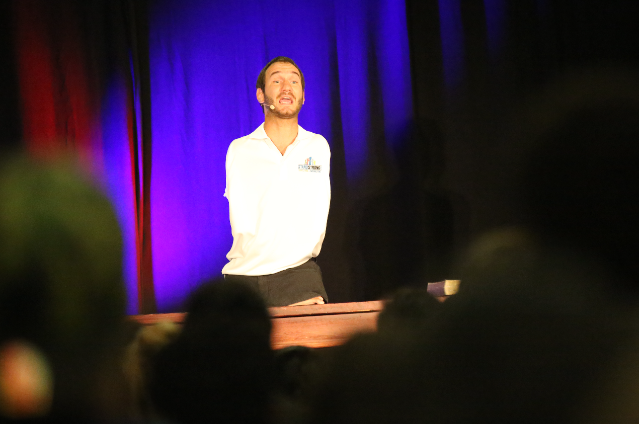
In every generation, a few extraordinary individuals challenge society’s assumptions about what human beings can achieve. Their lives remind us that success is not determined by physical perfection, wealth, or favourable circumstances, but by courage, faith, and an unwavering belief in purpose. Among the most remarkable examples of such resilience is Nick Vujicic, a man born without arms and legs who transformed his deepest struggles into a message of hope that has inspired millions across the world.
Nick’s life is not a fictional narrative designed to motivate readers. It is a thoroughly documented real story, grounded in verifiable facts and lived experience. His journey includes a rare medical condition, severe emotional pain, a childhood suicide attempt, educational achievement, global humanitarian work, and the creation of one of the most powerful motivational movements of modern times.
Early Life and Birth Condition-
Nicholas James Vujicic was born on December 4, 1982, in Melbourne, Australia, to Serbian immigrant parents. His father was a pastor, and his mother was a nurse. At birth, doctors discovered that he had tetra-amelia syndrome, a rare congenital disorder in which all four limbs fail to develop.
The diagnosis shocked his family. His parents were overwhelmed by fear and uncertainty, but they refused to believe that their son’s life had no purpose. Their faith and unconditional love became the foundation upon which Nick built his future.
Childhood Struggles and Bullying-
Nick’s early years were filled with emotional and practical challenges. He depended on others for many everyday tasks and soon realised that he was different from other children. At school, he was often stared at, mocked, and bullied.
Watching his classmates run and play made him feel isolated and inadequate. He began to question why he had been born this way and whether his life could ever have meaning.
Depression and Suicide Attempt-
By the age of ten, Nick had fallen into deep depression. He believed he would never become independent, never find love, and never achieve anything meaningful. In his despair, he attempted to drown himself in a bathtub.
At the final moment, he imagined the grief his parents would suffer if he died. That thought stopped him. This painful experience became the turning point that eventually led him to discover hope and purpose.
Learning Independence-
Nick refused to accept helplessness. Using a small foot with two toes, he taught himself to write, type, brush his teeth, use a computer, and perform many daily tasks independently.
Each new skill strengthened his confidence. These accomplishments proved that limitations could be overcome through creativity, persistence, and determination.
Education and Academic Success-
Education played a vital role in Nick’s transformation. Despite discrimination and self-doubt, he remained committed to his studies. He later graduated from Griffith University with a Bachelor of Commerce degree specialising in accountancy and financial planning.
This achievement symbolised far more than academic success. It demonstrated that physical challenges do not prevent intellectual growth or professional accomplishment.
Discovering His Purpose-
As a teenager, Nick began sharing his experiences with small groups. At seventeen, he delivered his first motivational speech. Audience members were deeply moved and told him that his story had changed their lives.
For the first time, Nick realised that his suffering could become a source of hope for others. What once seemed like a curse became his life’s mission.
Founding Life Without Limbs-
In 2005, Nick established Life Without Limbs, a nonprofit organisation dedicated to helping people facing physical, emotional, and spiritual challenges.
Through this organisation, he travelled around the world speaking in schools, prisons, churches, and conferences. His message focused on overcoming fear, depression, bullying, and hopelessness.
Books and Media Influence-
Nick expanded his impact through books and films. His bestselling book Life Without Limits inspired readers worldwide. He also authored Unstoppable, Stand Strong, and Love Without Limits.
In 2009, he starred in the short film The Butterfly Circus, portraying a man who discovers dignity and purpose despite severe disability.
Marriage and Family Life-
One of Nick’s childhood fears was that no one would ever love him. In 2012, he married Kanae Miyahara, and together they built a loving family with four children.
Marriage and fatherhood became living proof that his disability would not prevent him from experiencing a full and meaningful life.
Psychological Significance-
Nick’s life reflects the key principles of resilience identified by psychologists: supportive relationships, a strong sense of purpose, positive thinking, skill development, and service to others.
His journey demonstrates that emotional strength often matters more than physical ability.
Social Impact and Global Influence-
Nick has spoken to millions of people in numerous countries. His story raises awareness about disability inclusion, mental health, suicide prevention, and human dignity.
Students, parents, teachers, and individuals facing hardship continue to draw inspiration from his example.
Lessons from Nick Vujicic’s Life-
- Nick’s story teaches that:
- Human worth does not depend on appearance.
- Physical limitations do not define potential.
- Purpose can emerge from suffering.
- Education creates independence.
- Family support shapes destiny.
- True success lies in helping others.
The real story of Nick Vujicic is one of the most powerful examples of resilience in modern times. Born without arms and legs, he endured bullying, depression, and despair, yet transformed his pain into a mission that has inspired millions.
His life proves that our circumstances may challenge us, but they do not define us. No matter how difficult the beginning, a meaningful future remains possible for those who refuse to surrender.
That is the enduring power of Nick Vujicic’s real story, and that is why his life continues to inspire the world.