
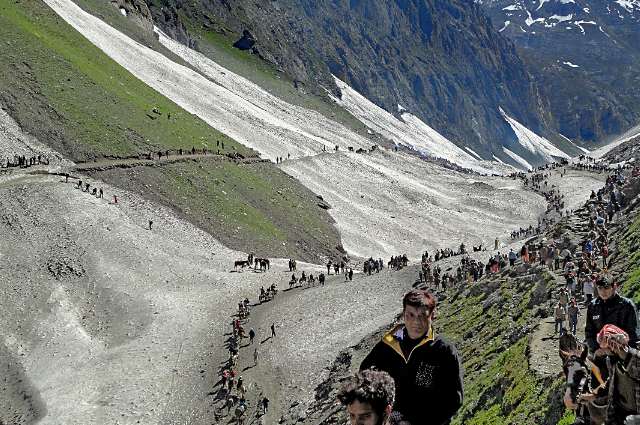
Divyanshu Khanna hiked many kilometres to get to the Amarnath cave, located at 3,888 metres inside the Kashmir Himalayas. He wanted this specific time — to see the Shivling, the ice stalagmite created by nature, which believers see as a sign of Lord Shiva, made every single year from freezing water drops falling down from the roof above. Upon arrival, he discovered the cave. He saw the pilgrims. However, the Shivling was mostly gone now.
He told the media: Baba has disappeared, but belief stays. Individuals continue arriving at the grotto since it involves piety. Even though the Shivling might not appear to certain ones, the spiritual force of Baba may still be sensed within each grain of that holy site. A lovely feeling. Yet it brings up a query which cannot be overlooked — what occurs when the consecrated starts melting?
May 23, 2026 saw Indian Border Security Force personnel photographing the Shivling within the cave structure. The object stood almost seven feet high then, appearing grand and whole for visitors to see. On July 6, merely three days after the yearly Amarnath Yatra started, images revealed a shape less than one foot tall. Then by July 7, travellers and administrators noted that only weak traces were left against the rock face. Nearly ninety-nine percent of the Shivling disappeared in fewer than seven days in total.
And this was not an outlier—it became standard practice. During the third successive year, the Shivling failed to last past the initial week of the pilgrimage period.
In order to comprehend what occurs, one must initially grasp the essence of this location.
The Shivling is not a statue made by people. It is a frozen water mass forming each winter when drops falling from the roof harden in sheets across many months, slowly creating a pillar of ice looking like the holy icon. Its dimensions vary yearly based on climate factors such as cold rain amounts, heat levels, and moisture within the cavern space.
The issue remains that these conditions are shifting rapidly now. Climate researchers have always noted that the Himalayan area warms quicker than the world mean. In 2025, Srinagar logged its highest heat since 1953, reaching 37.4°C. During recent decades, snow amounts in the Amarnath zone dropped by sixty to seventy percent. Paths covered with snow in July 2015 are currently dry, empty, and dusty then too — per veteran reporter Ashraf Wani, who tracked the Amarnath Yatra for thirty years.
As snowfall drops, less frozen water supplies the Shivling and keeps the cave cool. Outcome: tiny, weak ice meets hotter summers.
However, the weather is not merely the sole culprit. And here the narrative turns exceedingly intricate.
During the initial three days of the 2026 pilgrimage trip, by itself, over 56,000 devotees went to the cavern site, showing a rise of 18.6 percent versus the identical time frame in 2025. At the busiest times, from 13,000 up to 20,000 devotees walk inside in one day, within which lies fundamentally a tight natural hole located at great elevation.
Human bodies create heat. Twenty thousand bodies inside one cave make a lot of heat. The cave is not an open stadium; it is a small, enclosed area without airflow. The gathered body heat of many guests inside this locked place speeds up the melting of any ice there. Simply put, those pilgrims who come from all over India to see the Shivling are, by being there, helping it dissolve away.
This remains the harsh contradiction where no formal group wishes to speak about it clearly.
Since the Shri Amarnath Shrine Board was established in 2000, the pilgrimage season has been progressively extended to its current 57 days, running from July 3 to August 28. The annual pilgrim quota has grown steadily alongside it. Critics argue that this expansion is precisely what has accelerated the cave ecosystem's deterioration.
Ecological specialists want the pilgrimage period cut down to twenty or thirty days starting mid-June instead of July. They claim this allows more visitors to view the Shivling fully grown while greatly lessening crowding during busy times at the cave. They further demand the Shrine Board follow environmental rules used for similar structures in guarded highland areas, plus required studies on environmental effects and strict legal caps on plastic items and trash that does not rot away.
Pilgrims continue arriving. Numbers remain increasing. Faith stays true and strong despite missing ice — believers claim this. Yet questions raised by scientists and environmentalists concern nothing regarding belief. They focus on duration instead.
When will the Amarnath Yatra turn into a trip to a cave lacking a Shivling? Not due to design by anyone — yet because many small pressures, acting each summer silently, cause this shift. Increasing warmth levels. Snow falling back. Heat from vast crowds of people. Decades of growth ignoring nature's rules.
The Shivling, which needed months to build inside the Himalayan winter, melted away within just five days. And the question that neither a welcome banner nor a Shrine Board notice can answer is this: will this be how Amarnath appears going forward?
References:
- https://zeenews.india.com
- https://www.freepressjournal.in
- https://vibrantcolours.in
- https://climatesamurai.com
- https://nagarjunatravels.com