
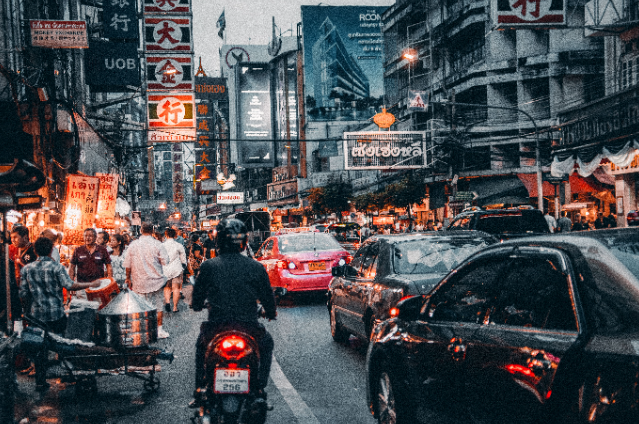
When you hear the word "Thailand " in the context of tourism, the imagination often conjures images of beautiful beaches, temples, and famous food. But there is a picture that isn’t in tourism brochures: a sex industry that rakes in $6.4 billion a year, employs between 200,000 and one million people, and accounts for 1.6% of the country’s gross domestic product. One question rarely asked, honestly, is: why? Why are all these numbers coming into this sector? The answer is not simple, and it is not simply moral – it is essentially a story of poverty, history, culture and failed laws.
This story didn’t start today, nor did it start with anyone’s choice. In the 1960s and 1970s, Thailand served as an official rest stop for American soldiers fighting in the Vietnam War. Thousands of soldiers descended on Bangkok and Pattaya, spending their dollars. This huge demand created a whole industry of hotels, bars and entertainment shops – built on the needs of strangers, and the people of the country worked there, because they had no other option. It is exactly this period that laid the ground for, and created the economic presence of industry in some areas that cannot be ignored (Cheng, 2010). The industry did not end with the end of the war but grew with the wave of Asian tourism in the 1980s and 1990s until it was rooted in the Thai economy, and uprooting it became extremely complicated. The generations after them, their heirs, did not choose this legacy.
But history does not account for why the phenomenon continues. The real driver is poverty – and that is worse than any moral judgment can be. Imagine a girl from a small village in Thailand’s northeastern Isan Province, one of the poorest regions of the country, bearing her family’s debts and her dreams on her shoulders. Her only other realistic option is to work in a factory or hotel and earn between 300 and 500 baht a day, equivalent to $8 to $14, or to work in the sex sector and earn many times that in fewer hours. It’s not just poverty; a report by UNAIDS states that organised recruitment networks are specifically targeting heavily indebted families in rural areas and making direct financial offers to parents so that some of these parents sell out their daughters’ futures, believing they are solving a problem (UNAIDS, 2006). For a family deep in debt and seeing no way out, this difference in income doesn’t seem like an option; it seems like the only way.
It becomes even more devastating because of the cultural aspect. In Thai society, especially girls are expected to assume such responsibility since an early age — providing financial assistance to their families and remitting money home is something that does not require any discussion and does not imply any rejection. A research paper published in the International Journal of Communication claims that mainly girls decide to join this business due to gender discrimination and insufficient legal support for victims (IJOC, 2016). In fact, most of these women do not identify themselves as sex workers; instead, they are daughters, ready to do everything for their families. The intentions when joining this job were simple for each girl: to earn enough money to buy a house for my parents, or to cover the school costs of my brother, or to pay off the debts that had bothered my father for many years. But the clock keeps running, and the initial purpose turns into a prison from which you have no way out.
In the first place, the law appears weak and even destructive, which may be the most painful aspect of the whole ordeal. Sex work in Thailand has been forbidden since the introduction of an anti-sex trafficking bill in 1996. However, in actuality, it is implicitly tolerated – police turn their backs or receive bribes, and businesses are run openly in plain sight of anyone who can observe them. According to the 2025 Borgen Project report, law enforcement is sporadic due to corruption and financial dependence on the industry; in addition, sex is usually negotiated in bars and massage parlours, while actual medical procedures are done off the radar to avoid breaking the law (Borgen Project, 2025). The outcome is disastrous – This young woman entering the Gaza Strip is either coerced, misled, or driven to desperation, and when her safety or health is at risk, she has no recourse but to leave the police office in peace, as, according to the law, she herself is the offender.
The reality, therefore, is neither one of moral decay as it is commonly depicted by many, nor is it that of total freedom as others would argue. It is simply the expected outcome of years of economic oppression, lack of alternatives and the legal protection of the economy over human beings. In the words of the GAATW Global Alliance Against Trafficking in Women, the laws that seek to prosecute workers continue to operate despite the lack of any legal protections for them because of their illegal nature (GAATW, 2016). Ultimately, when you reflect on the story of that young girl who came from Isan, all she wanted was to build a home for her mother and educate her little brother; it becomes hard for you to pass any kind of judgment on the situation. Without alternatives, there can be no question of having had choices to make. The answer to such an occurrence begins not with pointing fingers at the culprits but with questioning why they did not have other alternatives.
References:
- https://link.springer.com
- https://www.unaids.org
- https://borgenproject.org
- https://gaatw.org
- https://openlab.citytech.cuny.edu
- https://ijoc.org
- https://www.nationthailand.com
- https://youthforsdg.org