
In 1876, while working at his well-known laboratory, Thomas Edison proclaimed to the world that he had created something revolutionary for the business industry. Edison had developed his electric pen to assist business owners with rapidly copying documents. This pen included a tiny electric motor that created a puncture of 50 per second by moving a needle that would punch through paper to create a stencil from which many documents could be reproduced.
The electric pen was an excellent concept; however, the reality was completely different. The electric pen was extremely noisy and cumbersome to operate, and office owners were turning their backs on it and continuing to use their present methods. The electric pen entered into the "failed inventions" category and was basically lost to history.
But the folks in the history department were very good at re-working the past.
Somewhere on Bowery Pier in New York, another man was living an entirely different life than the one mentioned above. Samuel O'Reilly was born into a family of Irish immigrants in Connecticut in 1854. He learned how to tattoo during his brief service in the U.S. Navy. Although O'Reilly was not a scientist or inventor in the classical sense, he understood the intricacies of human skin more than any complex mathematical equation. He also had an intimate understanding of how much pain it took to complete his work and how long it would take.
Before O'Reilly, tattoos were created using needles dipped in ink that were repeatedly stabbed into the skin. A talented artist could only create two to three piercings per second. Thus, there were anywhere from 10-15 hours of roughing followed by approximately another 4-6 hours of finishing work for each tattoo. Among other things, this type of tattooing required both time (the total amount of time spent on a single tattoo could easily exceed a month) and expense (the cost of the equipment, the ink, and all of the other supplies associated with making a tattoo). It was real art, but it was so difficult to create that by the time you had completed your tattoo, you may have exhausted your supply of energy and completely consumed yourself before exhausting anyone else of their energy.
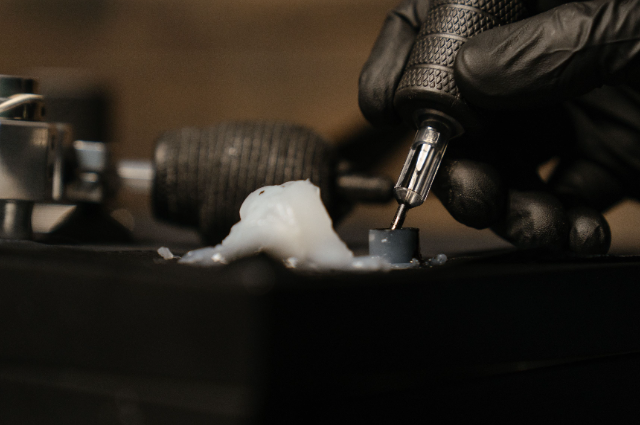
One day on an unknown date, O'Reilly happened to be passing in front of an office supply store on Bowery Street. He noticed that Edison's electric pen was displayed in the window, so he went in and watched a demonstration. As he watched, the needle would move, the motor would rotate, and the pricking would be repeated and run smoothly. O'Reilly also noticed something that Edison had never seen before — he had never seen a tool used for copying, and O'Reilly saw a tattoo machine instead.
Think of the way that craftsmen think versus the way that scientists think: What if you made the ink reservoir? What if you changed the shape of the handle to prevent fatigue in the hand? What if three needles were used instead of one?
Three easy modifications. No labs, no complicated math, and no research and development team were required. On December 8, 1891, Samuel Francis O'Reilly received United States Patent No. US464801 for the first-ever electric tattoo gun!
Everything changed with a silent but massive change. The tattoo went from a few to several pricks per second. It changed from hours to minutes. The characters on a tattoo became more refined; they hurt less, and they cost less because the time it took them to do was shorter. The cost reduction of tattoos caused more people to want to get them. At that point, they weren't just for sailors and soldiers; all the rich and noble people wanted tattoos too, and they were hoping O'Reilly would come to their homes instead of them going to see O'Reilly at his Bowery shop.
O'Reilly went from being in the margins of society to becoming famous. People started calling him "The Professor," and he became well known for his tattooing at his studio in New York. He gained notoriety beyond New York City and the whole Eastern Seaboard.
Edison is mentioned only as a footnote to the tattoo story. He invented a tool with each of its users; it is a tool that Edison tried to do something with, and someone else did something completely different with it. The basic machine, invented by O’Reilly, is still in existence over 130 years later, with the same basic principles that created it.
The real story behind each tattoo on a person’s body is not that of Edison's well-known genius. It is the story of an unknown Irish-American man who stood outside a New York City Storefront building and recognised an opportunity in a tool that its creator did not see.
References:
- https://en.wikipedia.org
- https://www.irishtimes.com
- https://www.si.edu
- https://invention.si.edu
- https://www.sparkmuseum.org
- https://www.jamesstreetparlour.com
- https://patentyogi.com