
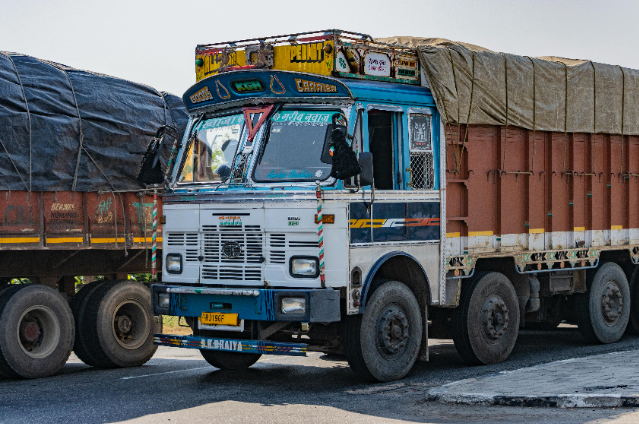
Have you ever been on a little road in India, going somewhere late at night, and you see a huge truck in front of you? You have no idea what’s in front of that truck, and how on earth can you get past it? Suddenly, you come across three words written in bold, colourful letters on the back of that truck: “Horn OK Please.”
No one can logically explain what these words mean, but they have been written on every single truck in India for the last several decades. If asked, someone would tell you a strange story about World War II, a bankrupt soap factory, and a little light bulb.
Indian roads in the 40s and 50s were little, winding, and narrow, as well as incredibly crowded with large commercial trucks that were taking up as much space as they possibly could. The main problem was that a driver had no way of knowing what was behind his truck. There were no mirrors, no cameras there. Drivers had no idea if someone was trying to overtake them. Many accidents happened because drivers would suddenly turn left, and the car would be overtaken. That’s why they would press the horn. But the genius of it was in the details that you will hardly ever find out nowadays. Above the “OK” was a small but significant light bulb. It was “OK” to overtake when you see the light. After the driver saw that there were no cars in front of his truck, he would press the button with his hand, thus turning on the light. It would be a signal that the road ahead was clear for overtaking.
Now let me tell you the story. Horn, please, is fine, but what about the OK in the middle? None of us knows why it is there now. Everybody has their theories going on. But believe me, there are three theories. The first one is really crazy.
People think that, at that time, before becoming a sentence, it was also written in such a way. On the left-hand side of the truck, there was a word HORN, on the right-hand side, there was ‘PLEASE.’ But in the middle, there was ‘OK’ and a lamp above it. That is why cars behind would read the sign, it says ‘Horn OK Please.’ But everybody knows that this was never a sentence. It was just instructions!
The second one is known to everybody; during World War II, diesel oil became a scarce commodity even in India. And commercial trucks had to use kerosene, which is a very cheap type of fuel. But it is very inflammable, highly dangerous in case of any accident. So if there were a simple rear-end collision, then the truck would catch fire in no time. What do you do then? So they put up a sign on the truck saying “Horn Please, On Kerosene.” Means ‘Stay Back, Warning,” you can approach only with caution. Later, the ‘On Kerosene’ part got reduced to the OK.
Okay. The best story of them all. Back in the mid-20th century, the TATA Group had a monopoly on truck manufacturing for the Indian market. That means that every truck you would see in India, be it in any village, town or city, was made by TATA. TATA also had another company, TOMCO, which used to manufacture household goods such as washing powders. One of its products was a cheap washing powder called OK with a beautiful logo of the lotus flower. The marketing strategy of the time was quite innovative – Why spend money on advertising when you have thousands of trucks travelling across the whole of India from top to bottom? They simply put their brand on the trucks. And on the reverse side of Indian trucks, you would see Horn OK Please. Seeing trucks (multiple of them) in every town and village with this message on the backside made it a brand, a permanent imitation of time. The product fell off the market, and Ok itself went off the shelves, but the message printed on trucks became a common thing and an imitation.
From just some advice on the road, it had become a full experience. Whoever would write this advice would soon start painting it with different colours, flowers, religious quotes, and little funny pictures. The backside of the Indian truck had become a canvas, and Horn OK Please was an everyday experience. BBC covered it; scholars analysed it; people from all over the world took pictures of it. It was no longer the truck, but India itself.
On April 30, 2015, the Government of Maharashtra decided to ban a very common phrase on commercial vehicles; the noise from the honking on monstrous roads, rather than the ferry of the old days, is the reason behind this. But one thing that is clear is that the rule-breaking may cost a vehicle owner 500 rupees. Pal Malkit Singh, the former president of the Indian Transport Congress, praised the resolution by saying: "'It was required in times when roads were narrow, but today enough with signals and lights.'" But ‘Horn Okay Please' was taken very differently by internet users. There were many comments like, ‘’The ban on Horn Okay Please will help with noise, like warnings against smoking on cigarette packs stopped people from smoking." And, “I am preparing to conduct a savings campaign for this ferry as part of our culture."
Now, ten years after the ferry disappeared from the roads of Maharashtra, the ferry lives on thousands of trucks all over the country. One can never know if the OKs came because of the use of kerosene oil, washing soap or even a little lamp of wood. But what is certain is the stories of war, business, art, and survival wrapped within the three words on the rear end of a truck.
References:
- https://en.wikipedia.org
- https://www.atlasobscura.com
- https://www.mahindratruckandbus.com
- https://www.fr8.in
- https://www.nagpurtoday.in
- https://www.dailyo.in
- https://www.bbc.co.uk