
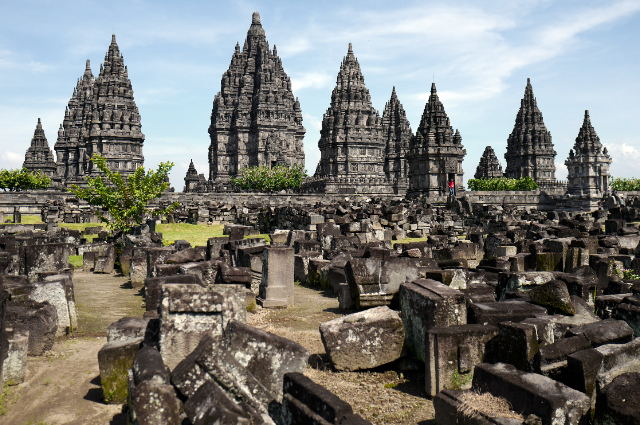
When India joined Indonesia in restoring the Prambanan Temple Compounds, the project represented more than the conservation of an ancient monument. On July 8, 2026, Prime Minister Narendra Modi and Indonesian President Prabowo Subianto jointly inaugurated the India-supported restoration project during Modi’s state visit to Indonesia. The Archaeological Survey of India (ASI) is working with Indonesian authorities to restore and conserve the temple complex. The project is a key milestone in India’s Act East policy. It also shows how India is using cultural diplomacy to strengthen its long-standing ties with Southeast Asia. This project also highlights India’s growing role in preserving shared heritage while strengthening international cooperation.
At the centre of this restoration project are the Prambanan Temple Compounds, one of Indonesia’s most significant historical landmarks. Built in the 9th century AD, this Hindu temple complex is situated in Central Java, Indonesia. It is one of the largest Hindu temple complexes in the country. The complex originally consisted of 240 temples dedicated to the Hindu trinity, Brahma, Vishnu, and Shiva. The innermost enclosure contains 16 temples. The centrepiece is a 47-meter-tall Shiva temple, which is flanked by a Brahma temple in the north and a Vishnu temple in the south. UNESCO describes the site as a masterpiece of classic Shiva art. The temple complex was also recognised as a UNESCO World Heritage Site and declared Indonesia’s National Cultural Property in 1998. The compounds are also known for their intricate stone reliefs depicting the Indonesian version of the Ramayana, highlighting centuries of cultural exchange between India and Indonesia. The restoration project goes beyond preserving an important monument. It also strengthens cultural relationships between the two countries.
Restoring a monument of this scale requires careful conservation planning. The ASI’s restoration focuses on the smaller temples within the 40-hectare Prambanan complex. Over the centuries, the site suffered damage from earthquakes, volcanic eruptions, and political upheaval in the 11th century. Formal restoration efforts began in 1918. The restoration combines traditional interlocking stone techniques and modern structural reinforcement. The restoration will primarily use the anastylosis technique. This involves reassembling the structure using the original stones found at the location. While the priority is to use the original stones, new stones will be added only where necessary to ensure the structural integrity of the complex. One of the biggest challenges is the vast number of architectural blocks scattered across the temple grounds. This requires a highly detailed cataloguing process to match the specific stones back to their original temple structure. The Indonesian Minister of Culture has also expressed interest in utilising digital tools and artificial intelligence to help in re-identifying and reassembling thousands of stone components. These efforts showcase India’s technical expertise and its commitment to preserving shared cultural heritage.
Beyond the conservation and its technical aspects, the Prambanan restoration project carries significant diplomatic value. Through cultural diplomacy, India uses heritage and culture to strengthen relationships with other countries, and this restoration project is an example of this approach. India’s collaboration with Indonesia is rooted in deep civilizational ties that have developed over centuries. Traces of ancient Indian civilisation can still be found across Indonesia today. Ancient Indian religions such as Hinduism and Buddhism played a major role in shaping many of the early Indonesian kingdoms. A good example of this is that Borobudur, a Buddhist temple, and Prambanan, a Hindu temple, were built only 50 miles apart in Central Java, highlighting how both faiths coexisted in the region. Sanskrit also influenced Old Javanese inscriptions and literature, with the language containing nearly 14,000 Sanskrit-derived words, many of which continue to be used in public life today. Even official Indonesian designations such as "Perdana Menteri" have Sanskrit roots, reflecting lasting linguistic influence. The Ramayana and Mahabharata are not simply ancient Indian epics. They remain an integral part of Indonesian culture through carvings and Ramayana ballets, which are staged under the full moon in an open-air theatre from May to October every year. During the inauguration, Prime Minister Narendra Modi emphasised that the temple is connected to memories of Brahma, Vishnu, and Mahesh (Shiva), reinforcing threads that bind India and Indonesia despite changes in Indonesia’s religious landscape over time. The project also aligns with India’s Act East policy, which seeks to deepen engagement with Southeast Asian countries through cultural, economic, and strategic cooperation. By preserving a monument that reflects a shared historical legacy, India is reinforcing not only its commitment to heritage conservation but also its long-standing partnership with Indonesia.
The Prambanan restoration project is one of several international heritage conservation projects undertaken by India over the years. The Archaeological Survey of India (ASI) has carried out restoration and conservation projects in several countries. Angkor Wat in Cambodia marked the beginning of the ASI’s international conservation efforts between 1986 and 1993. Under the leadership of Prime Minister Atal Bihari Vajpayee, an agreement was signed to restore the Ta Prohm Temple, another important monument within the Angkor Archaeological Park, and the conservation work was completed in 2021. India later expanded these efforts to other parts of Southeast Asia. In Laos, the ASI undertook the restoration of the 11th-century Vat Phou Shiva temple in two phases, investing over Rs. 41 crore in the project. In Vietnam, the ASI carried out the conservation work at the UNESCO-listed My Son Sanctuary, the religious centre of the ancient Champa Kingdom, where a 9th-century monolithic sandstone Shiva linga was discovered during the restoration. India's heritage conservation efforts have also extended to Myanmar, where the ASI restored twelve historic pagodas in the Bagan Archaeological Zone and carried out conservation work at the Ananda Temple. Similar projects have also been undertaken in Nepal, Bahrain, and Bangladesh, reflecting India's growing role in preserving shared cultural heritage beyond its borders. These projects show that India’s expertise in monument conservation has become an important tool of cultural diplomacy, helping strengthen historical and cultural ties across Asia.
As India continues to expand its international conservation efforts, the restoration of Prambanan stands as an important example of heritage serving a larger purpose. It helps preserve the cultural traditions and historical connections that continue to link the two countries today. India’s efforts at Prambanan reflect how the past can still play an important role in modern diplomacy. As both countries continue to work together, the project stands as a reminder that protecting shared heritage can also strengthen relationships for the future.
References
- Times of India https://timesofindia.indiatimes.com
- The Hindu https://www.thehindu.com
- The Print https://theprint.in
- DD India https://ddindia.co.in
- The Week https://www.theweek.in