
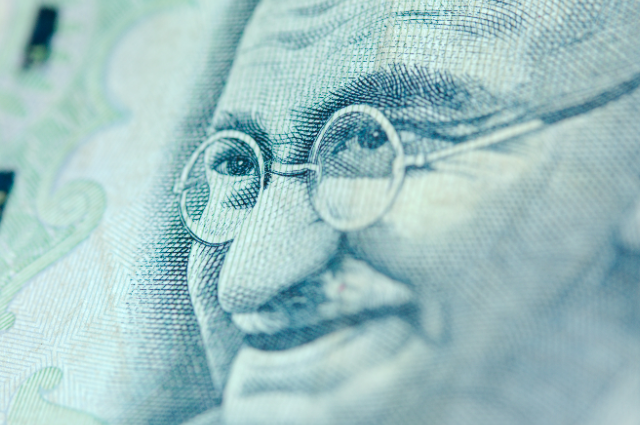
Every time we pull out a note from our wallet, we are looking at a history that isn’t as old as we think. These notes mirror the history of our nation and make us realise how far we have come. Unlike many other nations that immediately featured their founding leaders on their currencies, such as George Washington in the US, Mohammad Ali Jinnah in Pakistan, and Mao Zedong in China. India did something different. The face of the man we see today on our notes was not on it for nearly 50 years after independence, even though he was mostly responsible for the win. So how did Gandhi finally get there, and why did it take so long?
A Colonial Origin
Let us start by talking about how paper money came into existence first of all. The paper money in India has colonial roots. It was introduced in the late 18th century out of desperation by the East India Company, which had drained all the gold and silver out of Bengal because of its aggressive expansion methods. Notes were introduced not by choice but out of necessity. Then, in 1861, the Paper Currency Act was the official catalyst for India’s first officially issued banknotes. The first issue, however, featured Queen Victoria, who was then followed by George V in the 1923 series and George VI in the 1936 series, who were featured through the evolution of the notes during the pre-independence progression. [Source: The Economic Times]
The transition of the currency from colonial rule to independent India was a smooth process; while we got our independence on the 15th of August, 1947, the Republic was not established until January 26, 1950. In the interregnum between independence and the establishment of the Republic, the RBI continued to issue existing colonial-era notes, which had the king’s portrait on them. The first official issue of the Indian notes was in 1949 by the government of India. This issue had the Ashoka Lion capital replacing the king’s portrait; this is where Gandhi comes in. There was an initial proposal to replace the king’s portrait with Mahatma Gandhi, but the final consensus led to the choice of the Lion capital at Sarnath for the new notes. The reason for this change given was that an ancient, historical emblem drawn from India’s heritage better represented the ideas and secular ethos of the newly formed modern republic rather than a single personal figure. [Source: RBI]
Now that India was newly independent and wanted to show the world it was modern and progressive, the notes started to become travelling billboards for the nation’s achievements. In the year 1953, Hindi was prominently featured on notes, and that is how the word "Rupiye" came into use. From only featuring the Lion capital, the note design shifted in the 1980s towards science and technology being represented by Aryabhatta; progress represented by the oil rigs and farm mechanisation; and the Indian art forms through the Konark wheel and the Peacock. The modern industrial India, which was Nehru’s vision, was coming to life and could be seen on the currency.
Enter the Mahatma.
Finally, we come to the point when Gandhi arrives on currency, which happens gradually, not all at once. Mahatma Gandhi’s portrait was featured on our currency for the first time in 1969 on an Rs. 100 note, which was a commemorative design series in honour of his birth centenary celebrations. It was an issue where we could see Gandhi seated with the Sevagram ashram as the backdrop. Gandhi again appeared on the Rs. 500 notes that were introduced in the year 1987. Finally, to combat advancements in reprographic techniques that are used in the forgery of the currency, the “Mahatma Gandhi Series" was fully launched by the RBI in the year 1996. A human face is harder to forge than buildings or symbols. This new series also came with advanced security features such as a windowed security thread, latent images and also the intaglio feature to assist the visually impaired. The main reason they chose Gandhi as the human for the notes is also that he is a reflection of the nation’s ethos and symbolises peace, unity, and sacrifice. And this is how, since 1996, Gandhi’s face has remained on every Indian banknote, but not without debate.
What if not Gandhi?
While Mahatma Gandhi remains the face of the currency, there have been formal suggestions to feature other prominent Indian icons such as Jawaharlal Nehru, Subhas Chandra Bose, Sardar Vallabhbhai Patel, Rabindranath Tagore, and APJ Abdul Kalam. In the year 2022, a political debate emerged when the Aam Aadmi Party (AAP) proposed featuring Lord Ganesha and Goddess Lakshmi on the banknotes to symbolise prosperity, which was then met with opposition from the other parties. After all these suggestions, the minister of state of finance, Arjun Ram Meghwal, in the year 2016, confirmed that a committee formed during the UPA government had formally decided that there was "no need to change” the portrait, which then solidified the long-term policy across different administrations.
While the notes were standardised, the government used coins to honour a wider variety of historical milestones. Special coins in denominations of Rs. 75, Rs. 150, and Rs. 1000 were minted between 2010 and 2011 to celebrate the RBI’s Platinum Jubilee, Rabindranath Tagore's 150th anniversary, and the 1,000-year anniversary of the Brihadeeshwarar Temple, respectively. There were special edition coins also released of Rs. 125 to commemorate the birth anniversaries of Sarvepalli Radhakrishnan and B.R. Ambedkar. Through the currency, India has found a way to both represent its present and honour its past, where the notes carry the face of one of the greatest leaders, and the coins celebrate the many others who shaped the nation.
From the credit crisis in colonial Bengal to the face of Mahatma Gandhi on every note in our wallets today, it has been a long and eventful journey. From the face of Queen Victoria on the first note to the Ashoka Lion capital on the first indian note to the symbols of science, progress, and Indian art, to finally the face of Gandhi, the currency always reflected where India stood at every point of history. In a way, Gandhi represents stability in a constantly changing nation. In a country that debates everything, Gandhi’s face on the rupee may be the one thing no one could agree to change.
Reference:
- Reserve Bank of India — www.rbi.org.in
- The Economic Times — https://m.economictimes.com
- Hindustan Times — https://www.hindustantimes.com
. . .