
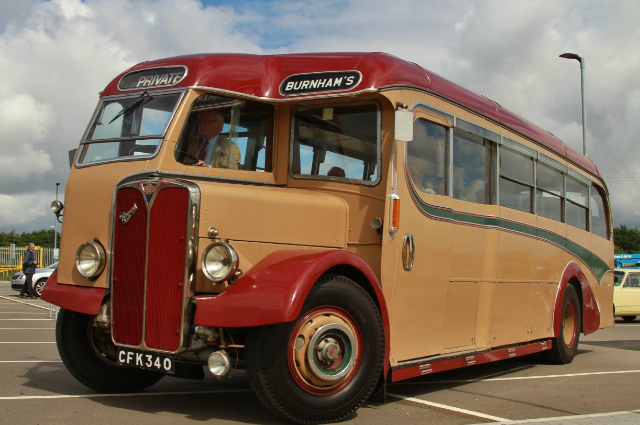
Imagine boarding a bus knowing that the journey ahead would take nearly two months, carrying you across mountains, deserts, bustling cities, and more than 150 international borders. Your days would turn into weeks spent sharing meals with strangers, listening to stories, and experiencing different cultures along the way. This journey through Europe and Asia was not just about reaching a destination. It was an opportunity for travellers to experience the world at a slower pace. Long before air travel became the fastest mode of transport between continents, this extraordinary overland journey was a reality. Between 1957 and 1976, passengers could travel from London to Calcutta (now Kolkata) aboard one of the world’s longest bus routes, turning the journey itself into an adventure.
The overland route began in 1957. The Indiaman was the inaugural bus that was organised and driven by Irishman Oswald Joseph Garrow-Fisher. The route was from London to Calcutta, which covered around 20,000 kilometres and took about 50 days. Following the success of the Indiaman, more than 30 operators eventually began running services on the same or similar routes. The outbound fare was £85, and the return leg from Calcutta to London was priced slightly lower at £65. Among them, the double-decker bus “Albert” became the most famous. It was introduced by Andy Stewart, who bought the bus in 1968 simply because he was looking for a way to travel back to London from India, having originally travelled from Sydney, Australia. He named the bus Albert to honour its previous owner. Stewart’s journey back to the west with a group of friends took 132 days to complete. This journey eventually led him to establish Albert Tours to keep the spirit of the bus alive. However, what truly made the service unique was not just the distance it covered but the experience it offered to those on board.
This bus was literally a home on wheels, where passengers were expected to sleep, eat, read and live together for the duration of the 20,000-kilometre journey. As Albert was a double-decker bus, it was a bit more spacious. The lower deck functioned as a reading and dining lounge, and the upper deck featured a forward observation lounge for passengers to view the landscape. The bus was also equipped with a radio and taped music system to entertain travellers during the months-long journey. The group utilised a mix of hotels and camping when no other lodging was available. Travelling long distances is exhausting, but the scenery, company, and the excitement of discovering a new place each day make the journey memorable.
The first Indiaman journey departed London on April 15, 1957, and arrived in Calcutta on June 5, 1957. The first trip carried about two dozen passengers, including 76-year-old Janet Seatter, proving that the journey was not just for young adventurers. Driver Garrow-Fisher noted that the famous cliffs and the hairpin turns near Mount Ararat in Turkey were actually less alarming than driving in India, where narrow roads, soft shoulders, and wandering cyclists posed his biggest concern. In Iran, between the cities of Kerman and Zahedan, the crew had to place wooden planks on the desert sands to provide enough traction for the bus wheels to move. The journey was filled with both blinding sandstorms and torrential rains.
During the trip, rumours circulated in Europe that the bus had been lost or, more dramatically, that everyone on board had been murdered by bandits in Turkey or Iran. The rumour of their death was so widespread that when the bus finally arrived in Tehran, the British Embassy held a cocktail party for the group to celebrate that they were alive. The bus terminal at Victoria Station in London was described as a scene of “human drama” upon the vehicle’s return on August 2, 1957. Only seven passengers, five men and two women, completed the full round trip back to London. The bus was 16 days behind schedule on its return journey, a delay that reportedly did not bother the travellers or the crowd awaiting them. What began as a unique travel idea turned into a story that would be remembered for years to come.
Albert’s popularity was not just because of the route it travelled but also because of the unique presence it created wherever it went. It was described as a beautiful green and cream double-decker. Stewart recalled the amazement of locals seeing the massive vehicle in places like the Black Sea coast, the packed streets of Calcutta, and the deserts around Tehran. He also noted that it acted as a social catalyst, stating that “people were so interested in Albert; he broke down barriers” and that they were always welcomed regardless of the country. Albert was a conversation starter, and through conversation came hospitality. The travellers were mostly Western youth seeking adventure or spiritual enlightenment. The overland route offered a more exciting and economical alternative to the expensive flights or costly boat rides. It was the best option for travellers who were looking for an experience rather than simply transportation. Albert was remembered not only for crossing countries but also for connecting people.
Despite its popularity, the overland bus service was not destined to last forever. The journey through Europe and Asia followed the ancient Silk Route, once travelled by Marco Polo. The route passed through Belgium, Turkey, Syria, Iran, Iraq, Afghanistan and Pakistan before reaching India. The route was chosen for its beauty and passed ancient monuments such as Hagia Sophia in Turkey, the Bamiyan Buddhas in Afghanistan, and the Taj Mahal in Agra. The service eventually ended in 1976 as political instability along the route increased. With the Iranian Revolution, which culminated in 1979, and the Soviet invasion of Afghanistan, overland travel through the region became too dangerous for Western travellers. The decline was finalised by the advent of affordable commercial air travel, which allowed adventurers to fly directly to Asian destinations with the security of a return ticket. Changing political realities and modern transportation brought an end to one of history’s most remarkable bus journeys.
More than four decades after the original service ended, the “Bus to London” project was first announced in 2020, with an original departure scheduled for April 2021. The first planned itinerary was an India-to-London voyage spanning 18 countries and 20,000 kilometres over 70 days. The project was envisioned as a light of hope for travel enthusiasts during the global COVID-19 pandemic. The primary reason for the initial postponement was the continued closure of land borders in Myanmar and China. In August 2023, the expedition was redesigned with a new starting point, from Istanbul to London, due to ongoing border restrictions on the original route. The project aims to recreate and preserve the spirit of the historical overland journey for a modern audience.
The London–Calcutta bus may no longer run across continents, but the stories from that journey continue to be shared. The revival of this remarkable journey shows that people continue to value slow travel, meaningful experiences, and the excitement of discovering the world one destination at a time. More than reaching London or Calcutta, this journey was about everything that happened in between. Decades later, it remains one of history's most extraordinary road trips, remembered not because of where it ended, but because of the stories it left behind.
References:
- https://www.hindustantimes.com
- https://www.messynessychic.com
- https://timesofindia.indiatimes.com
- https://timesofindia.indiatimes.com
- https://bustolondon.in/
- https://www.cnn.com
- https://www.nytimes.com