
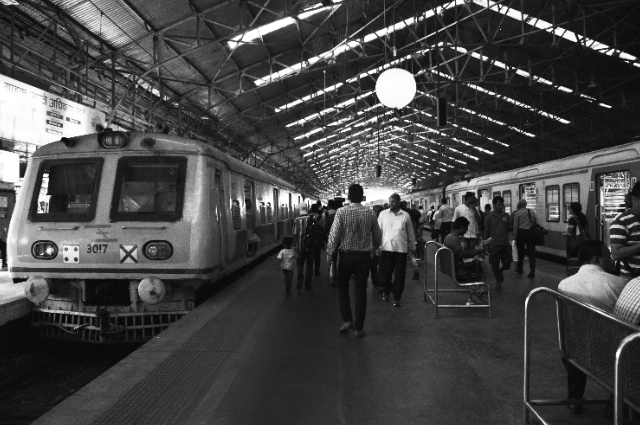
For millions of Mumbaikars, travelling by local train is an ordinary part of everyday life. However, one particular traveller's routine journey home ended in tragedy after he made a simple request for the train door to be closed. Mayank Lohar, a 22-year-old salesman from Virar, was travelling home from work in Andheri on the Churchgate-Nallasopara fast local train when the incident occurred. As heavy monsoon rains poured down on the city, he asked his fellow passenger to close the train door. What began as a simple request soon turned into a heated argument, which quickly escalated into violence. The co-passenger allegedly pulled out a knife and stabbed Lohar, leaving him critically injured. Despite being rushed to hospital, he later died from his injuries. This incident has once again raised serious concerns about commuter safety on Mumbai's suburban railway network.
The incident occurred late on Tuesday, 23 June 2026, inside the first-class carriage of the Churchgate-Nallasopara fast local trains. Following the stabbing, the perpetrator jumped off the train at Borivali station before it came to a complete halt at around 11:04 p.m. and fled the scene. Railway Protection Force (RPF) and Government Railway Police (GRP) personnel reached the carriage within three minutes of the train arriving at the station. As part of the emergency response, a medical team, along with a porter and stretcher, was immediately mobilised to remove Lohar from the train. He was first taken to the Emergency Medical Room (EMR) at Borivali Station for an initial examination before being transferred by ambulance to Shatabdi Hospital in Kandivali. Despite the doctors' efforts, Lohar later succumbed to his injuries and was pronounced dead at the hospital. Following the incident, investigators secured CCTV footage and recorded statements from passengers in the carriage. They also gathered additional evidence, while railway authorities assured full cooperation with the inquiry.
As the investigation progressed, the police uncovered further details about the accused and the events leading up to the fatal attack. Following the incident, the police launched a massive manhunt, scanning footage from almost 400 CCTV cameras. Seven investigation teams, comprising officers from Western Zone police stations and the Crime Branch, examined footage from Borivali, Andheri, Mira Road, and Nallasopara railway stations, as well as adjoining city entry and exit points. Using a combination of technical intelligence and CCTV footage, the investigators eventually identified the perpetrator and tracked him down to Panvel, where he was arrested on Wednesday, 24 June 2026. The accused was identified as Sachin Ramesh Suvarna, a resident of Mira Road. During interrogation the following day, Suvarna confessed to the attack and told the police that he had been under the influence of alcohol at the time of the incident. He claimed that an argument over closing the train door began as the train pulled into Andheri station, turning physical when Lohar punched him. Other passengers in the carriage then sided with Lohar and assaulted Suvarna. In response to what he described as the humiliation of the assault, Suvarna allegedly removed a sharp knife from his bag and stabbed Lohar in the chest and abdomen. He was later remanded in police custody until 29 June by a Borivali court. This case has once again raised concerns about passenger safety, particularly as similar violent incidents have recently been reported on Mumbai's suburban railway network.
The Mayank Lohar case is not an isolated incident. It is the second fatal stabbing reported on Mumbai's Western Railway suburban network this year, pointing to a concerning trend of seemingly minor disagreements escalating into deadly acts of violence. Earlier this year, Alok Kumar Singh, a 33-year-old lecturer at Narsee Monjee College, was stabbed inside a local train at Malad station following a minor argument about getting off the train. The accused, 27-year-old Omkar Shinde, allegedly stabbed Mr Singh in the abdomen with a small pair of tongs typically used to pick up jewellery. During questioning, Shinde claimed that he had only intended to hurt Singh and not kill him. According to investigators, he believed that Singh had pulled his hair during the argument and reacted violently. Police later recovered the weapon and arrested Shinde as part of their investigation. While the circumstances were different, both cases began with ordinary disagreements that quickly escalated into deadly violence. Together, these incidents have raised concerns about passenger safety and how quickly everyday conflicts in crowded public spaces can escalate into serious acts of violence.
Beyond the individual tragedy, the incident has once again drawn attention to broader concerns about passenger safety across Mumbai's suburban railway network. The Mumbai Rail Pravasi Sangh (MRPS), a city-based railway union, condemned the attack and highlighted serious security concerns within the network. MRPS Vice President Siddhesh Desai noted that, unlike airports or metro systems, the local train network, which carries nearly 7.5 million commuters every day, lacks an effective screening mechanism to prevent individuals from carrying weapons such as knives. The union also pointed out that, even where equipment such as baggage scanners and metal detectors exist, including at Thane station, it is often not consistently operated, adequately monitored, or effectively utilised. The incident has reignited discussions about the need to strengthen security measures to better protect the millions of commuters who rely on Mumbai's suburban railway network every day.
While stronger security measures remain essential, the incident also highlights how quickly ordinary disagreements can escalate in crowded public spaces. Every day, millions of people share trains, roads, and stations, making patience and cooperation an essential part of daily life. While most disagreements are resolved quickly, incidents like this show how swiftly a brief exchange can escalate into an irreversible tragedy. In that sense, this case is not only about railway security but also about how people respond to one another in moments of frustration.
The Mayank Lohar case serves as a reminder that even the smallest disagreements can have irreversible consequences if allowed to escalate into violence. While stronger security measures are necessary to protect commuters, creating safer public spaces also requires patience, mutual respect, and responsible behaviour from everyone who uses them. For the millions who depend on Mumbai’s local trains every day, safety depends not only on effective surveillance and policing but also on ensuring that ordinary disagreements do not end in irreversible tragedies.
References:
- The Times of India
https://timesofindia.indiatimes.com - The Hindu (Arrest Report)
https://www.thehindu.com - The Hindu (Confession and Remand Report)
https://www.thehindu.com - Deccan Herald
https://www.deccanherald.com. . .