
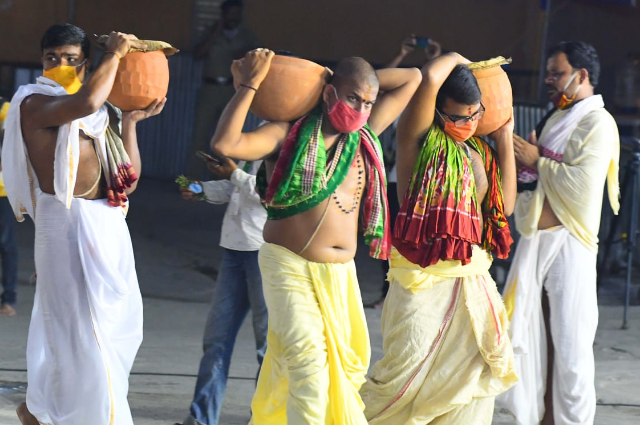
Some places in India don't just show faith—they make you feel it.
Here, centuries-old traditions continue to breathe, rituals are performed with astonishing precision, and even the most ordinary objects take on extraordinary meaning. The Shri Jagannath Temple in Puri, Odisha, is one such sacred place.
Millions of devotees visit Puri every year to seek darshan of Lord Jagannath, Lord Balabhadra, and Devi Subhadra. They come for the sacred atmosphere, the legendary Rath Yatra, the ancient rituals, and the overwhelming sense of devotion that surrounds the temple.
Yet, behind the magnificent traditions is another world—one that many visitors know surprisingly little about.
It is the Rosha Ghara, the sacred kitchen of Lord Jagannath.
For centuries, this enormous kitchen has prepared food for the Lord according to a system governed by ritual, discipline, tradition, and inherited knowledge. Its clay pots, wood-fired hearths, hereditary cooks, and elaborate offerings form one of India's most remarkable living culinary traditions.
However, what makes the Rosha Ghara truly fascinating is not merely its size. It is the philosophy behind the food.
Here, food is not simply cooked. It is offered.
It is not merely served. It becomes Mahaprasad.
It is not merely eaten. For devotees, it becomes a kind of divine grace.
A Kitchen Unlike Any Other
The kitchen of Lord Jagannath, traditionally known as Rosha Ghara or Rosha Shala, is situated within the temple complex, and it functions according to strict ritual regulations and an extraordinary body of inherited knowledge.
Descriptions of the kitchen portray an enormous complex containing numerous rooms, hundreds of traditional hearths, and a large community of cooks and assistants. Some accounts describe hundreds of earthen ovens and a capacity capable of serving tens of thousands of people, with traditional estimates sometimes extending to around a lakh of devotees.
Odisha Tourism describes the Jagannath kitchen as one of the largest temple kitchens in the world, highlighting both its extraordinary scale and its traditional cooking methods.
Yet, unlike a modern commercial kitchen, the Rosha Ghara does not depend on gas burners, electric ovens, sophisticated machinery, or computerised inventory systems.
Its fundamental technology is remarkably simple: firewood, clay pots, traditional ingredients, trained hands, and centuries of inherited knowledge. Surprisingly, this ancient system still prevails on a massive scale. That, in itself, is a wonder.
The Cooks Who Serve the Lord
The people traditionally responsible for preparing the food are known as Suaras, while senior or specialised cooks are known as Maha-Suaras.
To understand their role, however, we must move beyond the modern idea of a "cook."
Cooking inside the Jagannath temple is regarded as seva—sacred service.
The kitchen therefore operates according to a strict code. The Ingredients, preparation methods, vessels, sequence of cooking, handling of food, and timing of offerings are governed by established traditions.
The cooks improvise recipes according to personal preference.
Instead, they follow a culinary heritage handed down through generations.
Imagine possessing knowledge that is not merely written in a recipe book but preserved in one's hands, memory, experience, and disciplined practice.
- How much water should accompany the rice?
- How much fire is required?
- When should a pot be placed upon the hearth?
- When should it be removed?
- How should a particular preparation be handled?
- Which food belongs to which ritual?
- How must everything be completed before the prescribed offering?
- This is not merely cooking.
It is culinary heritage in motion.
The Astonishing Clay Pots
One of the most fascinating features of the Rosha Ghara is its extensive use of earthen pots.
In an age of stainless steel, pressure cookers, induction stoves, electric ovens, and automated food-processing equipment, the continued use of clay vessels on such a vast scale seems almost unbelievable.
Yet earthen pots remain integral to the traditional cooking system.
The pottery itself forms an important part of the Jagannath tradition, with specialised vessels made for temple cooking and serving.
And then comes the feature that has fascinated generations of devotees—the famous stacking of pots.
Several clay pots may be placed one above another over a single fire.
Traditional accounts say that the food in the uppermost pot cooks first, even though the lowest vessel is closest to the fire.
To someone witnessing the arrangement for the first time, the phenomenon can appear almost impossible.
How can the pot farthest from the fire cook before the one closest to it?
For devotees, the answer is simple:
It happens by the grace of Lord Jagannath.
From a physical perspective, however, heat transfer, steam circulation, and the enclosed arrangement of the vessels may provide possible explanations for the unusual cooking behaviour.
The two interpretations need not necessarily be enemies.
Science can investigate how heat moves through the pots.
Faith explains what that phenomenon means to the devotee.
Perhaps that distinction is important.
A miracle is not always about violating the laws of nature. Sometimes, it is about the meaning human beings discover in something that has been preserved and revered for centuries.
A Fire That Still Belongs to Tradition
Another striking feature of the Rosha Ghara is its traditional reliance on wood-fired cooking.
Think about the scale.
Thousands upon thousands of portions may need to be prepared, yet the kitchen relies on an ancient cooking method.
Amazing is that there are no rows of modern commercial gas ranges dominating the sacred kitchen.
Instead, there are hearths, firewood, clay vessels, and human coordination.
At first glance, this may appear simple.
But simple does not mean unsophisticated.
The system has been refined through generations of experience.
Modern technology gives us speed.
Tradition sometimes gives us something equally valuable: continuity.
The Jagannath kitchen represents the latter.
Hundreds of Hearths, Hundreds of Preparations
The Rosha Ghara is not one enormous fireplace.
Different types of traditional hearths are associated with different kinds of cooking. Research descriptions mention hearths such as Anna Chuli, which is associated with rice; Ahi Chuli, used for dal and curries; and Pitha Chuli, associated with pitha and related preparations.
This specialisation reveals something visitors may not immediately appreciate.
The kitchen is, in many ways, an enormous food-production system.
Raw ingredients enter. They are cleaned and prepared.
Different foods are assigned to particular cooking arrangements.
Preparations are cooked according to prescribed ritual schedules.
The food is then transported for offering. After the required rituals, it is distributed as Mahaprasad.
The entire process resembles a highly organised logistics operation—except that its operating manual is not a modern management handbook. Its operating manual is tradition.
From Bhoga to Mahaprasad
Perhaps one of the greatest misunderstandings about Jagannath's sacred food is the assumption that it is simply "temple food."
It is much more than that.
Food prepared in the kitchen is offered to Lord Jagannath as bhoga.
According to temple tradition, the food subsequently associated with Goddess Bimala acquires the sacred status of Mahaprasad.
This ritual transformation lies at the heart of the food's spiritual significance.
The sequence is therefore not simply: Kitchen → Dining
It is: Preparation → Offering → Divine association → Mahaprasad → Devotee
That transformation explains why devotees treat Mahaprasad with a reverence entirely different from that given to ordinary food.
It is not merely nourishment. It is considered sacred nourishment.
Anna Brahma — When Food Becomes Divine
In the Jagannath tradition, food is closely associated with the profound idea of Anna Brahma—the understanding of food as a manifestation of the Divine. It is a deeply meaningful concept.
We often associate spirituality with prayer, meditation, scripture, worship, or ritual. Jagannath offers another possibility:
Perhaps spirituality can also be experienced through food.
The grain grows from the earth. The grain becomes rice.
Rice becomes an offering. The offering becomes Mahaprasad.
Mahaprasad reaches the devotee, and nourishment becomes an expression of grace.
The journey from field to faith is therefore remarkably short.
The Mystery of the (Chhappan) 56 Bhog
The phrase Chhappan Bhog, or 56 offerings, is deeply associated with Lord Jagannath. Stories and traditions surrounding the 56 bhog have become an important part of popular devotional culture.
The offerings encompass an extraordinary variety of preparations—rice dishes, dal, vegetables, sweets, pitha, khichdi-like preparations, and many other traditional foods.
However, it is not to be assumed that exactly 56 separate dishes are prepared at every offering or at every moment of every day.
The temple follows numerous daily rituals, with different offerings associated with different occasions.
What remains beyond question is the extraordinary diversity of its traditional food repertoire.
That variety does not depend upon elaborate modern ingredients.
Instead, it emerges from the creative possibilities of rice, lentils, vegetables, grains, flour, milk products, sugar, jaggery, and traditional spices.
It is a cuisine shaped by simplicity and discipline.
A Kitchen Where Food Is Not Tasted
One of the most intriguing traditions concerns the tasting of food during preparation.
In an ordinary household kitchen, the cook tastes the dal, adjusts the salt, checks the vegetables, and makes corrections along the way.
Imagine the challenge in the sacred kitchen: food prepared for offering is governed by ritual restrictions, and the traditional practice does not involve tasting the food before it is offered. Food is prepared in enormous quantities.
Yet the cooks cannot simply taste it and say: "Perhaps it needs a little more salt."
Consistency therefore depends upon experience.
The cooks must understand their ingredients, quantities, fire, cooking vessels, and timing almost instinctively.
This makes the skill of the Suaras particularly remarkable.
Their knowledge is not merely culinary. It is inherited, disciplined, ritualised, and deeply connected to seva.
The Absence of Onion and Garlic
The temple cuisine follows traditional sattvic principles, and onion and garlic are excluded from the preparations.
Believe it or not, a fascinating contrast with contemporary Indian cooking, in which onion and garlic form the foundation of countless recipes.
The extraordinary variety of Mahaprasad is therefore achieved without depending upon many ingredients that modern cooks might consider indispensable.
The kitchen demonstrates that complexity does not necessarily require complicated ingredients.
Sometimes, mastery lies in knowing what not to use.
The Sacred Journey to Ananda Bazaar
Once the food has passed through the prescribed ritual process, it becomes Mahaprasad and reaches the famous Ananda Bazaar.
The name itself evokes happiness and spiritual joy.
Ananda Bazaar is one of the most distinctive features of the Jagannath tradition. It is here that the devotees obtain Mahaprasad and participate in the sharing of sacred food, but there is a deeper meaning.
The food is not meant to remain locked away inside the temple kitchen.
- It is meant to reach people.
- It is meant to be shared.
- It is meant to become part of human life.
- And that brings us to perhaps the most beautiful dimension of Mahaprasad.
Food That Breaks Social Barriers
The Mahaprasad tradition carries a powerful message of equality. Traditionally, Mahaprasad is regarded as sacred food that can be shared without the caste-based distinctions that historically divided Indian society.
When people sit together and partake of the same sacred food, social differences become less important.
The rich person and the poor person receive the same nourishment.
The influential pilgrim and the ordinary traveller can share the same Mahaprasad.
The message is beautifully simple:
Before sacred food, everyone is a devotee.
In this sense, the Jagannath kitchen is not only a religious institution.
It is perhaps a social institution. It transforms food into a language of equality.
The Belief That Food Never Runs Out
Among the many stories surrounding the Rosha Ghara is the belief that the food prepared somehow accommodates the number of devotees who arrive.
On extremely crowded days, devotees often speak with amazement about the kitchen's ability to feed enormous numbers of people.
Traditional narratives sometimes describe this as divine intervention.
From a practical perspective, there is obviously planning, experience, procurement, preparation, and distribution involved.
Yet the devotional interpretation remains powerful.
For a believer, the kitchen provides an illustration of the abundance associated with Lord Jagannath.
Whether one calls it divine grace or extraordinary human organisation, the outcome remains remarkable: a traditional kitchen continues to serve enormous numbers of people.
Goddess Lakshmi — The Divine Mistress of the Kitchen
Yet another beautiful dimension enriches the mythology surrounding the kitchen.
According to Jagannath tradition, Goddess Lakshmi, the divine consort of Lord Jagannath, is associated with the Lord of the household and kitchen.
This gives the Rosha Ghara a deeper symbolic meaning.
It is not merely an institutional kitchen.
It is imagined as the Lord's own household kitchen.
This belief is also connected with the mythology surrounding Lord Jagannath's annual journey to Gundicha Temple during Rath Yatra and Goddess Lakshmi's displeasure at his departure.
In the devotional imagination, therefore, the kitchen belongs not merely to an institution but to a divine household.
Nirmalya — A Sacred Food That Can Be Preserved
Mahaprasad has another fascinating form known as Nirmalya.
Rice of Mahaprasad can be dried and preserved.
For devotees, Nirmalya is deeply sacred.
A pilgrim can therefore carry home something far more meaningful than an ordinary souvenir.
A small quantity can represent the temple, the Lord, the pilgrimage, and the blessing of Mahaprasad.
It transforms food into memory, and memory into faith.
Khaja — Taking a Taste of Jagannath Home
Among the dry varieties of Mahaprasad, Khaja is particularly famous.
This layered sweet preparation has become a beloved edible reminder of a pilgrimage to Puri, because dry Mahaprasad is easier to carry than freshly cooked food, and pilgrims can take it home for family and friends.
In this way, the sacred experience of Puri travels beyond the temple walls. A devotee may return home hundreds of kilometres away, but a packet of Khaja can carry with it a small, tangible part of the pilgrimage.
The Mystery of Fragrance
Another devotional account associated with the temple kitchen concerns the fragrance of the food.
Temple traditions describe devotees experiencing the aroma of the food differently before and after the prescribed offering.
Such accounts are sometimes presented as evidence of something supernatural.
There is, however, no established scientific basis for declaring such experiences miraculous.
They are better understood as part of the devotional tradition surrounding Mahaprasad.
And perhaps that is enough.
Not every sacred experience needs to be converted into a scientific claim.
Faith has its own language.
Science has its own.
Both can coexist when we understand the difference between explaining a phenomenon and understanding its meaning.
The Real Miracle of Rosha Ghara
Popular discussions of the Jagannath kitchen often focus on its "mysteries."
- The seven pots.
- The upper pot cooking first.
- The enormous quantities of food.
- The belief that the food does not run out.
- The mysterious fragrance.
- The divine association of Goddess Lakshmi with the kitchen.
- All of these are fascinating.
- But there is another miracle that requires no supernatural explanation.
The survival of the tradition itself.
- For generations, cooks have learned the techniques.
- Potters have continued making the vessels.
- Families have maintained their traditional roles.
- Ingredients have continued to arrive.
- Recipes have survived.
- Ritual schedules have remained meaningful.
- And an ancient culinary system continues to feed people in the modern world.
That is a cultural miracle.
Ancient Knowledge, Modern Lessons
The Rosha Ghara also challenges our assumptions about technology.
We often associate technological advancement with computers, automation, machines, and artificial intelligence.
But technology is fundamentally the application of knowledge.
By that definition, the Jagannath kitchen possesses a remarkable form of traditional technology.
It has systems for:
- procurement,
- preparation,
- cooking,
- timing,
- quality control,
- ritual compliance,
- distribution,
- preservation,
- and large-scale service.
- Its tools may be simple.
- Its organisational intelligence is not.
The kitchen reminds us that human beings solved complex logistical problems long before computers existed.
They used memory where we use databases.
Experience where we use algorithms.
Apprenticeship where we use training manuals.
And community coordination where we use software.
The lesson is not that modern technology is unnecessary.
Rather, it is that human ingenuity did not begin with modern machines.
More Than a Kitchen
Ultimately, the Rosha Ghara cannot be understood merely by counting its hearths or pots.
Its true significance lies in what happens to the food.
A handful of grains enters the kitchen. Through human labour, fire, discipline, and tradition, those grains become Nourishment.
Through ritual, nourishment becomes an Offering.
Through devotion, the offering becomes Mahaprasad.
Finally, through sharing, Mahaprasad becomes Community.
This is why the kitchen occupies such a special place in the Jagannath tradition.
It connects:
- the sacred and the ordinary,
- the divine and the human,
- the temple and the household,
- the pilgrim and the resident,
- the rich and the poor,
- the ancient and the modern.
It reminds us that spirituality does not always have to remain distant or abstract.
- Sometimes, it can be held in the hands.
- Sometimes, it can be placed upon a leaf.
- Sometimes, it can be shared between strangers.
- Sometimes, it can be tasted.
The Final Wonder
Perhaps the greatest lesson of the Divine Kitchen is beautifully simple.
A devotee may travel to Puri believing:
"I have come to see Lord Jagannath," but the Jagannath tradition offers something more.
You do not merely see the Lord. You receive His food.
The Lord is not encountered only in stone, ritual, architecture, or sacred imagery. He is encountered in nourishment.
In sharing.
In hospitality.
In humility.
In the hands of the cooks who serve Him.
And in the quiet moment when a devotee receives Mahaprasad with folded hands.
That is perhaps the greatest mystery of the Rosha Ghara.
Not whether the upper pot cooks before the lower one.
Not whether the food miraculously multiplies.
Not whether a fragrance has a supernatural explanation.
The deepest wonder is that, after centuries, the sacred kitchen continues to transform something as ordinary as food into something extraordinary: faith that can be touched, tradition that can be tasted, and devotion that can be shared.
The Rosha Ghara, therefore, stands as much more than an ancient kitchen.
It is a living monument to India's ability to preserve tradition.
It is a testament to the power of collective discipline.
It is a remarkable example of indigenous culinary knowledge.
It is a living connection between generations—where knowledge is not merely recorded but practised, preserved, and passed forward.
And, above all, it is a place where millions of devotees encounter one of the simplest and most profound truths of Indian spirituality:
Food is sacred when it is prepared with devotion, offered with reverence, and shared with love.
Perhaps that is why, in Puri, a meal is never merely a meal.
When it becomes Mahaprasad, it becomes a blessing.