
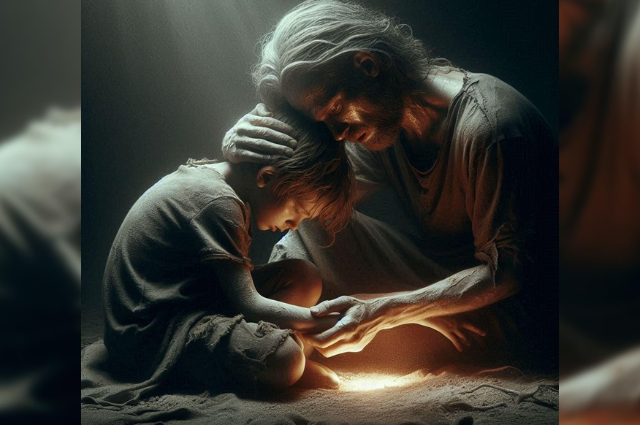
Image by Ralph/Altrip/Germany from Pixabay
When I was twelve years old, my father disappeared for three days.
Not vanished in the mysterious way people disappear in films. There were no police reports, no television announcements, no dramatic searches through forests. He left home one rainy evening with an old cloth bag on his shoulder and never returned.
At first, my mother pretended nothing was wrong.
“He must have gone for work,” she said while kneading dough with trembling fingers.
But my father had no permanent work. He repaired umbrellas during the monsoon, sold tea near the bus stand in winter, and carried sacks in the grain market whenever someone needed cheap labour. Men like him did not travel for business. They survived one day at a time.
By the second day, our tiny house felt smaller than ever. My younger sister cried from hunger, and my mother stopped eating entirely. Every time footsteps echoed in the lane outside, she would rush to the door and then return silently, disappointment hanging from her face like wet clothes.
On the third night, I woke up to muffled sobbing.
I found my mother sitting beside the kerosene lamp, holding my father’s faded shawl. It was the first time I realised adults could be afraid too.
“We may have to leave school,” she whispered without looking at me.
That sentence frightened me more than my father’s absence.
School was the only place where life felt different. It smelled of chalk dust and old books instead of damp walls and poverty. I loved sitting near the window and imagining a future beyond our narrow lane. The thought of losing it made my chest ache.
The next morning, I made a decision that changed my life forever.
Without telling my mother, I went to the railway station.
Our town’s station was called Platform No. 3 by most people because the nameboard had broken years ago. It was a place filled with tired travellers, stray dogs, tea vendors, and forgotten people sleeping on newspapers. If a man wanted to disappear without questions, that was where he would go.
I searched for hours.
I checked tea stalls, benches, waiting rooms, and even behind freight wagons. By evening, my legs hurt, my stomach burned with hunger, and rainwater had soaked through my slippers.
Then I saw him.
He was sitting near the far end of the platform beneath a flickering yellow bulb. His shoulders looked smaller somehow. In front of him lay a tin box filled with cheap ballpoint pens.
My father—the man who once carried sacks heavier than himself—was trying to sell pens to strangers.
I wanted to run toward him, but something stopped me.
A group of college boys approached him, laughing.
“How much?” one asked.
“Five rupees,” my father replied softly.
The boy took a pen, scribbled on his friend’s shirt, and tossed it back.
“Doesn’t work.”
They laughed and walked away.
My father picked up the pen slowly. For a moment, he stared at it as though it were proof of his failure. Then he wiped it carefully on his sleeve and placed it back in the box.
I had never seen a man look so defeated.
That night, I learned something terrible about poverty: it doesn’t only empty your pockets. It empties your pride first.
I finally walked toward him.
“Papa.”
He looked up sharply.
For a second, panic crossed his face. Then shame.
“What are you doing here?” he asked.
“Maa is crying.”
He looked away immediately.
Rain hammered the station roof above us. Somewhere in the distance, a train horn wailed.
“I was going to come home,” he murmured.
“Then why didn’t you?”
He stayed silent for a long time.
Finally, he opened the tin box and showed me the pens.
“I borrowed money to start a small tea stall,” he said quietly. “The man ran away with all of it. I owed people money. I thought… if I stayed away for a few days, maybe they would stop coming home to shout at your mother.”
I stared at him, unable to speak.
Until then, my father had always seemed unbreakable. Even when we had no food, he joked. Even when neighbours insulted him, he smiled. I had believed fathers were immune to fear.
But sitting on that cold railway platform, I realised he was just a tired man trying not to drown.
“I sold only three pens today,” he continued with a bitter laugh. “Three. I can’t even earn enough for dinner.”
Then he did something I had never seen before.
My father cried.
Not loudly. Not dramatically. Just silent tears rolling down a face hardened by years of struggle.
People walked past without noticing.
A train arrived, passengers rushed by, vendors shouted, children laughed—but in that moment the world narrowed to one broken man and his son sitting beside a tin box of unsold pens.
I didn’t know how to comfort him.
So I did the only thing a twelve-year-old could think of.
I picked up the box and shouted, “Pens! Five rupees! Good pens!”
My father looked shocked.
I kept shouting.
At first, people ignored me. Then an old woman bought one. A clerk bought two more. A schoolgirl purchased a blue pen because she said it reminded her of her younger brother.
Within an hour, half the box was empty.
My father stared at me as though he couldn’t believe what was happening.
“See?” I said breathlessly. “You just need to shout louder.”
For the first time in days, he smiled.
That night, we walked home together through muddy streets carrying twenty-seven rupees and a packet of biscuits.
My mother opened the door and burst into tears the moment she saw him. She hit his chest repeatedly while crying, “How could you leave us?”
My father didn’t defend himself. He simply held her hands and whispered, “I’m sorry.”
Years passed after that night.
Life did not magically improve.
We still struggled. There were days when electricity was cut off, days when creditors came shouting at our door, days when my mother skipped meals so my sister and I could eat.
But something changed inside me on Platform No. 3.
I stopped being ashamed of my father.
Before that day, I used to avoid walking with him in public because his clothes were worn and his slippers torn. I hated when classmates asked what he did for a living because I never had a proper answer.
But after seeing him cry alone on that platform, I understood the weight he carried every day.
He was not weak because he failed.
He was strong because he kept trying despite failure.
That realisation became the foundation of my life.
I studied harder than ever before. My father sold pens, repaired bicycles, unloaded trucks—anything he could find—to keep me in school. Sometimes he returned home limping from exhaustion, yet every night he asked the same question:
“What did you learn today?”
Years later, I earned a scholarship to a university in Delhi.
On the day I left home, my father accompanied me to the railway station. Platform No. 3.
The same flickering lights. The same tea vendors. The same smell of smoke and rain. Only this time, he stood straighter. Before my train arrived, he handed me a small wrapped package. Inside was a blue ballpoint pen.
“One of the last pens from that box,” he said with a smile. “Keep it. It brought you luck.”
I still have that pen today.
Its ink dried long ago, but I cannot throw it away.
Because whenever life becomes difficult, I remember a rainy night at a forgotten railway station where a broken man taught a frightened boy the true meaning of courage.
Not through success.
Not through speeches.
But through survival.
And sometimes I think the world misunderstands heroes.
They are not always soldiers or celebrities or people whose names appear in newspapers.
Sometimes they are men sitting beneath flickering railway lights, selling five-rupee pens while fighting battles no one else can see.