
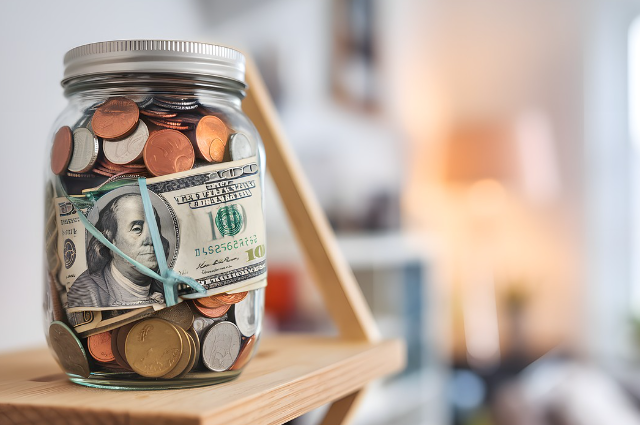
Image by Paul ( PWLPL) from Pixabay
My grandmother kept a jar of pennies on her kitchen windowsill. Not the decorative kind you see in magazines—this was an old mayonnaise jar, the label half-scraped off, filled with tarnished copper that caught the afternoon light in a way that made it look like something precious. I never thought much about it until the summer I turned twelve, when I asked her why she didn't just take them to the bank.
She was kneading bread dough at the time, her hands dusted white, and she paused in that way she had—like she was listening to something I couldn't hear.
"Those aren't for spending," she said. "Those are for remembering."
My grandmother, Eleanor, grew up during the Depression in a small town in Oklahoma. Her father worked at a grain elevator until it closed, and then he worked wherever he could—odd jobs, farm labour, anything that kept food on the table. She was the youngest of six children, and by the time she was eight, she had learned that hunger wasn't an abstract concept. It was a Wednesday night with nothing but water for dinner. She was watching her mother cry into an empty flour bin.
When Eleanor was ten, she found a penny on the sidewalk outside the general store. She told me this story so many times I can still hear her voice telling it, that particular mixture of wonder and something harder underneath.
"I picked it up, and I thought, 'This is mine. I found this, and nobody can take it from me." She smiled when she said it, but her eyes didn't. "I hid it in my shoe. I was so afraid someone would find it, take it away. I slept with that shoe under my pillow for a week."
She never spent that penny. Instead, she started collecting them. Every penny she found on the ground, every bit of copper that came her way and wasn't immediately needed for survival—she kept them. By the time she was sixteen, she had forty-three pennies hidden in a tin box under a loose floorboard in the room she shared with two sisters.
"It wasn't about the money," she explained to me once, years later. "It was about having something. Anything. Something that proved I existed, that I had made it through another day."
Eleanor met my grandfather, Thomas, at a dance in 1952. He was back from Korea, quieter than he'd been before he left, according to everyone who knew him. She said she liked that about him—that he didn't fill silences with noise just because he was uncomfortable. They were married six months later.
Thomas knew about the pennies. He found the jar—a different one than an old coffee tin—during their first week in their new apartment. He never asked her to explain, never suggested she deposit them or spend them. He just moved the tin to the kitchen windowsill, where the morning light could reach it.
"That's when I knew I'd married the right man," she told me. "He understood without me having to say a word."
They built a life together in the way people did back then—carefully, brick by brick. Thomas worked at the post office for thirty-seven years. Eleanor raised three children and kept the books for a local hardware store. They weren't wealthy, but they were comfortable. They paid off their house. They took a trip to the Grand Canyon in 1978. They watched their grandchildren being born.
And every day, without fail, Eleanor added to her jar—a penny here, a penny there. Found in parking lots, given as change, discovered in coat pockets and couch cushions. The coffee tin became a mason jar, which became the mayonnaise jar I knew. When it got full, she'd start another one. By the time I was twelve, there were seven jars in a row on that windowsill, catching the light like a cathedral's worth of amber.
Thomas died in the spring of my junior year of high school—a heart attack, quick and final. Eleanor called my mother at six in the morning, and I remember hearing my mother's voice crack through the wall—"No, no, no"—like the word could undo what had already happened.
At the funeral, Eleanor didn't cry. She stood very straight, shook everyone's hand, and thanked them for coming. I stood next to her for most of it, not knowing what to say, and at one point she reached over and squeezed my hand so hard I thought my bones would crack.
"I'm still here," she whispered. I didn't know if she was talking to me or to herself or to Thomas. Maybe all three.
After Thomas died, I started visiting Eleanor every Sunday. At first, it was because my mother asked me to, but eventually it became something I needed—the quiet of her kitchen, the smell of coffee and bread, the way she listened without rushing me to finish.
One Sunday, about a year after the funeral, I found her sitting at the kitchen table with all seven jars spread out in front of her. She was counting the pennies, stacking them in neat piles of ten, her lips moving silently as she worked.
"What are you doing?" I asked.
"Counting," she said, without looking up. "I want to know how many there are."
I sat down across from her and started helping. We didn't talk much—just the soft click of copper against copper, the occasional clink of a stack being moved. It took us almost two hours to count them all.
Twelve thousand, four hundred and sixteen pennies. One hundred and twenty-four dollars and sixteen cents.
Eleanor looked at the stacks for a long time. Then she looked at me.
"That's sixty-three years," she said. "Sixty-three years of still being here."
Eleanor died three years later, in her sleep, in the house she and Thomas had built their life in. She left me the pennies in her will—all seven jars, along with a note written in her careful cursive:
These aren't worth much, but they're worth everything. Keep adding to them. Remember that you made it through every day that felt impossible. Remember that you're still here.
I'm forty-two now. I have my own jar on my own kitchen windowsill—the same mayonnaise jar she had, because I couldn't bring myself to use anything else. It's about a quarter full. My daughter, who is nine, asked me about it last week.
"What are those for?" she said.
I thought about Eleanor. I thought about that little girl in Oklahoma, so hungry and so scared, holding a single penny like it was proof of something. I thought about all the days I've had since then that felt impossible—the job I lost, the divorce, the nights I lay awake wondering if I was doing any of this right.
"Those are for remembering," I told my daughter. "Come here. I'll teach you how to count them."
There's a penny jar in my kitchen now, but there's also one in my daughter's room. She started it herself, without me asking. She drops coins in it every few days—pennies, mostly, but sometimes nickels or dimes she finds in her coat pockets. Last week she told me she's saving them "for when things get hard."
She's nine. She doesn't know yet what hard really means. But she will, someday. And when she does, she'll have her jar of pennies, her proof that she made it through all the days before. Her grandmother's gift, passed down through four generations of women who learned, in different ways, the same lesson:
You're still here. That's worth something. That's worth everything.