
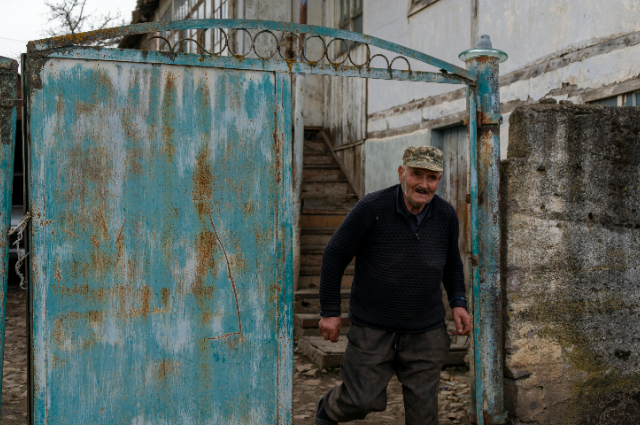
Once, during one of my visits to Pazal Pora in Bijbehara, I found myself sitting quietly inside an old-age home housed within the Hilal Institute Complex, a place beautifully named “Aahata-e-Waqar”—the Courtyard of Dignity. The name itself carried a strange tenderness, as though it had been chosen to soften the harsh reality hidden behind its walls. Yet, despite the grace of its name, the atmosphere inside was wrapped in an indescribable silence—a silence that spoke louder than words.
The building stood modestly amidst the calm surroundings, away from the noise and rush of ordinary life. At first glance, it appeared peaceful, almost comforting. But the moment one stepped inside and looked into the eyes of its residents, another world revealed itself—a world where memories had become companions, where loneliness echoed through long corridors, and where time moved not by clocks, but by fading hopes.
This was not my first visit there. Over time, I had developed a quiet acquaintance with many of the elderly residents. I would sit among them for hours, listening to their stories—stories woven with sacrifice, struggle, love, and abandonment. Every wrinkled face carried the map of a long journey; every trembling voice held entire lifetimes buried within it.
Some spoke about the days of their youth with glowing eyes. Others remembered orchards they had planted with their own hands, homes they had built brick by brick, children they had raised through hardship and hunger. One old woman often recalled how she would stay awake through freezing winter nights, stitching clothes for her children so they would not suffer from the cold. Another elderly man spoke proudly of how he had once walked miles every day to educate his sons, believing education would secure their future.
As they narrated these memories, there was always a peculiar mixture of pride and pain in their expressions. Pride for what they had given to their families, and pain for what they had eventually become—forgotten fragments of lives they themselves had once nurtured.
Whenever I visited, the residents would gather together in the courtyard or along the narrow hallways. They would talk endlessly about the past because, perhaps, the past was the only place where they still felt needed. Their conversations moved like old rivers—slow, winding, yet deep. They would laugh at forgotten incidents, argue gently over details from decades ago, and sometimes fall into long silences that revealed wounds too deep for words.
But among all the visits I made to that place, one particular day remains engraved upon my heart with unbearable clarity.
That afternoon, the sky outside was pale and quiet. A soft autumn breeze moved through the compound, carrying fallen leaves along the ground. Inside the sitting hall, a few elderly men were talking among themselves while others remained lost in thought. I too sat among them, listening silently.
It was then that my attention was drawn towards one old man sitting near the corner of the room.
He appeared deeply restless.
Every few minutes, he would rise slowly from his chair with trembling hands, adjusting his worn pheran as though gathering strength from within. Then, with uncertain steps, he would walk towards the main gate of the building. His eyes searched anxiously beyond the entrance, filled with expectation. After standing there briefly, he would return quietly to his seat.
At first, I assumed he might simply be uncomfortable or perhaps disturbed by some inner anxiety. But then the same scene repeated itself… and again… and again.
Four times.
Five times.
Each time he walked towards the gate, there was a flicker of hope in his eyes. And each time he returned, that flicker dimmed a little more.
Unable to contain my curiosity and concern, I turned towards another elderly resident sitting beside me and asked softly:
“Why does he keep going to the gate? Is he waiting for someone?”
The man beside me lowered his eyes immediately. A deep sigh escaped his chest—a sigh heavy with helplessness and sorrow. After a moment of silence, he replied in a faint voice:
“Someone told him this morning that a family member would come to visit him today. Since then, whenever he hears even the slightest sound near the gate, he believes it must be someone from his home. So he gets up and goes to see… but every time he finds no one there.”
For a moment, I felt as though time itself had stopped around me.
His words pierced through my heart with painful force. I turned my gaze once again towards the old man. He was now seated silently, but his eyes remained fixed upon the gate, unmoving—as though the last surviving thread of his existence was tied to that doorway.
There was something unbearably tragic in that sight.
It was not merely an old man waiting for visitors.
It was a father waiting for remembrance.
A grandfather waiting for affection.
A human being waiting to feel that he still mattered to someone in this world.
As I continued watching him, countless thoughts stormed through my mind. I wondered how many nights he must have remained awake during the illnesses of his children. How many dreams must he have sacrificed for their comfort? How many times must he have gone hungry so his family could eat? And now, in the twilight of his life, all he longed for was a simple visit… a few moments of companionship… a reassuring voice saying, “We still remember you.”
But even that small hope seemed too much for fate to grant him.
Hours passed slowly.
Every little sound from outside startled him. Every footstep revived hope within his tired eyes. Yet no one came.
No son.
No daughter.
No relative.
No familiar face.
As evening shadows began stretching across the courtyard, the painful truth gradually settled over the place like darkness itself. The old man stopped walking towards the gate. He simply sat there motionless, staring silently ahead, as though something inside him had finally broken.
And perhaps it had.
I cannot adequately describe what I felt in that moment. Some griefs are too sacred for language. They silence not only speech, but thought itself.
I realised then that loneliness is not merely the absence of people. The deepest loneliness is to feel forgotten by those for whom you once made the entire world meaningful.
Old age is already a difficult journey. The body weakens, memories become fragile, and time slowly strips away strength and independence. But when neglect is added to that suffering, old age transforms into a silent punishment.
We often speak proudly of progress, education, wealth, and modern lifestyles. Yet what meaning does progress hold if our elders spend their final years waiting endlessly at doorways for children who never arrive? What kind of success is it that teaches people to abandon the very hands that once held them lovingly through childhood?
In our traditions, parents are regarded as blessings. Their prayers are considered treasures greater than wealth. Entire civilisations have taught respect for elders as a sacred duty. Yet somewhere along the way, many hearts have grown distant. Relationships have become hurried, responsibilities burdensome, and affection conditional.
The tragedy is not only that elderly people live in old-age homes.
The greater tragedy is that many of them still wait every single day for someone who never comes.
That old man’s face still lives in my memory. Even today, whenever I recall him sitting near the gate with fading hope in his eyes, an unbearable heaviness grips my heart. I often wonder whether anyone eventually came to see him on another day. Or whether he continued waiting until hope itself abandoned him forever.
There are moments in life when even the pen refuses to move further. This is one such moment.
Words fall helpless before certain sorrows.
And so, I leave this thought not merely as a story, but as a question for every human heart:
We proudly call ourselves civilised, compassionate, and noble among creation. But if those who once sacrificed everything for us are left alone in the final chapters of their lives, then we must ask ourselves honestly—
Have we truly given our elders the place, dignity, love, and respect they deserve?