
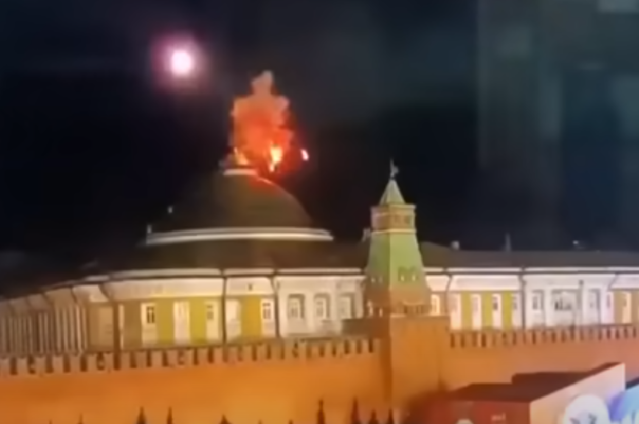
On the morning of May 17, 2026, drones filled the skies above Moscow. Not Russian drones, Ukrainian ones. In what analysts described as one of the largest Ukrainian drone strikes on Russian territory since the war began, at least four people were killed, three of them near the capital, and more than a dozen others were wounded. Debris fell on the grounds of Sheremetyevo, Russia's largest airport. Over 500 drones were launched overnight. Russian air defences claimed to have shot down 556 of them, yet still, fires burned in Khimki, apartment windows shattered in Krasnogorsk, and a truck driver died in Belgorod. The message was clear, and it was addressed not just to the Kremlin, but to the Russian public: You are not safe.
What the EU Is Actually Saying
Days before the drone strike, EU Foreign Policy Chief Kaja Kallas stood before reporters on the sidelines of an informal EU foreign ministers meeting and made a striking declaration: "Putin is in a weaker position than he has ever been before." She pointed to mounting battlefield losses, growing domestic discontent inside Russia, and the toll of sustained Western sanctions. She wasn't speaking in metaphor; she was laying out a strategic assessment that the balance of power in this war has measurably shifted.
That statement carries weight. Kallas, the former Prime Minister of Estonia and one of Europe's most hawkish voices on Russia, has firsthand knowledge of what Russian aggression looks like. Estonia borders Russia and has long operated under its shadow. When she says Russia is losing, she means it as intelligence, not rhetoric.
According to Kallas, Russia's summer 2025 offensive had already failed. EU sanctions had deprived Moscow of hundreds of billions of euros needed to fund the war. She described Ukraine's position as "much better than a year ago," bolstered by a €90 billion EU loan package, expanded long-range strike capabilities, and continued military support. In the same breath, however, she cautioned against complacency, noting that the peace process had reached a deadlock and that nothing was currently happening at the negotiating table.
The Numbers Don't Lie: Russia's Cost of War
Strip away the propaganda, from both sides, and what remains is this: Russia is bleeding at a scale the modern world has not seen since World War II.
According to the Centre for Strategic and International Studies (CSIS), Russian forces have suffered nearly 1.2 million casualties, killed, wounded, and missing, between February 2022 and December 2025. That figure represents more losses than any major power has sustained in any war since 1945. To contextualise it: Russian forces have been advancing at an average pace of between 15 and 70 meters per day in their most prominent offensives. That is slower than Allied forces during the Battle of the Somme in World War I, a campaign historically synonymous with futile, costly stalemate.
The human cost extends beyond the battlefield. An estimated 500,000 to 750,000 men have fled Russia to avoid conscription, many of them educated, young, and drawn from the country's technology and professional sectors, the very people needed to power a peacetime economy. NATO Secretary General Mark Rutte estimated in early 2026 that between 20,000 and 25,000 Russian servicemen were dying every month. To put that in perspective: during the entire 47-day Meuse-Argonne Offensive, the bloodiest American military campaign of World War I, approximately 26,000 US soldiers died in battle.
Russia has crossed a threshold of 1 million total casualties. Male life expectancy has fallen. The body of the Russian nation, one analyst wrote, is "metabolising its own muscle tissue for energy."
An Economy Quietly Cracking
Russia's economy is a case study in what happens when wartime stimulus meets structural rot. Between 2023 and 2024, the Russian GDP grew by around 4% annually, a wartime sugar rush fueled by military spending and defence production. By 2026, that growth had collapsed to a projected 0.4%, roughly on par with Germany's sluggish rate. The difference is that Germany's slowdown is a peacetime economic issue. Russia is the beginning of a long-term unravelling.
Inflation exceeded 20% in late 2025. Russia raised its value-added tax from 20% to 22% at the start of 2026, a policy that, economically, functions as a direct tax on ordinary Russians. Government spending reached 44.1 trillion rubles (approximately $551 billion) in 2026, with military spending remaining a dominant line item that crowds out investment in healthcare, infrastructure, and education. Interest payments on government debt this year are already projected to exceed combined spending on education and health care.
Meanwhile, Russia's manufacturing sector is declining. Its energy revenues, the lifeblood of the Kremlin's budget, are shrinking due to sustained Western pressure on its shadow fleet and oil exports. Moscow is now experiencing what economists call a "managed cooling" heading into outright stagnation, with any meaningful recovery unlikely before 2027 at the earliest. The Moscow Times described the situation bluntly: Russia is entering a phase where the longer the war continues, the less funding will be available for civilian development, and taxes will keep rising to close an ever-widening gap.
The paradox Kallas identified is one that economist Renaud Foucart raised as early as 2024: Russia's economy has become so dependent on the war that it cannot afford to either win or lose. Victory would require occupying and rebuilding Ukraine, a cost Moscow cannot bear. Defeat would expose decades of military spending as waste, triggering a domestic political crisis. The Kremlin is caught in a trap of its own making.
Putin's Peace Talk: Strategy or Desperation?
Against this backdrop, Putin's words on May 9, 2026, Victory Day, carried unusual weight. Speaking after a scaled-down military parade in Moscow (scaled down, notably, because of intensified Ukrainian strikes), Putin said the war was "coming to an end" and proposed direct talks with Ukraine in Istanbul, without preconditions. He said he was ready to meet President Zelenskyy in Moscow or a neutral country. A US-brokered three-day ceasefire had been in effect from May 9 to 11, coinciding with the Victory Day celebrations, though both sides traded accusations of violations almost immediately.
Zelenskyy called the proposal "a positive sign," but demanded something concrete first: a full, lasting ceasefire. "The very first step in truly ending any war is a ceasefire," he said. "There is no point in continuing the killing even for a single day." The EU, meanwhile, remains split on whether to engage Russia directly. Kallas acknowledged the topic was "not yet mature" among EU member states, with some preferring to continue weakening Russia's hand before any negotiations begin.
The EU's position is that any peace must reflect Ukraine's sovereignty and security, not reward territorial aggression. Behind the scenes, European ministers had already begun discussing a 21st sanctions package targeting Russia's military-industrial sector and shadow fleet operations. The bloc is simultaneously working to fast-track Ukraine's EU accession, with Kallas pushing to open all negotiating clusters before summer, framing it not as charity but as "an investment in our own security."
Kallas offered perhaps the most direct reading of Putin's motives: "Since Russia cannot conquer Ukraine militarily, it would have already done so by now, Putin will try to negotiate his way there." The ceasefire proposals and peace rhetoric, in the EU's assessment, are tactical manoeuvres, not genuine concessions.
The Bigger Picture: Who Holds Leverage Now?
The drone strike on May 17 was not just retaliation for Russian attacks on Kyiv earlier that week, attacks that killed at least 25 people. It was a demonstration of reach. Ukraine's Commander of Unmanned System Forces posted a message addressed specifically to residents of Patriarshy, one of Moscow's most elite neighbourhoods. The psychological warfare dimension is unmistakable: if the wealthy, well-connected citizens of Russia's capital begin feeling the war's weight, domestic pressure on Putin intensifies.
That pressure is already building. Kallas noted "growing discontent in Russian society." Internet crackdowns have intensified in Moscow and St. Petersburg. The country has lost hundreds of thousands of men, a generation of its educated workforce has left, and inflation is eating into the savings of ordinary families. Nigel Gould-Davies, a senior analyst who commented on the May 17 strikes, noted that Ukraine reminding Moscow's population of its vulnerability "is likely to intensify the mix of concerns" inside Russia, though he was careful to add that these factors alone may not yet force Russia to accept the compromises needed for genuine peace.
Kallas also flagged the indispensable role of China, Iran, and North Korea in keeping Russia's war machine alive. Without their support, military hardware, drones, and economic lifelines, Russia's position would be significantly weaker. That is why the EU has been working to bring global partners into the conversation, framing the Ukraine war not as a European issue but a global one.
Final Thought: The End Is Not Yet Written
The Ukraine-Russia war is now over four years old, longer than the active fighting in World War II on the Western Front. The numbers, the economics, and the battlefield reality increasingly point in one direction: Russia is paying an extraordinary price for minimal gain. But data does not end wars. Political will does.
The EU is betting that sustained pressure, military, economic, and diplomatic, will force Russia to negotiate from a position of weakness rather than strength. Ukraine, backed by European support and driven by its own extraordinary resilience, is holding the line and pushing back. The drones over Moscow are not just weapons. They are a statement: we have not forgotten, and we have not given up.
Whether peace comes through Istanbul talks, a US-brokered ceasefire, or some other channel yet to emerge, one thing Kallas got right: the tide has shifted. Russia is weaker than it has ever been. The world is watching how it handles that weakness, and whether it will choose negotiations over more bloodshed.
References
- Newsweek, "Putin in 'Weaker Position Than Ever Before' on Ukraine War: EU's Kallas", https://www.newsweek.com
- European Pravda, "Kallas: Russia not in strongest position, China could help force it to end war", https://www.eurointegration.com.ua
- WION News, "' Putin in a weaker position than ever before', says EU VP Kaja Kallas", https://www.wionews.com
- NPR, "Ukraine conducts large-scale drone strikes on Russia, killing 4", https://www.npr.org
- CNN, "Ukraine attack 'largest in over a year' on Moscow", https://www.cnn.com
- CSIS, "Russia's Grinding War in Ukraine", https://www.csis.org
- CSIS, "Russia-Ukraine War in 10 Charts", https://www.csis.org
- The Moscow Times, "Russia's Economy in 2026: More War, Slower Growth and Higher Taxes", https://www.themoscowtimes.com
- Fortune, "Russia's economy is now eating its own muscle", https://fortune.com
- Al Jazeera, "Putin hints at ending Russia's war in Ukraine, but why now?", https://www.aljazeera.com
- Reuters / Yahoo News, "Putin proposes direct peace talks with Ukraine after three years of war", https://www.aol.com
- Euronews, "EU still split over direct talks with Russia", https://www.euronews.com
- EU Neighbours East, "Kaja Kallas in Kyiv: Russia's war economy is already weak", https://euneighbourseast.eu