
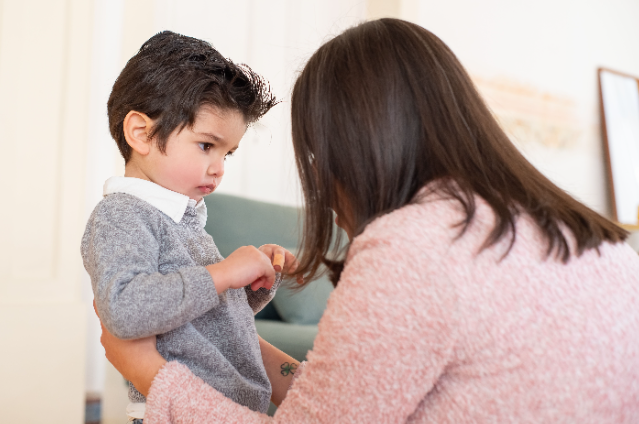
It was supposed to be the happiest day of his short life. A birthday. Balloons, perhaps. A cake. The warm, uncomplicated joy that a five-year-old deserves as a birthright. Instead, when his mother leaned close and asked him what was wrong, why he seemed so quiet, so small inside himself, the child told her something no mother should ever have to hear. He told her what Papa had done.
That confession, whispered on a birthday in a home in the Satara area of Chhatrapati Sambhajinagar, has since led to a POCSO case being registered against the father. The man who was supposed to be his protector is now in custody. And a five-year-old boy is learning, far too soon, that the world is not always safe, not even within the walls where he sleeps. What makes this case particularly harrowing is not just the act itself, but where it happened and who committed it. Home. Father. The two words that are supposed to mean safety and love. Instead, they became the geography of the boy’s suffering.
This is, tragically, not an anomaly. In cases of sexual assault within the family, fathers and stepfathers constitute 46% of accused persons, and in 60% of cases, the assault takes place in the home of the victim. The child’s bedroom, the kitchen, the familiar smell of home, all of it contaminated. In roughly 94% of rape cases registered under the POCSO Act, the perpetrator is known to the victim. Family members account for 34.2% of all perpetrators, while acquaintances account for 58.7%. Only 7% of perpetrators are strangers. We warn children about strangers. We rarely warn them about fathers.
India is in the midst of a child protection emergency that its numbers are only beginning to reveal. Between 2017 and 2022, reported sexual offences against children under the POCSO Act rose by 94% from 33,210 to 64,469 cases. That is not evidence of a worsening epidemic alone; it is also, partly, evidence of more children finally being heard. But the real scale is almost certainly far larger. In 2021 alone, 53,874 cases were registered under the POCSO Act, yet only 36.5% of crimes against children are estimated to be reported at all. The rest, the majority, stay buried in silence, shame, and fear. Representative survey data from India, Nepal and Sri Lanka indicate that around one in eight children, nearly 54 million across the three countries, report sexual assault or rape before turning 18. Fifty-four million children. Each of them, once, was just a child having a birthday.
The boy in Chhatrapati Sambhajinagar chose his birthday to speak. Perhaps it was the warmth of the day, the closeness of his mother, or simply the unbearable weight of a secret too heavy for a five-year-old’s small shoulders. Whatever the reason, he spoke. Most children don’t, not for months, not for years, sometimes never. Experts note that abuse typically unfolds at the fourth or fifth stage of a relationship, only after the perpetrator has thoroughly established trust. The child, largely out of fear that no one will believe them, stays silent.
In 45% of POCSO cases, the abuse is continuous rather than a single incident. Every day of that silence is another day the child endures alone.When a child does speak, especially to a mother, the person they trust most, the weight of that moment is immeasurable. It is an act of extraordinary courage from someone who has barely learned to tie their shoes.
In this story, the mother did not look away. She heard her child, she believed him, and she acted. That, too, is rarer and braver than it sounds. In many POCSO cases, parents are reluctant to pursue cases further, often due to stigma, fear of the child’s identity being exposed, or pressure, especially when the perpetrator is a family member. Society whispers that some things are best kept inside the home. That the family’s “honour” matters more than the child’s pain. That involving police is a shame too large to bear.
This mother chose her son over all of that. She chose his truth over family silence. That choice, simple, devastating, necessary, is the reason a case exists at all. Somewhere in Chhatrapati Sambhajinagar, a little boy is trying to understand a world that has already broken one of its most fundamental promises to him. He is five. He should be worried about nothing more serious than which flavour of cake comes next year.
The law has been invoked. The POCSO Act exists precisely for children like him, to ensure that the crime committed against him is named, recorded, and pursued. India’s prosecution rate under POCSO remains above 90%, signalling stronger enforcement. The system, when it works, can deliver justice. But justice, even when it arrives, does not undo a birthday. It does not give a child back the father he deserved.What it can do, what we owe this boy, and every child like him, is make sure the silence that sheltered his abuser never wins again.
Sources
- Into the Light Index 2025, Childlight Global Child Safety Institute (University of Edinburgh / University of New South Wales) — POCSO case rise statistics, 94% increase from 2017–2022, prosecution rate above 90%, 54 million children figure across South Asia
- National Crime Records Bureau (NCRB) — Data on perpetrator relationships to victims, POCSO case volumes, state-wise distribution of cases
- Aarambh India — Indian Research on Child Sexual Abuse — Family member perpetrator percentages (34.2%), father/stepfather share in intra-family abuse (46%), location of abuse (60% in victim’s home), continuous abuse statistics (45%)
- Journal of Family Medicine and Primary Care (JFMPC) — Urban India child sexual abuse study; 94% of POCSO rape cases involved a known perpetrator, 8% were family members
- Humanities & Social Sciences Communications / Springer Nature (Jan 2023) — Maity & Chakraborty study on POCSO Act implications; 90% of accused known to the child, 53,874 cases in 2021, under-reporting analysis
- Deccan Herald — Karnataka POCSO conviction gap data; parental reluctance to pursue cases due to stigma and identity fears
- Resource and Development Centre on Child Rights (via Deccan Herald) — Perpetrator trust-building patterns; child silence rooted in fear of disbelief • Childline India — Helpline reference (1098)