
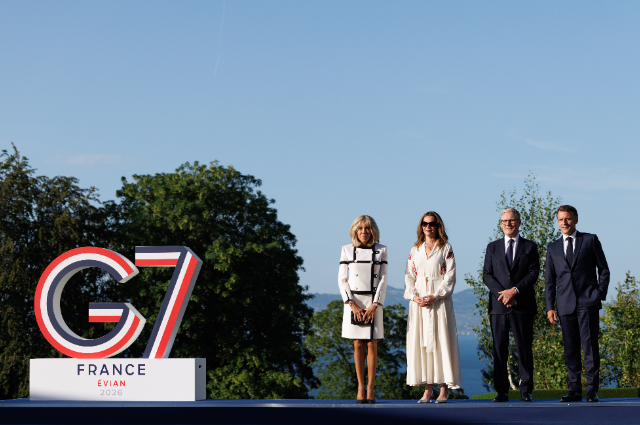
The G7 has never had a headquarters, a secretary-general, or a binding vote. It began as an emergency dinner, a phone call between finance ministers after the 1973 oil crisis spiralled out of control, before seven of the world’s wealthiest democracies decided they needed to talk more regularly. No permanent staff, no treaty obligations, no enforcement mechanism. And yet, every year, the nation that gets to host it walks away with something arguably more valuable than any of that: the agenda. In 1975, France hosted the very first meeting of what was then the Group of Six, convened in the aftermath of oil shocks, inflation, and the collapse of the Bretton Woods monetary order. Fifty years later, France is hosting again, and the parallels are not accidental. President Macron has explicitly framed this G7 presidency as a return to the original spirit of 1975, reducing global inequalities and economic imbalances as a central priority. That framing alone tells you what hosting actually means: it’s not logistics, it’s narrative.
The mechanics are simple; the implications are not. The G7 comprises the US, Canada, the UK, France, Germany, Italy, and Japan plus the European Union, rotating the host seat annually. Russia joined in 1998, was suspended after Crimea in 2014, and the forum quietly went back to seven. China has never been invited. What the host nation controls is the guest list beyond the core members, the working session themes, and the optics of who sits where. This year, France invited Brazil, India, Kenya, and South Korea as partner countries in the Sherpa track, with additional invitations extended to Egypt, Qatar, Saudi Arabia, Syria, Ukraine, and the UAE. Syria’s inclusion was especially notable; it marked the first time Syria had been invited to participate in a G7 summit. None of these guest nations gets a vote or a core seat. But the bilateral conversations that happen in the corridors, the sideline bilaterals over lunch, the handshakes caught on camera- that’s where the real value moves. Macron knows this better than most.
To keep Trump in France after the summit concluded, Macron hosted him at the Palace of Versailles, a deliberate choice, knowing Trump’s preference for grand settings, framing a post-summit dinner around the 250th anniversary of American independence and France’s historical role in it. It’s a masterclass in soft power choreography: using history, aesthetics, and timing to extend a geopolitical conversation past its official end. Trump ultimately signed a memorandum of understanding with Iran at Versailles on June 17, 2026, during a dinner hosted by Macron, aimed at ending the Iran War and reopening the Strait of Hormuz. That this happened on French soil, at a table Macron set, was not a coincidence. The host nation doesn’t just manage the summit; it shapes what the summit becomes.
On the substance, France has been unusually strategic about picking fights it can actually win. France is the only G7 country with a balanced current account, giving it credibility when calling for a collective approach to global macroeconomic imbalances, a topic it placed front and centre on the 2026 agenda. On AI, the numbers reveal the gap France is trying to close: in 2025, nearly 79 percent of newly funded AI companies across the G7 were based in the United States, while France accounted for just 3.4 percent yet Macron has used the presidency to push for shared standards and cross-border collaboration, positioning Paris as the rule-setter even where it isn’t the biggest player. SoftBank recently announced plans to invest €45 billion over five years to build AI infrastructure in France, a commitment partly enabled by the gravitational pull of the presidency itself. Critical minerals, cancer research, Ukraine, and Middle East stability all made it onto the communique. The agenda is a portrait of what France wants the world to think France cares about.
That’s the G7’s real product: not treaties, not aid disbursements, not enforcement but legitimacy, visibility, and the subtle power of convening. For a country like France, which has always seen itself as a civilisational project as much as a political one, the host role is less about diplomacy and more about self-definition. What the 2026 summit has made increasingly clear is that European nations pushed by diminished trust in the United States and a desire to reduce strategic dependencies on Washington are coordinating more closely among themselves. France, by hosting, gets to be the room where that coordination begins. In a forum with no votes and no vetoes, that’s not a small thing. That’s everything.
Sources:
- Wikipedia (52nd G7 Summit)
- France 24
- Al Jazeera
- Council on Foreign Relations (CFR)
- Atlantic Council
- France ONU (French Mission to the UN)
- France in the U.S. (French Embassy)
- IEA (International Energy Agency)