
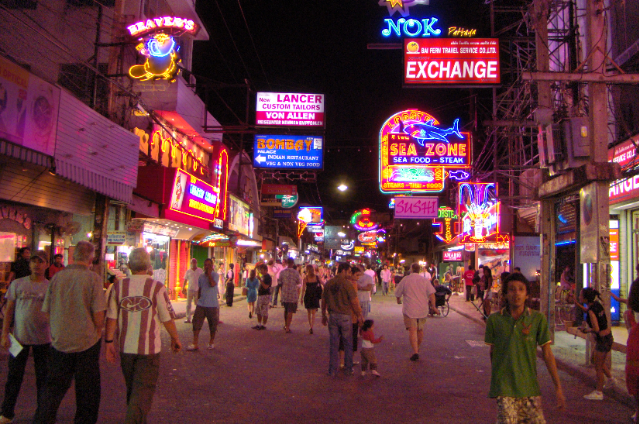
Thailand greets the world with gilded temples, jasmine garlands, and a smile so practised it has become national identity. What the tourism brochures don’t mention but the neon signs of Pattaya and Bangkok’s Nana Plaza make impossible to ignore is the other economy running quietly alongside. Thailand’s sex industry is technically illegal. It is also impossible to miss. And in certain communities, in certain families, across certain generations, it has stopped being a secret and started being a plan.
This is not a story about sin. It is a story about what happens when poverty, culture, and institutional failure occupy the same space for long enough.
The Economics of Limited Choice
In the rice-farming regions of Isaan and northern Thailand, Chiang Rai, Udon Thani, and Buriram, agricultural income is seasonal, unreliable, and shrinking. A factory worker earns 300 to 500 baht a day. A hotel maid earns roughly the same. Sex work can earn that in an hour. For a young woman carrying the weight of a family’s survival, a sick parent, a sibling’s school fees, a debt that arrived before she was old enough to understand it, this is not an abstract calculation. It is arithmetic.
Thai family structure, particularly in rural communities, places the burden of parental support disproportionately on daughters. Sons carry cultural prestige; daughters carry obligation. The remittance arriving from Bangkok or Pattaya builds the house that the village can see. It buys the motorbike. It keeps the younger brother in school. Communities notice results without asking questions, and families learn not to ask them.
Most women who enter the industry do so with a timeline and a target. A debt to clear. A house to build. An exit point that feels specific and near. What the timeline rarely accounts for is how debt cycles compound, how recruitment networks structure obligations, and how “temporary” has a way of becoming years.
The Culture That Built the Architecture
Thailand’s visible sex industry did not emerge from nowhere. During the Vietnam War, the United States military stationed troops across Southeast Asia and designated Thailand a hub for rest and recreation. Entire towns restructured their informal economies around servicing foreign soldiers. When the war ended, the soldiers left. The infrastructure, the bars, the hotels, the networks, the normalised transactional exchange, did not.
It pivoted to tourism. And tourism arrived in extraordinary numbers.
Layered beneath this modern history is an older cultural current. The concept of mia noi, minor wives and the broader acceptance of transactional companionship have long existed in Thai society, blurring the boundary between paid and unpaid intimate relationships. This is not an excuse. It is context. When a culture has historically accommodated transactional relationships within its social grammar, the industry that commercialises those relationships meets less structural resistance.
The kathoey, transgender women, add another dimension that rarely enters Western coverage of this subject. Discrimination in formal employment pushes many toward an industry that, whatever its costs, does not turn them away at the door. The sex industry becomes one of the few spaces where their identity is commercially tolerated, even if never fully respected. This is not freedom. It is the shape that exclusion takes when it runs out of other rooms to close.
The Law That Looks Away
Under the Prevention and Suppression of Prostitution Act 1996, sex work is illegal in Thailand. In practice, it operates in broad daylight, appears informally in tourism infrastructure, and sustains itself through a network of selective enforcement and institutional corruption. Establishments pay. Raids happen to those without connections. Workers without legal status, including regional migrants from Myanmar, Laos, and Cambodia, are most exposed.
The cruelty of this legal grey zone is precise: because the work is illegal, workers cannot unionise, cannot report violence without risking arrest, and cannot access labour protections or formal healthcare tied to their occupation. The law does not eliminate the industry. It simply ensures that those inside it have no rights within it. Criminality without consequence for the industry. Vulnerability without protection for the worker.
When Silence Becomes Inheritance
The most uncomfortable part of this story is generational. The first time a daughter leaves, and money arrives, the family learns not to ask. The second time, there is precedent. A younger sister grows up watching what was built, the house, the cleared debt, the sibling who stayed in school, and absorbs a lesson no one explicitly taught her.
Mothers who once worked in the industry sometimes facilitate their daughters’ entry. Not from cruelty. From a belief, calcified by experience, that this is how survival works. The psychological toll, the dissociation, the years spent performing a self that isn’t yours, travelling home in envelopes of cash that families accept without ever accounting for the cost inside them.
Thailand did not build this industry. Poverty did. Inequality did. Decades of policy indifference did. Thailand just gave it an address, and the world bought a flight ticket to visit.
Until rural economies offer genuine alternatives, until legal reform protects rather than criminalises, until the daughter is no longer the family’s last financial resort, the arithmetic will keep making the same brutal sense. And the neon will stay on.
Sources
- International Union of Sex Workers (IUSW) — “Global Sex Worker Rankings by Country” — October 2023 — approximately 250,000 sex workers estimated in Thailand
- ScienceDirect / Elsevier — “Depression and Quality of Life Among Thai and Migrant Sex Workers in Thailand: A Cross-Sectional Study” — October 2025 — sciencedirect.com — sex work generates an estimated $6.4 billion (1.5% GDP, 2015 figures)
- Joint UPR Submission — “Business and Human Rights in Thailand” — uprinfo.org — sex industry contributes an estimated 10–12% of GDP, including indirect revenue
- LSE Gender Blog — “What You Want to See is What You Get: Realities, Representations and Reputations of Sex Tourism in Bangkok” — October 2019 — blogs.lse.ac.uk
- Actualitica — “Sex Tourism: Thailand’s Strongest Economic Asset” — September 2025 — actualitica.com — tourism accounts for 14% of national GDP, 35.6 million foreign tourists in 2024
- ZipDo — “Thailand Sex Tourism Statistics 2026 Edition” — February 2026 — zipdo.co — 450,000 directly employed, 35% reported physical violence, 12% HIV prevalence among female sex workers
- Nation Thailand — “Thailand Ties With Brazil in Number of Sex Workers” — May 2024 — nationthailand.com
- Nation Thailand — “Time to Rethink Prostitution Ban, Say Experts” — May 2021 — nationthailand.com — estimates of 800,000 to 2 million sex workers cited
- Wikipedia — “Prostitution in Thailand” — en.wikipedia.org — full legal and historical overview
- Legal Information Institute, Cornell Law School — “Prevention and Suppression of Prostitution Act B.E. 2539 (1996)” — law.cornell.edu — legal text, criminalisation details, penalty structure
- ThaiLawOnline — “Prostitution Laws in Thailand” — July 2023 — thailawonline.com — legal grey zone, enforcement inconsistency
- Siam Legal — “Is Prostitution Legal in Thailand?” — January 2024 — siamlegal.com — Sex Workers Protection Bill draft overview
- Isaan Lawyers — “The Sex Trade in Thailand: Effects on Workers and the Laws Surrounding It” — July 2023 — isaanlawyers.com — Penal Code Section 286, Anti-Trafficking Act
- G.A.M. Legal Alliance — “Legalised Prostitution” — March 2026 — gam legalalliance.com — 2024–2026 soft decriminalisation phase, proposed Sex Workers Protection Bill
- Benoit Partners — “Thailand Prostitution Laws: Legal Framework, Enforcement and Reform” — August 2025 — benoit-partners.com — three-pillar legal framework analysis
- Harwell Legal International — “Sex Laws in Thailand: What Foreigners Must Know” — October 2025 — harwell-legal.com — enforcement inconsistency, massage parlour loophole
- Youth for SDG — “Navigating the Shadows: The Plight of Female Sex Workers in Thailand” — September 2024 — youthforsdg.org
- World Bank — “GDP Thailand” — 2024 — $526.41 billion GDP — tradingeconomics.com / worldbank.org
- Thai National AIDS Authority — HIV prevalence data among sex workers — 12% vs 0.05% general population (2022)
- Thai Health Promotion Foundation — Survey on physical violence among sex workers — 35% reported violence in 2022
- Alliance Anti-Trafficking — “In-Depth Analysis of the Sex Trafficking Industry in Thailand” — aatthai.org — 2016
- Decker, Michele R. et al. — “Trafficking, Client and Police Violence, Sexual Risk and Mental Health Among Women in the Sex Industry at the Thai Myanmar Border” — Violence Against Women, Vol. 28, No. 11, 2021 — doi.org