
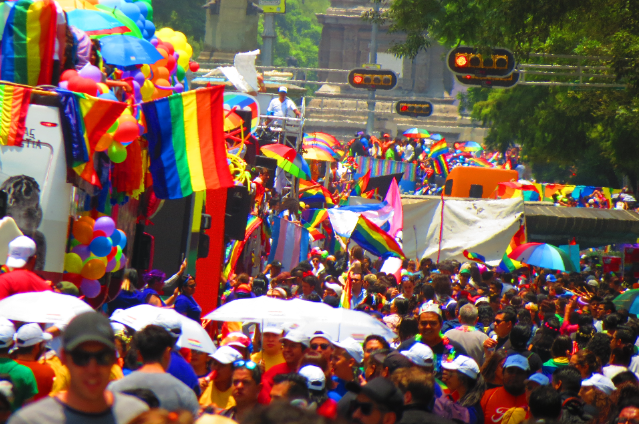
We know June just as a normal month, but for the LGBTQ+ community, it's a special month, Pride Month. The thing is, people think Pride month is all about parades, rainbows and corporate logos, but it is much more than that! The real origin is a night of resistance and not a celebration. The story of Pride is one of survival, reclamation, and radical joy, and it begins not with a parade, but with a riot.
So it all started on June 28, 1969! Police raided the Stonewall Inn in Greenwich Village, a mafia-owned gay bar operating without a liquor license. A criminal statute at the time required people to wear at least three "gender-appropriate" items of clothing, and arrests were routine. In fact, in 28 US states, gay people could be legally fired just for their sexuality — a reality that persisted until the Supreme Court’s Bostock v. Clayton County ruling as recently as 2020. That night, people fought back. The uprising lasted six days and sparked the modern LGBTQ+ rights movement.
Basically, before 1969, homosexuality was classified as a mental disorder by the American Psychiatric Association. That one night of resistance lit a fire that the world could no longer ignore.
Most people credit Stonewall, but only a few know the names behind the first Pride celebrations. It was none other than Brenda Howard, a bisexual woman, better known as “Mother Of Pride.” She was the one who organised the first Christopher Street Liberation Day March on the riot’s first anniversary, and like that, parades were initiated. She originated the idea of a week-long series of events around Pride Day, which became the model for annual Pride celebrations worldwide. She, along with Robert A. Martin and L. Craig Schoonmaker, also popularised the very word “Pride” to describe these events, arguing the community needed self-worth, not just visibility!
Marsha P. Johnson and Sylvia Rivera, both trans women of colour, were also among the most prominent figures at Stonewall itself. Their presence on the frontlines was a reminder that the most marginalised were often the most fearless. Pride was not built by institutions; it was built by individuals who refused to let their community be forgotten.
So how did the symbols and flags become a part of the community? Before the rainbow, the LGBTQ+ community used a pink triangle, adapted from the badge gay prisoners were forced to wear in Nazi concentration camps; the community reclaimed it as an act of resistance. Gilbert Baker designed the original rainbow flag in 1978 with 8 stripes, pink for sex, red for life, orange for healing, yellow for sunlight, green for nature, turquoise for art, indigo for harmony, violet for spirit. Hot pink was dropped because the fabric was unavailable after demand surged following Harvey Milk’s assassination. Turquoise was later removed so the flag had an even number of stripes, practical reasons, not artistic ones! The newer Progress Pride Flag (2018) added a chevron for trans people and people of colour, showing the symbol continues to evolve, and hence the current flag was invented! What started as a symbol of shame was transformed, stripe by stripe, into one of the most recognisable emblems of hope and resistance in the world. Every stripe, every colour, every symbol carries a wound that was turned into a war cry.
Now the question arises, how Pride Today faces the issue of celebration vs commercialisation. Pride Month wasn’t always official. President Bill Clinton made it official in the US only in 1999 and 2000. Started in the US, but today over 150 countries hold Pride events; São Paulo’s Pride parade regularly draws 3–4 million attendees. What started as an act of defiance in one bar in New York had quietly become a global phenomenon. Tension is created when some early organisers now criticise the commercial nature of modern Pride, especially corporations that sponsor parades while donating to politicians who vote against LGBTQ+ rights. As a consequence, in 2023, several brands pulled back Pride campaigns under boycott pressure, reigniting the debate about genuine allyship vs. performative support. But this doesn’t bring it to an end; the debate between celebration and protest is very much alive within the community itself. But Pride was never meant to be a marketing strategy — it was, and still is, a demand to be seen, heard, and protected!
Pride began as a riot, survived as a movement, and lives today as a celebration, but beneath every rainbow flag is a history written in courage, blood, and the stubborn refusal to disappear. Pride began as resistance, ordinary people who refused to be erased. The joy today is built on that courage. The tension between celebration and protest isn’t a contradiction; it is Pride; both are necessary. Pride Month is not just a month; it is a reminder that the fight for dignity and equality is still ongoing in many parts of the world!
Sources
- History.com — The Stonewall Riots
- American Psychiatric Association (APA) archives — removal of homosexuality from DSM, 1973
- GLAAD — Stonewall and the origins of Pride
- Library of Congress — Lesbian, Gay, Bisexual, and Transgender Pride Month
- Gilbert Baker Foundation — History of the Rainbow Flag
- Smithsonian Magazine — Brenda Howard and the Origin of Pride
- Human Rights Campaign (HRC) — Timeline of LGBTQ+ History
- NBC News — 2023 brands pulling back Pride campaigns
- São Paulo Pride official records — attendance figures
- Supreme Court — Bostock v. Clayton County, 2020
- Daniel Quasar — Progress Pride Flag, 2018 (quasar.wiki)