
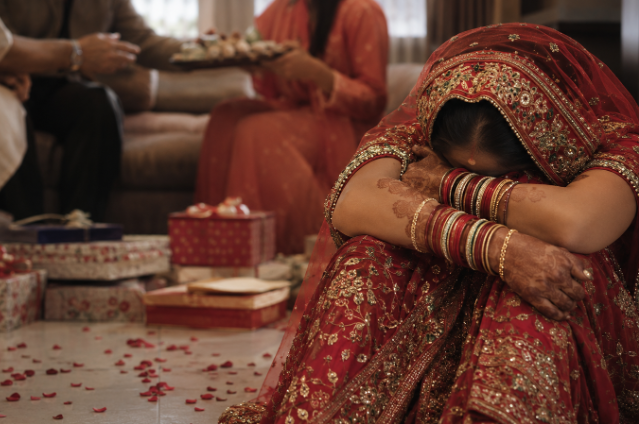
In India, dowry deaths don’t shock society anymore — they briefly trend. It treats dowry deaths like “breaking news” for 48 hours and then forgets. The same cycle is followed, outrage followed by an NCW notice, then hashtags and finally silence. Two such cases happened in mid-May 2026. One of Twisha Sharma in Bhopal, and the other one in Deepika Nagar, Greater Noida. These are just one of the cases known, while many just keep happening and go silent. These are not isolated incidents but symptoms of a system where dowry violence survives despite laws, education, and public awareness. The problem is no longer the absence of laws. It is the absence of consequences.
Twisha Sharma Case
When the accused belong to powerful circles, justice often starts late and moves more slowly. This is what happened in the Twisha Sharma case. Twisha Sharma, a 33-year-old MBA graduate and former model, was found dead at her marital home in Bhopal’s Katara Hills on May 12. Just five months back, she had married lawyer Samarth Singh. Her family alleges mental torture, dowry harassment, and forced abortion on Twisha, which involved her husband and retired judge mother-in-law. The suspicious highlight included CCTV footage and a three-hour gap before death was recorded. The case stands at the position where her husband has absconded, and the police have offered a ₹30,000 reward for his arrest, and a Lookout Circular has been issued to stop him from leaving the country. While her mother-in-law has secured anticipatory bail — a decision Twisha's family is now challenging in the Madhya Pradesh High Court. Basically, this case reflects how even educated, urban, financially secure women remain vulnerable. In many Indian homes, abuse survives comfortably behind polished surnames and family reputations!
Deepika Nagar Case
Not totally the same but not even absolutely different was the case of Deepika Nagar from Greater Noida. She was a 24 year old, BA BEd graduate who ended her life on the 17th of May after allegedly falling from the terrace of her in-laws' three-storey home in Jalpura. She had married just 14 months earlier, with her family spending nearly ₹1 crore on the wedding. Despite this, her in-laws allegedly demanded an additional ₹50 lakh and a Toyota Fortuner. Her post-mortem revealed brain haemorrhage, ruptured spleen, liver, and kidney injuries inconsistent with a simple fall. The saddest part is that hours before her death, she called her father crying, saying she was beaten! But the good part here in this case is that three accused, including her husband and father-in-law, have been arrested. Yet this won't bring her life back, and shows how dowry is no longer “tradition”; it operates like extortion normalised by families. Like how for many families, marriage negotiations still resemble business deals with emotional decoration.
The Common Pattern
These cases reflect how marriage is treated as a transaction and daughters aren’t wedded but literally made a deal of! Women are the ones blamed for adjustments, and if things don’t work as said by the in-laws, then the woman is tortured till death! The problem isn’t only with the groom’s family; the problem is how even the bride’s side of the family decides to stay silent, fearing social stigma, and to save marriages. Dowry deaths aren’t the result of torture of a day or two; the emotional and mental death of the soul happens long before the person dies herself. Still, every year, NCRB records thousands of dowry deaths in India, while dowry was legally banned in India in 1961.
NCW angle
Despite decades of legislation and repeated institutional interventions, dowry violence in India continues almost uninterrupted. The National Commission for Women (NCW) routinely issues notices and takes suo motu cognisance after high-profile cases, but these actions rarely translate into systemic change. According to NCRB data, India recorded 5,737 dowry deaths in 2024 — roughly one woman dying every 90 minutes due to dowry-related violence. Between 2017 and 2022, more than 35,000 dowry deaths were reported nationwide, yet conviction rates remain disturbingly low. The deeper crisis lies not just in the numbers, but in the predictability of the pattern. Most cases involve repeated complaints, ignored warning signs, and prolonged abuse before a woman’s death finally draws public attention. NCRB’s 2023 report also showed that “cruelty by husband or relatives” remained the single largest category of crimes against women, accounting for nearly 30% of all such cases. Yet institutional responses often stop at notices, statements, and promises of investigation. Public outrage fades, media attention shifts, and the justice process slows into silence. As a result, NCW notices increasingly feel less like instruments of accountability and more like symbolic reactions issued after an irreversible tragedy.
Biggest Question
The most important question that comes up here is, why are laws failing? There are already existing laws for Dowry, such as:
Dowry Prohibition Act,1961: It makes giving, taking, or demanding dowry a punishable offence in India.
Section 80 of the Bharatiya Nyaya Sanhita defines dowry death and applies when a woman dies unnaturally within seven years of marriage after facing dowry-related harassment.
Section 85 of the Bharatiya Nyaya Sanhita criminalises cruelty by a husband or his relatives, including physical and mental harassment linked to dowry demands.
The Protection of Women from Domestic Violence Act (2005) provides civil protection to women facing physical, emotional, verbal, or economic abuse within households.
Moreover, Indian evidence laws also allow courts to presume dowry-related abetment when harassment before death can be proven. Yet the cases of dowry deaths are just increasing! Various reasons add to it, such as police negligence, family pressure, delayed courts, economic dependence, social conditioning, etc. The problem is that society still treats dowry as a gift and gives it various names to not call it an offence! Not only the uneducated ones but the literate ones, the rich ones, all are equal criminals in it! Modern weddings may look progressive on Instagram, but many still run on feudal expectations behind closed doors.
Dowry continues because shame is attached to divorce, not abuse. Twisha and Deepika are not exceptions. They are warnings! The tragedy is not that these cases happened — it’s how familiar they feel. Until society stops rewarding greed with status, dowry deaths will continue wearing different names. Dowry survives because society normalises it before the law confronts it. And so it should be called out and stopped cause a country cannot claim progress while its daughters are still being priced before marriage.
References:
- The Indian Express
- NDTV
- Hindustan Times
- The Times of India
- National Crime Records Bureau (NCRB)
- National Commission for Women (NCW)